Cognitive · Reference
PE-22-28: What It Is, Where to Get It Prescribed, and What It Costs
This page covers what PE-22-28 is, the potassium-channel mechanism researchers describe, what the published work does and does not establish, where it stands with the FDA, how it is dosed, and how to get it prescribed.

Reviewed by Dr. Gene, MD · Board-certified Family Medicine
Every Pepti prescription is reviewed by a licensed U.S. physician before it's dispensed — and only provided if clinically appropriate.
Treatments mentioned
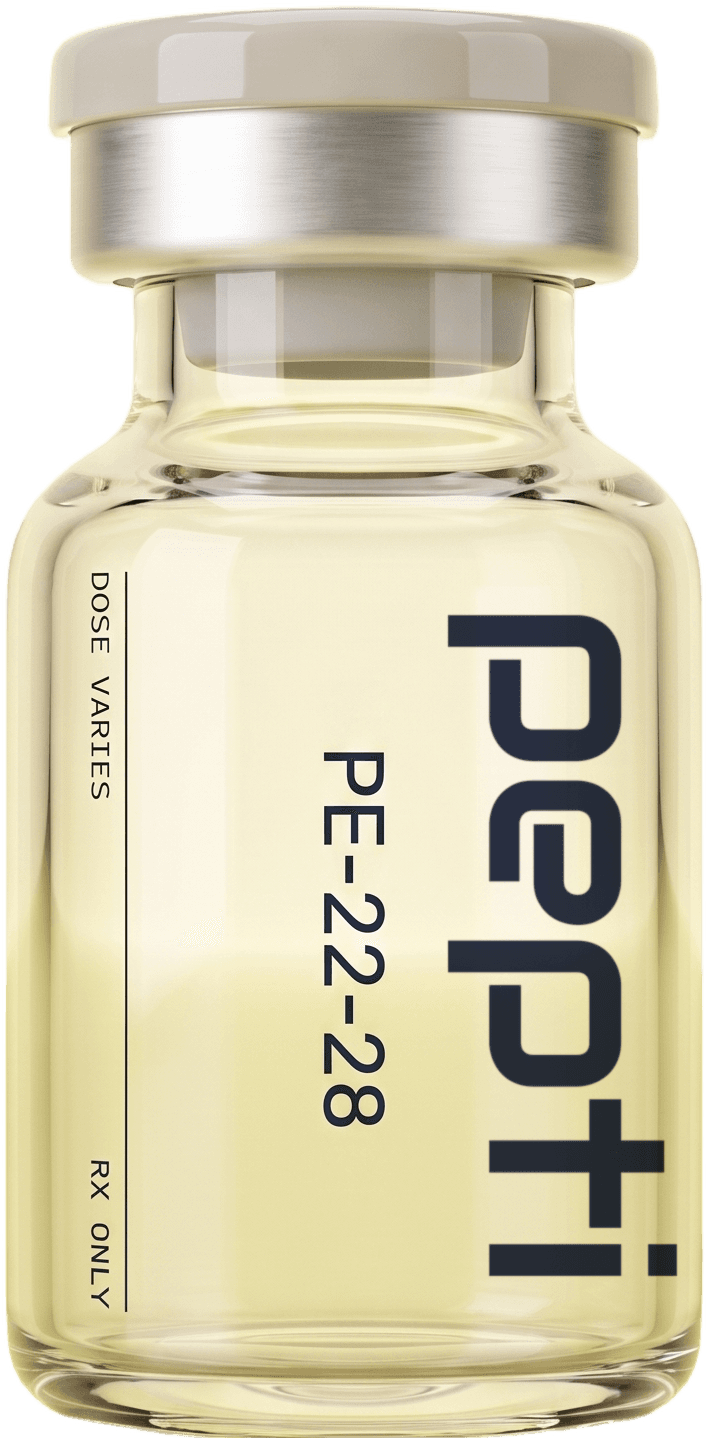
PE-22-28 is a prescription injection supplied as 5 mL multi-dose vial, PE-22-28 2 mg/mL (10 mg PE-22-28 per vial). The reviewed directions are: Inject 0.25 mL (25 units) subcutaneously once daily Monday through Friday. That is 20 doses per vial, about 4 weeks at Monday through Friday. It requires a prescription from a physician licensed in your state, is compounded by a state-licensed US pharmacy, and is not FDA approved.
This page covers what PE-22-28 is, the potassium-channel mechanism researchers describe, what the published work does and does not establish, where it stands with the FDA, how it is dosed, and how to get it prescribed.
PE-22-28
What PE-22-28 actually is
A seven-amino-acid fragment of a protein the body already makes
PE-22-28 is a short peptide, seven amino acids long — a fragment of a larger, naturally occurring protein piece called the sortilin propeptide. Sortilin (also written NTSR3) is a receptor found throughout the nervous system, and when the body makes it, a 44-amino-acid propeptide is clipped off and released. Researchers in Nice, France — the group around Catherine Heurteaux, Marc Borsotto and Jean Mazella — found that a section of that propeptide binds and blocks a potassium channel in nerve cells called TREK-1. They named that fragment, residues 12 to 28, spadin. PE-22-28 is a shorter version: residues 22 to 28 only.
That origin matters. This is not a drug designed against a target from scratch; it is a piece of a protein already circulating in people, trimmed to the shortest part that still works in cells and mice.
Why the name is a set of numbers
"PE" stands for propeptide; "22-28" is the fragment's position within it. The same group published spadin (PE 12-28) in PLoS Biology in 2010, then in Frontiers in Pharmacology in 2017 described shorter analogs, of which PE 22-28 was the shortest retaining TREK-1 blocking activity and, in their hands, the most potent. It appears as PE 22-28, PE-22-28 and PE22-28; the same peptide.
What it is not
It is not an antidepressant medication in the regulatory sense. No drug agency has approved it for depression, or for anything, and it has not been through human trials. It is not a stimulant, not a sedative, and not a nootropic in the sense of a compound with human cognitive-performance data. It does not act on serotonin transporters the way SSRIs do, and it is not a replacement for treatment you already receive for a diagnosed mood disorder.
PE-22-28
How PE-22-28 is described to work
Everything mechanistic below comes from cell and rodent studies, almost all of it from the same French group and from labs that have since replicated pieces of it. There is no human mechanistic data.
Blocking the TREK-1 potassium channel
TREK-1 is a two-pore-domain potassium channel — a background "leak" channel that helps set how excitable a neuron is. The more open TREK-1 channels a neuron has, the harder it is to fire. The starting observation, in Nature Neuroscience in 2006, was that mice bred without the TREK-1 gene behaved across standard behavioural tests as though given an antidepressant, and that drugs such as fluoxetine reduce TREK-1 activity as one of their downstream effects. That made TREK-1 blockade a candidate mechanism in its own right.
Spadin, and then PE-22-28, were characterised as direct TREK-1 blockers. The 2017 paper reported PE-22-28 inhibiting TREK-1 in cultured cells at sub-nanomolar concentrations against tens of nanomolar for spadin — why the shortened fragment became the one of interest.
Why TREK-1 blockade is proposed to affect mood
The proposed chain, again from rodent work, runs through serotonin. TREK-1 is expressed on serotonergic neurons in the dorsal raphe, which supplies serotonin to the cortex and hippocampus. Blocking TREK-1 in the rodent studies was associated with increased firing of those neurons — the same direction of effect SSRIs are thought to produce, by a different route. Brain Structure and Function (2016) described spadin interacting with prefrontal 5-HT4 and mGluR2 receptors in rats, and a 2015 European Neuropsychopharmacology paper from a separate group reported TREK-1 blockade producing an antidepressant-like response in rodents that synergised with 5-HT1A signalling.
Hippocampal neurogenesis and synapse formation
The 2010 PLoS Biology paper reported spadin-treated mice showing increased hippocampal neurogenesis after four days, a window the authors contrasted with the several weeks conventional antidepressants take for the same change in animals. A 2015 British Journal of Pharmacology paper described spadin regulating synaptogenesis — the formation of connections between neurons — in cultured neurons and in mice. The 2017 paper reported PE-22-28 retaining the neurogenesis effect.
Selectivity, and why the shortened fragment mattered
TREK-1 does several jobs beyond mood: pain signalling, protection against seizures, and protection of neurons during reduced blood flow. A 2012 paper in Neuropharmacology tested spadin in mice against exactly those endpoints and reported no pro-pain, pro-seizure or ischaemia-worsening signal at the doses that produced the behavioural effect. The 2017 work reported PE-22-28 also having a longer half-life in the mouse — roughly a day rather than several hours — the practical reason a seven-residue fragment was pursued over the original seventeen.
PE-22-28
What the research actually shows
Depression-like behaviour in rodents
This is the core of the literature. The 2010 PLoS Biology paper reported antidepressant-like effects of spadin in mice across the forced-swim, tail-suspension, novelty-suppressed feeding and learned-helplessness tests, appearing after four days. The 2017 Frontiers in Pharmacology paper reported PE-22-28 reproducing those effects after a four-day course and, in that study, also intranasally. A 2018 ACS Chemical Neuroscience paper compared TREK-1 blockers with fluoxetine in a chronic unpredictable mild stress model in rats. These are the standard rodent screens across antidepressant development: an entry point, not proof of clinical efficacy.
Post-stroke recovery in mice
A 2019 paper in Neuropharmacology from the Nice group reported sortilin-derived peptides, including the shortened analog, associated with improved functional recovery and reduced depression-like behaviour in a mouse stroke model — one study, in mice, framed by its authors as a first indication.
What human data exists
This is the part to understand before starting. There are no randomised controlled trials of PE-22-28 in humans, and no published human trials of any kind, of any size. Everything above is animal or cell research.
The closest thing to human data is observational. A 2017 paper in the Journal of Affective Disorders reported serum levels of the natural sortilin propeptide being lower in patients with major depressive disorder than in controls, and a 2018 paper reported them rising after electroconvulsive therapy in treatment-resistant patients. Those concern the body's own propeptide as a possible marker; they are not studies of giving PE-22-28 to anyone.
Prescribing rests on the mechanism, the rodent data and clinical judgement — a legitimate basis for a physician prescribing under supervision, but not evidence that it works in people. Any source implying otherwise is overselling it.
What the evidence does not establish
- It does not establish that PE-22-28 has any effect on mood, cognition or anything else in humans. That study has not been run.
- It does not establish a human dose. The directions in use are a prescriber's translation from animal work, not a dose-finding trial.
- It does not establish an effect size or a timeline in people.
- It does not establish safety in humans beyond the absence of problems in the animal work, and says nothing about long-term use.
- It does not establish that it can replace or be combined with any antidepressant. Those interactions are unstudied.
- It does not establish efficacy for any condition as an FDA-approved treatment. It is not approved for anything.
PE-22-28
Where PE-22-28 stands with the FDA right now
As of September 2026 the FDA has not evaluated PE-22-28 at all. That is different from the situation of better-known peptides, and worth being precise about.
Under section 503A, a compounding pharmacy may use a bulk substance only if it has a USP or NF monograph, is a component of an FDA-approved drug, or appears on the 503A bulks list. Separately, the FDA sorts nominated substances into three interim categories. PE-22-28 does not appear in Category 1, Category 2 or Category 3 of the FDA's 503A nominated-substances document, most recently updated 14 May 2026. It is also absent from the FDA's page of substances that raise significant safety risks, both from the current Category 2 table and from the substances withdrawn from it. And it is not on the positive 503A bulks list at 21 CFR 216.23, which as of the 22 September 2026 eCFR issue still holds the six substances placed there in 2019.
The Pharmacy Compounding Advisory Committee's 23–24 July 2026 meeting reviewed BPC-157, KPV, TB-500 and MOTS-c on the first day and DSIP, Semax and Epitalon on the second. PE-22-28 was not on the agenda.
So: no safety notice, no Category 2 listing, no advisory-committee vote either way, no position on the bulks list. It has simply not been through the process. The FDA's 503A page also notes that substances nominated on or after 7 January 2025 are no longer placed into the interim categories at all. It is not an FDA-approved drug product, and compounded medications never are.
PE-22-28
Realistic expectations
These are patterns described by prescribers, not trial endpoints. There is no human timeline for PE-22-28. A physician decides whether it is appropriate at all.
The first week
The rodent work reports behavioural change after four days. That is a mouse result, not a promise. Most of what people report in the first week is the injection routine settling in, and injection-site effects if any. Noticing nothing in this window is normal.
Weeks two to four
If any change in how someone feels is reported, prescribers generally describe it in this window, which is why a vial is sized at about four weeks. Because the compound has no human evidence, be honest with your physician about what you are noticing, including nothing.
If you have a diagnosed mood disorder
PE-22-28 is not a treatment for depression, and no existing antidepressant should be stopped on the strength of a rodent literature. If you are under treatment, the physician managing it needs to be part of the decision. Thoughts of harming yourself are an emergency that no peptide addresses; contact a crisis line or emergency services.
After the course
No withdrawal and no rebound have been described — but only because the human studies that would find them have not been run. Whether to continue past a first vial is your physician's call.
PE-22-28
When something else makes more sense
A reference that only ever recommends its own product is not much of a reference. Cases where PE-22-28 is not the first thing to reach for:
- You want a compound with human data behind it. Everything on this page is animal and cell work. Selank and Semax have a longer record of human use, and are the more established conversation for mood and focus. The Semax + Selank preparation combines them.
- Your primary complaint is anxiety rather than low mood. Selank is the compound most often described around that, and the SERENITY blend pairs it with DSIP.
- Sleep is the real problem. DSIP is the more direct conversation; poor sleep drives low mood in its own right.
- Focus and cognition are the goal rather than mood. Semax, the SYNAPSE blend or Dihexa are aimed at that more directly.
- You prefer a nasal spray. PE-22-28 is a vial only. Selank nasal spray and Semax nasal spray exist for people who would rather not inject.
- You have a diagnosed mood disorder. That is a physician's decision about approved treatment, made with whoever manages the diagnosis.
Your physician will tell you if PE-22-28 is not the right tool for what you have described. A consultation does not guarantee a prescription, and being declined is refunded.
PE-22-28
Dosing, and how a vial is actually used
Why the dose is measured in units
The directions are written in millilitres and insulin-syringe units because that is what you read off the barrel. 0.25 mL is 25 units on a U-100 syringe. You are not calculating anything — the number is printed on your medication.
Subcutaneous, and where
Subcutaneous means into the fat layer, not the muscle. Abdomen and thigh are the usual sites, rotated so the same spot is not reused. There is no reason to inject near any particular body part: the proposed mechanism is in the brain, reached through the circulation or not at all.
Why it is Monday through Friday
The reviewed directions are once daily on weekdays, weekends off. That gives twenty doses a vial, about four weeks, which is why refills run on a 28-day cycle. It is a prescriber's schedule, not a trial-derived one — the rodent studies used short daily courses — and your own directions may differ. One vial per fill, always; not a stockpile.
Storage
Refrigerated, and it ships that way in insulated packaging with ice packs. Beyond-use dating runs from first puncture and is on the label. Keep the vial upright, do not freeze it, and do not use it past that date.
PE-22-28
Safety and side effects
There is no human safety data for PE-22-28. What exists is the rodent work, which reports no pro-pain, pro-seizure, cardiac or ischaemia-worsening signal at the doses that produced behavioural effects (Neuropharmacology, 2012), and no toxicity in the mice and rats studied. That is reassuring as far as it goes, and it does not go far.
What gets reported clinically is mostly injection-site: redness, mild soreness, occasional bruising. Some people report a headache in the first days of any new injected peptide.
Three things deserve specific mention. Because the proposed mechanism runs through serotonin signalling, anyone taking an antidepressant, a triptan, lithium, tramadol or any other serotonergic drug must say so on the intake; the combination has not been studied in humans. Cell work has described the parent peptide increasing insulin secretion from pancreatic beta cells (Journal of Diabetes Research, 2016), so people with diabetes or on glucose-lowering medication should raise that. And TREK-1 is involved in seizure protection; the rodent work found no problem, but anyone with a seizure history should discuss it rather than assume.
There is no established interaction list, because the trials that would produce one have not been run. That is why the intake asks for every medication you take and why a physician reviews it rather than a form.
Stop and contact your physician for any reaction that is severe, spreading, involves difficulty breathing, or involves a change in mood that worries you or those around you. New or worsening thoughts of self-harm are an emergency.
PE-22-28
How PE-22-28 compares
PE-22-28 vs Selank
Different targets. PE-22-28 is a TREK-1 blocker with rodent data only. Selank is a synthetic analogue of the immune peptide tuftsin, described around GABA and serotonin modulation, with published human use behind it as well as animal work. Selank is the more established choice for anxiety-type complaints and comes as a nasal spray; PE-22-28 is a vial only.
PE-22-28 vs Semax
Semax is a fragment of ACTH described around BDNF and attention, with a long clinical record in its country of origin, and is usually the conversation when the goal is focus rather than mood. PE-22-28 has no human record at all. They are not interchangeable, and no published work covers using them together.
PE-22-28 vs an approved antidepressant
An SSRI or SNRI has decades of randomised human trials, an established side-effect profile, known interactions and FDA approval for specific diagnoses. PE-22-28 has none of those. The research interest in it is that it is proposed to reach one of the same downstream effects — reduced TREK-1 activity — by a different route and, in mice, faster. That is a hypothesis about a future drug class, not a reason to substitute it for treatment that works. If you have a diagnosis, this comparison belongs to the physician managing it.
PE-22-28
Availability and formats
| Question | Answer |
|---|---|
| Can I get it by telehealth? | Yes, where a physician licensed in your state prescribes it |
| Which states? | All 50 states and DC |
| Does it come as a pen? | No, this one is a vial and syringe only |
| Does it come as a capsule? | No |
| Does it come as a nasal spray? | No |
| Is bloodwork required first? | Not routinely; your physician decides |
PE-22-28
Where to get PE-22-28 prescribed
PE-22-28 cannot be bought legitimately without a prescription. Sites shipping it with no prescription are selling a research-use-only product, where no pharmacy is accountable for identity, purity, sterility or concentration.
The prescription route works like this:
- Complete a medical intake covering your history, medications, allergies and what you are treating.
- A physician licensed in your state reviews it.
- If appropriate, a state-licensed, FDA-registered pharmacy compounds it to that prescription.
- It ships refrigerated with your directions printed on the vial.
- Your physician stays reachable afterwards for dose questions and side effects.
Current all-in pricing for PE-22-28 is published: medication, physician review, refill management and shipping in one figure, with no separate membership fee. What to check on any provider is in how to tell if a peptide seller is legitimate.
PE-22-28
Who should not take it, or should discuss it first
| Situation | Why |
|---|---|
| Pregnancy or breastfeeding | Not used; safety data is absent |
| Tested athletes | Many peptides are prohibited in competition; check the current list |
Full specification
Everything on the label.
Product
PE-22-28 (Injectable)
How supplied
5 mL multi-dose vial, PE-22-28 2 mg/mL (10 mg PE-22-28 per vial)
Typical directions
Inject 0.25 mL (25 units) subcutaneously once daily Monday through Friday.
Dose volume
0.25 mL (25 units on a U-100 insulin syringe)
Doses per vial
20
Coverage per vial
about 4 weeks at Monday through Friday
Formats
Vial and syringe
Available in
All 50 states and DC
Bloodwork
Not routinely required; your physician decides
Legal status
Prescription-only, compounded, not FDA approved
Category
Cognitive
References
What this is based on.
References
- Djillani A, Pietri M, Moreno S et al.. Shortened Spadin Analogs Display Better TREK-1 Inhibition, In Vivo Stability and Antidepressant Activity · Front Pharmacol (2017) · PMID 28955242
- Mazella J, Pétrault O, Lucas G et al.. Spadin, a sortilin-derived peptide, targeting rodent TREK-1 channels: a new concept in the antidepressant drug design · PLoS Biol (2010) · PMID 20405001
- Heurteaux C, Lucas G, Guy N et al.. Deletion of the background potassium channel TREK-1 results in a depression-resistant phenotype · Nat Neurosci (2006) · PMID 16906152
- Moha Ou Maati H, Veyssiere J, Labbal F et al.. Spadin as a new antidepressant: absence of TREK-1-related side effects · Neuropharmacology (2012) · PMID 21807005
- Devader C, Khayachi A, Veyssière J et al.. In vitro and in vivo regulation of synaptogenesis by the novel antidepressant spadin · Br J Pharmacol (2015) · PMID 25598009
- Moha ou Maati H, Bourcier-Lucas C, Veyssiere J et al.. The peptidic antidepressant spadin interacts with prefrontal 5-HT(4) and mGluR(2) receptors in the control of serotonergic function · Brain Struct Funct (2016) · PMID 25233810
- Ye D, Li Y, Zhang X et al.. TREK1 channel blockade induces an antidepressant-like response synergizing with 5-HT1A receptor signaling · Eur Neuropsychopharmacol (2015) · PMID 26441141
- Hivelin C, Béraud-Dufour S, Devader C et al.. Potentiation of Calcium Influx and Insulin Secretion in Pancreatic Beta Cell by the Specific TREK-1 Blocker Spadin · J Diabetes Res (2016) · PMID 28105440
- Devader C, Roulot M, Moréno S et al.. Serum sortilin-derived propeptides concentrations are decreased in major depressive disorder patients · J Affect Disord (2017) · PMID 27838145
- Roulot M, Minelli A, Bortolomasi M et al.. Increased serum levels of sortilin-derived propeptide after electroconvulsive therapy in treatment-resistant depressed patients · Neuropsychiatr Dis Treat (2018) · PMID 30233189
- Qi X, Xu H, Wang L et al.. Comparison of Therapeutic Effects of TREK1 Blockers and Fluoxetine on Chronic Unpredicted Mild Stress Sensitive Rats · ACS Chem Neurosci (2018) · PMID 29952548
- Djillani A, Pietri M, Mazella J et al.. Fighting against depression with TREK-1 blockers: Past and future. A focus on spadin · Pharmacol Ther (2019) · PMID 30291907
Citations are provided for educational purposes. They do not constitute medical advice. Always discuss any peptide protocol with your prescribing physician.
Common questions
PE-22-28, answered.
Through a telehealth provider where a physician licensed in your state reviews a medical intake and a licensed US pharmacy compounds the prescription. Pepti prescribes PE-22-28 in all 50 states and DC; start with the free assessment.
5 mL multi-dose vial, PE-22-28 2 mg/mL (10 mg PE-22-28 per vial)
Inject 0.25 mL (25 units) subcutaneously once daily Monday through Friday. Your physician sets your own dose and it is printed on your medication.
20 at the standard volume, about 4 weeks at Monday through Friday.
PE-22-28 is supplied as a vial, drawn with an insulin syringe. It is not available as a pen or capsule.
Not routinely, though your physician may want labs depending on your history. at-home blood testing covers hormone, metabolic and thyroid markers without a lab visit.
It is legal to prescribe and dispense in the United States with a valid prescription. It is not FDA approved: compounded medications are prepared by licensed pharmacies pursuant to a prescription rather than approved as manufactured products. See are peptides FDA approved.
Pricing is published on the PE-22-28 page as one all-in figure covering medication, physician review, refill management and shipping. What drives peptide pricing generally is in how much do peptides cost.
Closely related but not identical. Spadin is a seventeen-amino-acid fragment (residues 12 to 28) of the sortilin propeptide, described in PLoS Biology in 2010. PE-22-28 is the last seven residues of it, reported in Frontiers in Pharmacology in 2017 as a shorter analog with stronger TREK-1 inhibition and a longer half-life in mice. Both come from the same French group and act on the same channel.
TREK-1 is a background potassium channel that helps set how easily a neuron fires. The research describes PE-22-28 as a TREK-1 blocker, not an activator. The interest comes from a 2006 Nature Neuroscience finding that mice without TREK-1 behaved as though given an antidepressant, and that established antidepressants reduce TREK-1 activity as part of their effect.
No. There are no randomised controlled trials and no published human trials of any kind; the evidence is rodent and cell research. The only human data in the area is observational measurement of the body's own sortilin propeptide in blood, which is not a study of PE-22-28. Any source claiming proven human efficacy is overstating it.
Only if the physician who prescribes both says so. The proposed mechanism overlaps with serotonin signalling, the combination has never been studied in people, and no existing antidepressant should be stopped on your own. List every psychiatric medication on the intake.
That is the reviewed prescriber schedule, and it gives twenty doses a vial, about four weeks. It is not derived from a human trial — none exists. Your physician may write different directions, and yours are the ones printed on the vial.
No. Unlike several better-known peptides, PE-22-28 has never been placed in any of the FDA's 503A interim categories, has not been the subject of an FDA safety notice, and was not on the Pharmacy Compounding Advisory Committee's July 2026 agenda. It has not been evaluated by the FDA at all, and it is not FDA approved.
In humans, unknown, because no trials have been run. Rodent work reported no pain, seizure or cardiac signal at the doses studied. What gets reported clinically is mostly injection-site reactions and occasionally a headache in the first days. Anyone on serotonin-affecting medication, anyone with diabetes and anyone with a seizure history should discuss it specifically before starting.
Next step
See what a physician recommends for you.
A licensed physician in your state reviews your intake and decides what is appropriate. A consultation does not guarantee a prescription.