Anti-Aging · Reference
Liposomal NAD+ vs NAD+ Injection: What Liposomal Means and What the Evidence Shows
Liposomal NAD+ is an oral supplement in which NAD+ is enclosed in liposomes, microscopic spheres made of fat-like molecules, with the aim of protecting it in the gut; an NAD+ injection is a prescription medication placed under the skin, bypassing the gut altogether.
Treatments mentioned
Neither has been tested in a randomised human trial with a clinical outcome. The randomised human evidence for raising NAD+ comes from oral precursors, NR and NMN, not from liposomal NAD+ and not from NAD+ injections. Pepti prescribes NAD+ injections; it does not sell liposomal NAD+ or other oral NAD+ supplements, and compounded NAD+ is not FDA approved.
This page explains what "liposomal" means, what is known about getting NAD+ into the body by each route, how both compare with the precursors that have the trials, where each stands with regulators, and how Pepti supplies NAD+. Liposomal products are described neutrally and generally, and no products or companies are named.
Liposomal NAD+ vs NAD+ Injection
The short answer
| Question | Liposomal NAD+ | NAD+ injection |
|---|---|---|
| What is it? | NAD+ enclosed in liposomes, taken by mouth | NAD+ in sterile solution, injected under the skin |
| Route | Through the gut | Bypasses the gut |
| Prescription needed? | No; sold as a supplement | Yes |
| Randomised human trials with an outcome | None | None |
| What it is regulated as | A dietary supplement | A compounded prescription medication |
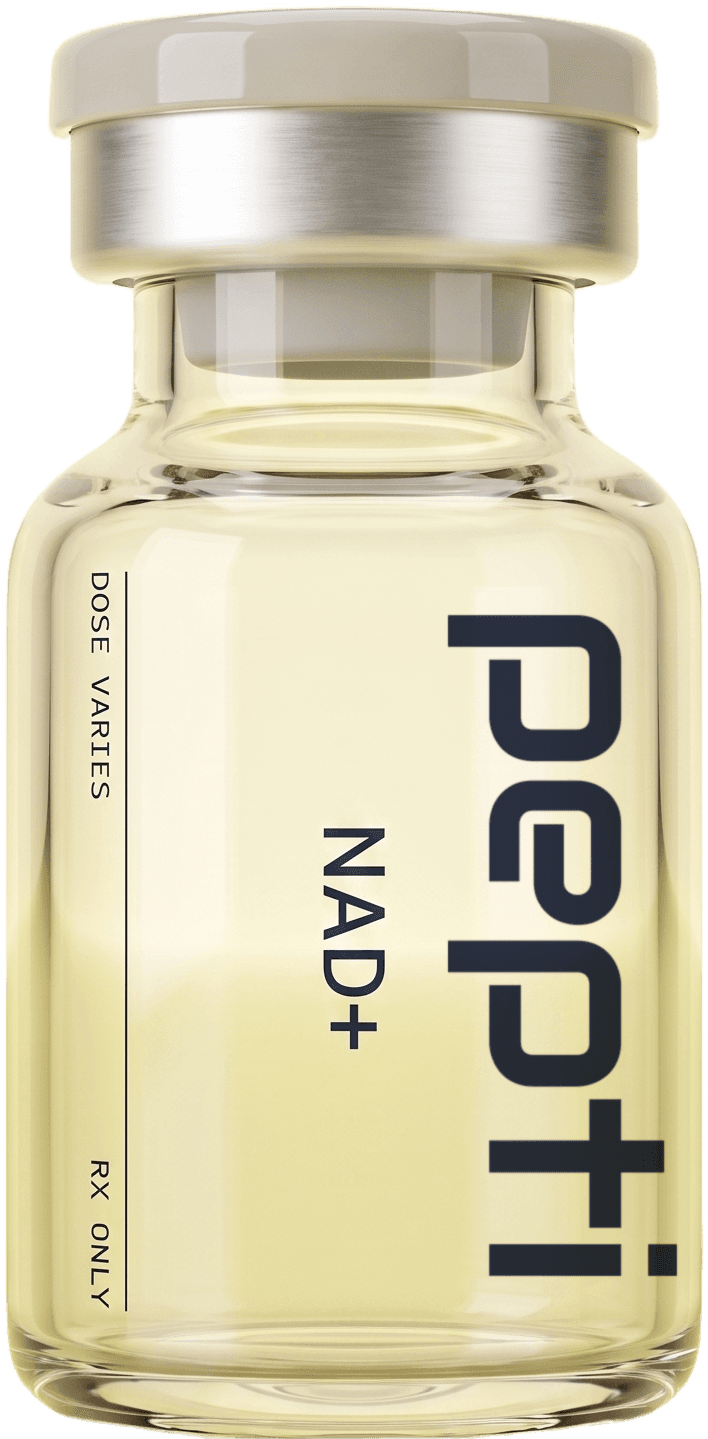
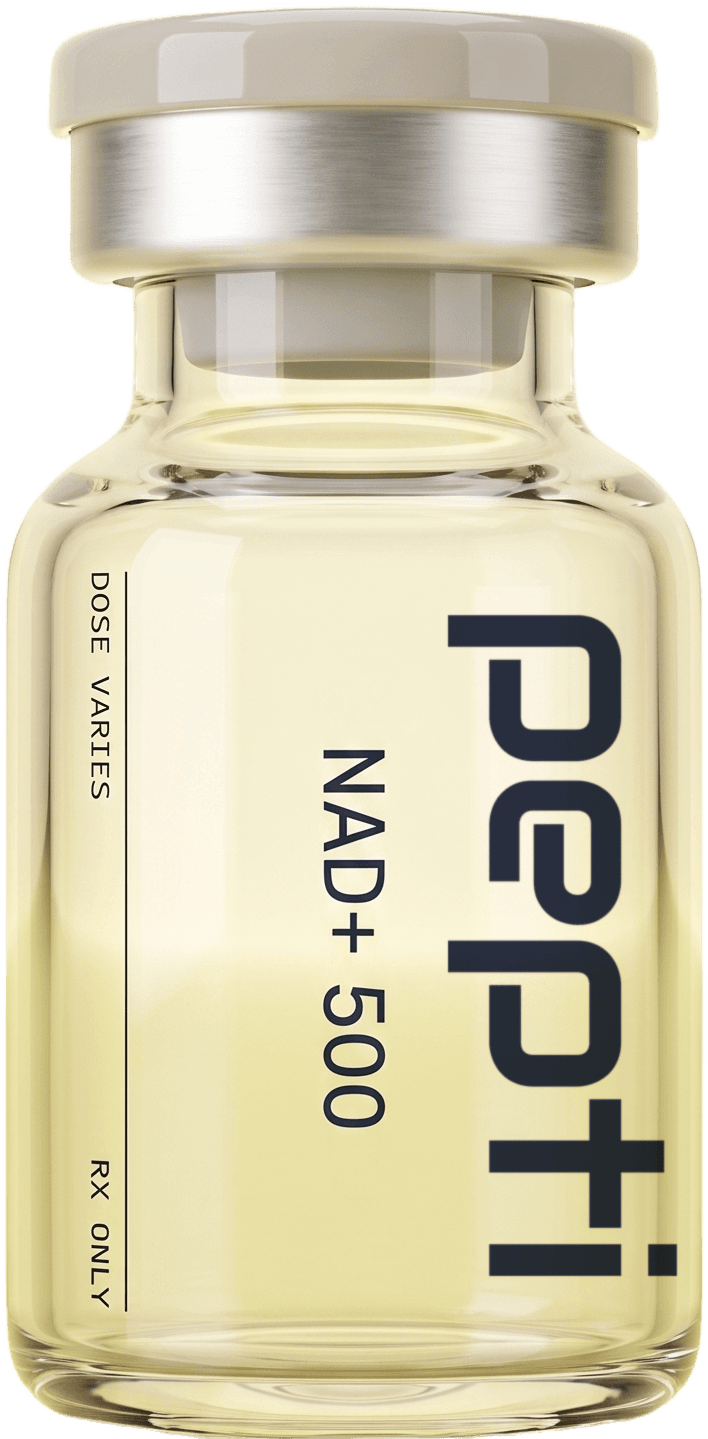
| Supplied by Pepti | No | NAD+ Injection, $249/mo; NAD+ Injection (500 mg), $229/mo |
Pepti prices are all-in, covering medication, physician review, refill management and shipping, with no separate membership fee. Current pricing always lives on each product page.
Liposomal NAD+ vs NAD+ Injection
What NAD+ is, briefly
NAD+ is nicotinamide adenine dinucleotide, a coenzyme made from a form of vitamin B3 that every cell makes and uses continuously. It carries electrons from broken-down glucose and fat to the mitochondria to make ATP, and it is consumed as fuel by sirtuins and PARP enzymes, which are involved in cell stress responses and DNA repair. A 2012 study in PLOS ONE reported lower NAD+ in older human skin, which is the observation behind much of the interest. The full reference is at what is NAD+ injection.
Liposomal NAD+ vs NAD+ Injection
What "liposomal" means
A liposome is a tiny hollow sphere whose wall is made of phospholipids, the same kind of fat-like molecule that forms cell membranes. A substance can be carried inside the sphere or within its wall. Liposomes are used in pharmaceutical science to carry some medicines, and in the supplement market they are used to package nutrients with the stated aim of protecting them from digestion and improving absorption.
Applied to NAD+, the idea is that wrapping the molecule might help more of it survive the stomach and intestine. That is a plausible formulation goal. Whether it works for NAD+ specifically, how much intact NAD+ reaches the blood, and whether that changes anything in tissue, are questions that published human trials have not answered.
Liposomal NAD+ vs NAD+ Injection
Liposomal NAD+ on its own terms
What is known
The general case for liposomes is real formulation science. The specific case for liposomal NAD+ is thin. There is no randomised human trial of liposomal NAD+ with a clinical outcome, and no published human study establishing how much NAD+ from a liposomal supplement reaches the blood intact. The closest liposomal human data in this area is for a different molecule: a 2018 pilot in the European Journal of Clinical Nutrition reported rises in body glutathione stores with a liposomal form of glutathione in 12 adults. That is a small pilot, of glutathione, and it does not transfer to NAD+.
How it is regulated
Liposomal NAD+ is sold as a dietary supplement. Supplements do not go through FDA approval before sale, and the manufacturer, not the FDA, is responsible for what the label says about contents and strength. That is a general feature of the category, not a statement about any particular product.
Liposomal NAD+ vs NAD+ Injection
NAD+ injection on its own terms
What is known
The case for injection is that it bypasses the gut entirely. Whether that produces any benefit beyond oral routes has not been tested. There are no randomised controlled trials of subcutaneous NAD+ injection in humans. The only published study of NAD+ given directly to people, a 2019 pilot in Frontiers in Aging Neuroscience, infused it intravenously over six hours. For the first two hours, plasma NAD+ and its metabolites did not rise at all: the molecule was cleared as fast as it arrived. Only after that did plasma levels and breakdown products such as nicotinamide appear, and the kidneys excreted both NAD+ and methylnicotinamide. The likeliest reading is that injected NAD+ is broken down outside cells into fragments, including nicotinamide and NMN, which tissues rebuild into NAD+.
How it is regulated
An NAD+ injection is a compounded prescription medication. NAD is in Category 1, "Bulk Drug Substances Under Evaluation," on the FDA's 503A list updated 14 May 2026, under which state-licensed pharmacies may compound it while the FDA's evaluation is pending. It was never in Category 2. In October 2024 the FDA warned that food-grade NAD+ powder is not suitable for sterile injections after reports of endotoxin reactions, which is about ingredient sourcing, not the molecule. Compounded NAD+ is not FDA approved.
Liposomal NAD+ vs NAD+ Injection
Head to head
| Liposomal NAD+ | NAD+ injection | |
|---|---|---|
| Form | Oral liquid or capsule, NAD+ inside liposomes | Sterile solution in a multi-dose vial |
| Gets past the gut by | Packaging intended to protect it | Not going through the gut |
| Human data on what reaches the blood | Not established in published trials | One 2019 intravenous pilot: cleared as fast as it arrived for two hours |
| Randomised outcome trials | None | None for subcutaneous injection |
| Who makes it | A supplement manufacturer | A licensed compounding pharmacy, to a prescription |
| Who checks it | The manufacturer | The pharmacy's sterile process and lot testing |
| Concentration known | As labelled by the manufacturer | Stated on the vial |
| Common reported effects | Not characterised in published trials | Site stinging; flushing or nausea if injected quickly |
| Involves a physician | No | Yes |
The real difference is accountability, not proven absorption
People often ask which route "works better." Nobody has compared them, and neither has outcome data, so the honest answer is that it is unknown. What does differ is concrete: an injection is a sterile prescription product with a stated concentration, made by an accountable pharmacy and supervised by a physician; a supplement is a consumer product whose label the manufacturer stands behind. Which one fits depends on whether you want physician involvement, how you feel about needles, and cost, not on an absorption advantage either one has demonstrated.
Liposomal NAD+ vs NAD+ Injection
Where NMN and NR fit
The molecules with the randomised human trials are neither liposomal NAD+ nor injected NAD+. They are the oral precursors nicotinamide riboside (NR) and nicotinamide mononucleotide (NMN), which the body converts into NAD+ through its recycling pathway.
| Oral NR or NMN | Liposomal NAD+ | NAD+ injection | |
|---|---|---|---|
| What it is | A precursor the body converts to NAD+ | NAD+ itself, packaged for the gut | NAD+ itself, under the skin |
| Randomised human trials | Yes, 2018 to 2024 | None | None for subcutaneous use |
| What those trials showed | Reliable rises in blood NAD+; small, mixed functional effects | Not studied | Not studied |
| Head-to-head comparison | None | None | None |
NR raised blood NAD+ in healthy middle-aged and older adults (Nature Communications, 2018) and dose-dependently in healthy overweight adults (Scientific Reports, 2019); NMN raised blood NAD+ over 60 days in 80 middle-aged adults (GeroScience, 2023). The effects on outcomes were modest and mixed, strongest in older or metabolically impaired people. Precursor results cannot simply be transferred to liposomal NAD+ or to injections, and a provider who quotes NMN or NR trials as evidence for either is skipping a step. Pepti does not supply NMN or NR. The benefit-by-benefit picture is in NAD+ benefits.
Can you measure which one raised your levels?
Not meaningfully. There is no validated routine clinical test for tissue NAD+, and blood is not tissue. Research trials measure whole-blood NAD+ under controlled conditions. Anyone offering to show your NAD+ rising on a supplement or an injection is overstating what the test can tell you.
Liposomal NAD+ vs NAD+ Injection
How Pepti supplies NAD+
| Product | What is in it | Typical printed directions | Math at that concentration | Price |
|---|---|---|---|---|
| NAD+ Injection | 10 mL vial, 100 mg/mL (1000 mg NAD+) | 0.83 mL (83 units) subcutaneously three times per week | About 83 mg per injection; 12 injections per vial | $249/mo |
| NAD+ Injection (500 mg) | 10 mL vial, 50 mg/mL (500 mg NAD+) | 0.83 mL (83 units) subcutaneously three times per week | About 41.5 mg per injection; 12 injections per vial | $229/mo |
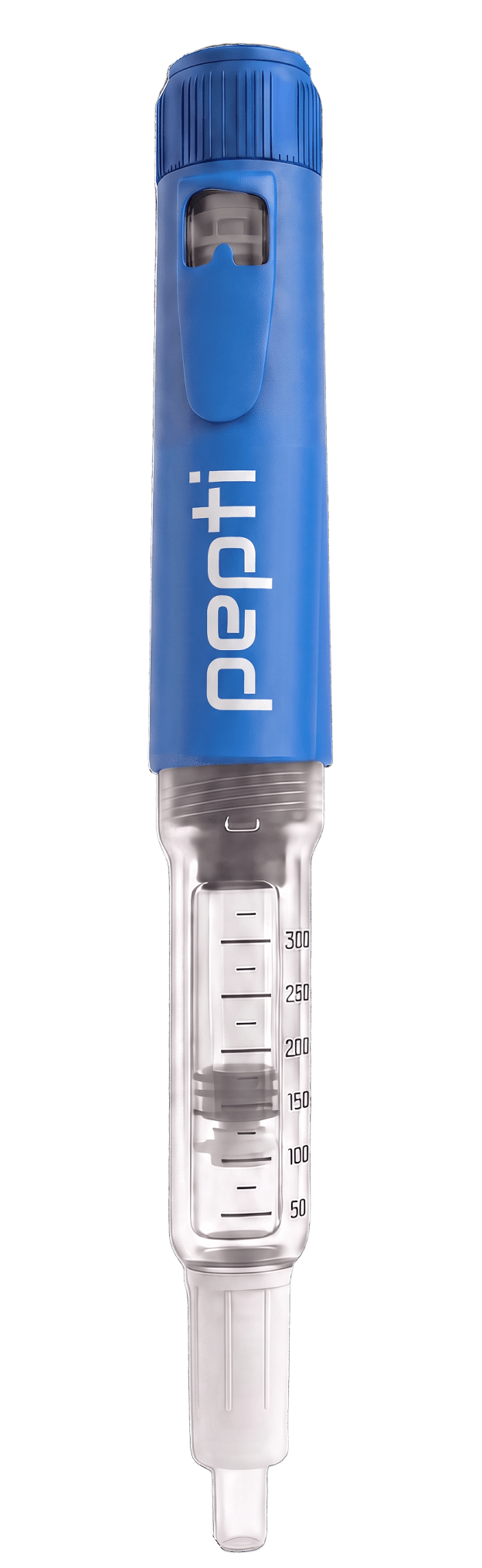
The math column is arithmetic on the vial's concentration, not a dose recommendation. Your physician sets your directions after reviewing your intake, and they are printed on the vial. Twelve injections at three a week is about four weeks, which is why refills run every 28 days, one vial per fill. The 500 mg vial is the same volume at half the concentration, which some prescribers describe as easier on the injection site for people starting out. NAD+ Injection also comes as a pre-filled Pen cartridge with 600 mg; the medication is the same. Vials ship refrigerated with ice packs, sterile syringes and alcohol prep pads; NAD+ degrades with heat and light, so keep it in the fridge and out of light. More is in NAD+ injection dosage.
Liposomal NAD+ vs NAD+ Injection
Side effects
NAD+ injection. Most of what people feel is driven by how fast NAD+ enters the circulation, not by the molecule.
| How often | What is reported | What to do |
|---|---|---|
| Common | Stinging or burning at the site, redness, a small lump | Inject slowly; rotate sites between abdomen and thigh |
| Common | Flushing, warmth, chest or abdominal tightness, or nausea during the injection, fading within minutes | Usually rate-related; inject slowly and report it |
| Uncommon | Headache, light-headedness, a wired feeling with evening doses | Report it |
| Stop and call | Chills, shaking or vomiting after a dose | Not expected; contact your physician the same day |
| Stop and get help | Facial or throat swelling, widespread rash, difficulty breathing | Call 911, then tell your physician |
The cautions are an active or recent cancer, significant kidney or liver disease, and pregnancy or breastfeeding. More is in is NAD+ safe.
Liposomal NAD+. Its side-effect profile has not been characterised in published trials. If you take it, or any NAD+ supplement, put it on your intake.
Liposomal NAD+ vs NAD+ Injection
What the evidence shows, honestly
The biochemistry of NAD+ is textbook and not in question. The clinical layer is thin for both routes on this page. Liposomal NAD+ has a plausible formulation rationale and no published human trial establishing absorption or any outcome. NAD+ injection has a direct route and no randomised human trial, with the only direct human data a 2019 intravenous pilot that tracked metabolism rather than outcomes. The randomised evidence belongs to oral precursors, and even there the functional effects are small and mixed. Claims that either route reverses aging or treats a named disease are marketing.
Liposomal NAD+ vs NAD+ Injection
Where to get NAD+ injections prescribed
NAD+ injections cannot be bought legitimately without a prescription. Products sold "for research use only" are not accountable for what is in the vial, and with NAD+ the FDA has specifically warned about contaminated ingredients. The prescription route:
- Complete a free online intake covering your history, medications, supplements and what you want help with.
- A physician licensed in your state reviews it, usually within 24 hours.
- If it is appropriate, a PCAB-accredited, FDA-registered US 503A pharmacy compounds it to that prescription. Lot test results are published at /quality/lab-results.
- It ships refrigerated with your directions printed on the vial.
- Your physician stays reachable for questions and dose changes.
Pepti prescribes NAD+ in every state except Oklahoma, plus DC Pepti is cash-pay and does not bill insurance. Step by step: how to get NAD+ prescribed online.
References
What this is based on.
References
- Massudi H, Grant R, Braidy N, et al.. Age-associated changes in oxidative stress and NAD+ metabolism in human tissue · PLOS ONE (2012) · PMID 22848760
- Yoshino J, Baur JA, Imai SI. NAD+ Intermediates: The Biology and Therapeutic Potential of NMN and NR · Cell Metabolism (2018) · PMID 29249689
- Verdin E. NAD⁺ in aging, metabolism, and neurodegeneration · Science (2015) · PMID 26785480
- Martens CR, Denman BA, Mazzo MR, et al.. Chronic nicotinamide riboside supplementation is well-tolerated and elevates NAD+ in healthy middle-aged and older adults · Nature Communications (2018) · PMID 29599478
- Dollerup OL, Christensen B, Svart M, et al.. A randomized placebo-controlled clinical trial of nicotinamide riboside in obese men: safety, insulin-sensitivity, and lipid-mobilizing effects · American Journal of Clinical Nutrition (2018) · PMID 29992272
- Yoshino M, Yoshino J, Kayser BD, et al.. Nicotinamide mononucleotide increases muscle insulin sensitivity in prediabetic women · Science (2021) · PMID 33888596
- Yi L, Maier AB, Tao R, et al.. The efficacy and safety of β-nicotinamide mononucleotide (NMN) supplementation in healthy middle-aged adults: a randomized, multicenter, double-blind, placebo-controlled, parallel-group, dose-dependent clinical trial · GeroScience (2023) · PMID 36482258
- Brakedal B, Dölle C, Riemer F, et al.. The NADPARK study: A randomized phase I trial of nicotinamide riboside supplementation in Parkinson's disease · Cell Metabolism (2022) · PMID 35235774
- McDermott MM, Martens CR, Domanchuk KJ, et al.. Nicotinamide riboside for peripheral artery disease: the NICE randomized clinical trial · Nature Communications (2024) · PMID 38871717
- Shiffman S, Stone AA, Hufford MR. Ecological momentary assessment · Annu Rev Clin Psychol (2008) · PMID 18509902
- Conze D, Brenner C, Kruger CL. Safety and Metabolism of Long-term Administration of NIAGEN (Nicotinamide Riboside Chloride) in a Randomized, Double-Blind, Placebo-controlled Clinical Trial of Healthy Overweight Adults · Scientific Reports (2019) · PMID 31278280
- Nacarelli T, Lau L, Fukumoto T, et al.. NAD+ metabolism governs the proinflammatory senescence-associated secretome · Nature Cell Biology (2019) · PMID 30778219
Citations are provided for educational purposes. They do not constitute medical advice. Always discuss any peptide protocol with your prescribing physician.
Common questions
Liposomal NAD+ vs NAD+ Injection, answered.
An oral supplement in which NAD+ is enclosed in liposomes, microscopic spheres with walls made of phospholipids, intended to protect it during digestion. It is sold without a prescription.
Nobody has compared them, and neither has a randomised trial with a clinical outcome. An injection bypasses the gut and is a sterile prescription product with a stated concentration; a liposomal supplement relies on packaging to get through the gut, and how much intact NAD+ reaches the blood is not established.
That has not been established in published human trials. Liposomes are a real formulation tool, but there is no published human study showing how much NAD+ from a liposomal supplement reaches the blood intact.
There is no head-to-head comparison. NMN and NR are the forms with randomised human trials, which reported reliable rises in blood NAD+ with small, mixed functional effects. Liposomal NAD+ has no equivalent trials.
It has not been measured for the subcutaneous route. The one published study of NAD+ given directly, a 2019 intravenous pilot, found it was cleared as fast as it arrived for the first two hours and then appeared as breakdown products that cells can rebuild into NAD+.
No. Pepti prescribes NAD+ as an injection, in 1000 mg and 500 mg vials. It does not sell oral NAD+, NMN or NR.
No. NAD is in Category 1 of the FDA's 503A list, under evaluation, updated 14 May 2026, and compounded medications are not FDA approved.
Supplements do not go through FDA approval before sale. The manufacturer is responsible for what its label says.
Mostly stinging at the site and flushing, chest tightness or nausea during the injection that fades within minutes, usually tied to injecting too fast. Chills or vomiting after a dose are not expected and should be reported the same day.
NAD+ Injection (1000 mg) is $249 a month and NAD+ Injection (500 mg) is $229 a month, all-in, covering medication, physician review, refill management and shipping, with no membership fee.
No. Bloodwork is not required for any Pepti treatment. If your physician wants labs for your care, they'll ask through your account. The free assessment goes to a physician licensed in your state. A consultation does not guarantee a prescription.
Related answers
Keep reading.
- NAD+ Injection: What It Is, Where to Get It Prescribed, and What It Costs
- NAC vs NAD+: What Each Is, How They Differ, and Whether to Take Both
- NAD+ for Men: What the Research Has Looked At, and What to Check First
- NAD+ for Women: What the Research Has Looked At, and What to Check First
- Liraglutide vs Semaglutide: Daily vs Weekly GLP-1, Evidence, Side Effects and Cost
Next step
See what a physician recommends for you.
A licensed physician in your state reviews your intake to see whether treatment fits your history. A consultation does not guarantee a prescription.