Recovery · Reference
KPV vs KLOW: Same KPV Dose, Three Extra Peptides, and Which One Fits
This page explains what each vial contains, what the three extra peptides in KLOW add and what they do not, what the research does and does not show, where each component stands with the FDA, how each is dosed, what each costs at Pepti, and who tends to suit which.
Treatments mentioned
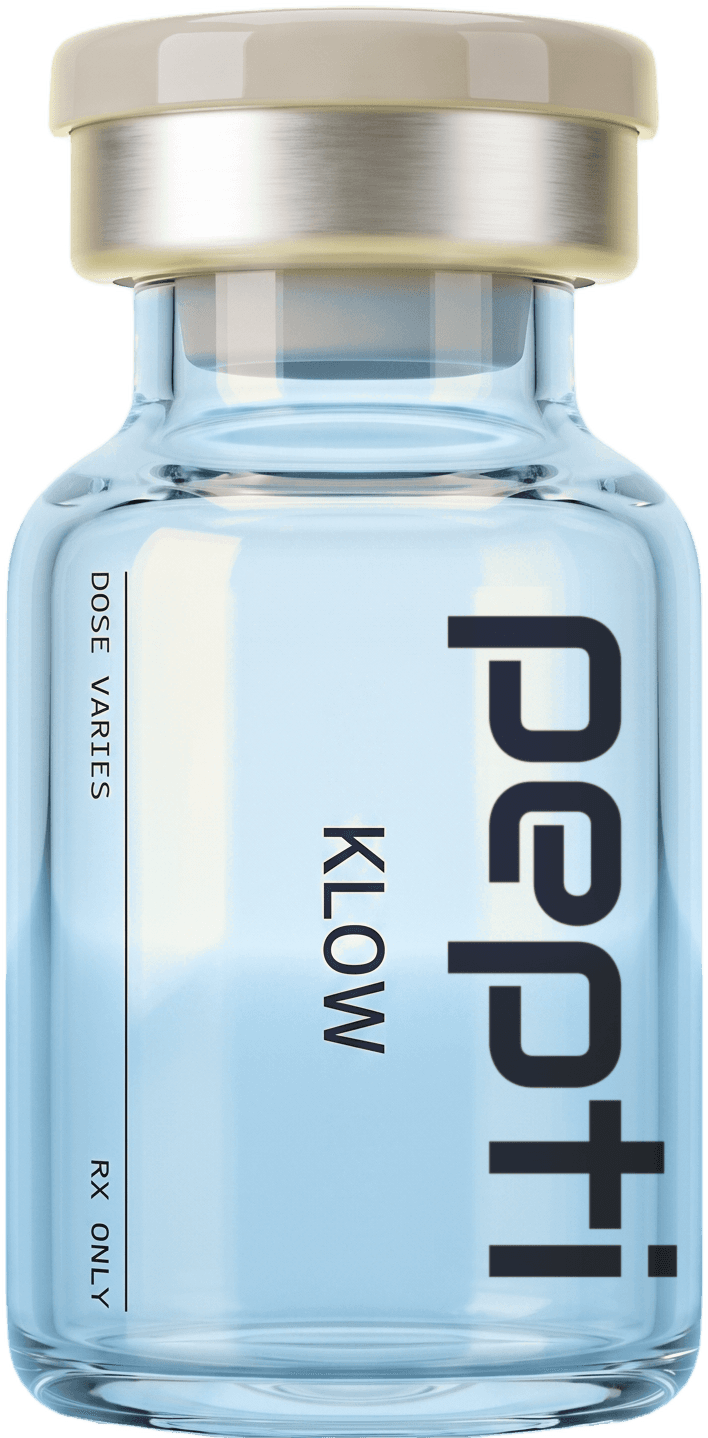
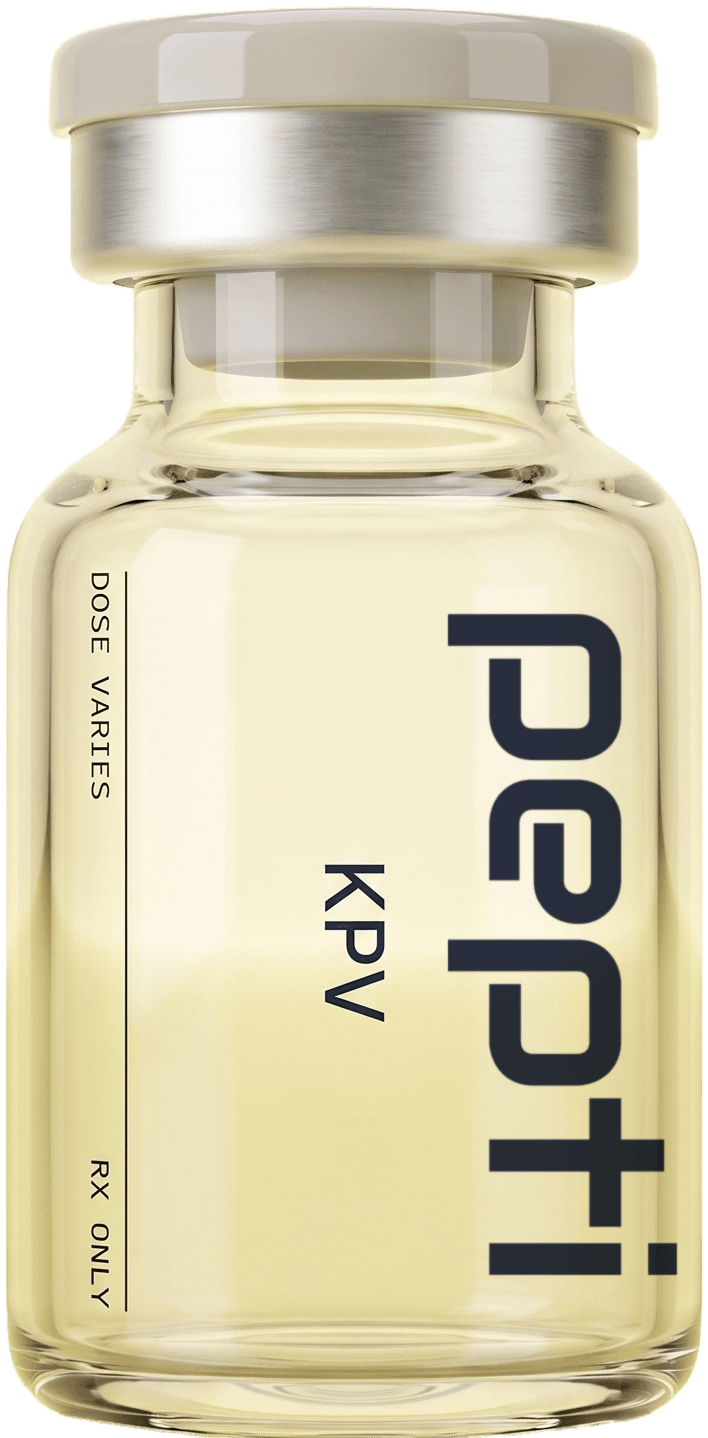
KPV is one peptide; KLOW is KPV plus three more. Both vials carry the same 10 mg of KPV in 5 mL and are dosed at 0.25 mL, so each injection delivers the same 0.5 mg of KPV either way. KLOW adds 2.5 mg of GHK-Cu, 0.5 mg of BPC-157 and 0.5 mg of TB-500 to every dose, which turns an inflammation-focused prescription into a repair and skin blend. KPV on its own suits inflammation without a specific injury; KLOW suits repair or skin goals where inflammation is also part of the picture. Both are prescription-only, compounded by a licensed US pharmacy, and neither is FDA approved.
This page explains what each vial contains, what the three extra peptides in KLOW add and what they do not, what the research does and does not show, where each component stands with the FDA, how each is dosed, what each costs at Pepti, and who tends to suit which.
KPV vs KLOW
The short answer
| If your main goal is | The usual prescription | What is in it | Price |
|---|---|---|---|
| Background inflammation, no specific injury | KPV | 10 mg KPV in a 5 mL vial | $229/mo |
| Repair and skin, with inflammation that will not settle | KLOW | 50 mg GHK-Cu, 10 mg KPV, 10 mg BPC-157, 10 mg TB-500 in 5 mL | $259/mo |
| Repair and skin, without an inflammation focus | GLOW | 50 mg GHK-Cu, 10 mg BPC-157, 10 mg TB-500 in 5 mL | $259/mo |
| KPV alongside immune support | FORTIFY Blend | Thymosin Alpha-1, BPC-157, KPV and LL-37 | $289/mo |
| A gut complaint | BPC-157 | 5 mg BPC-157 in 5 mL | $209/mo |
Every figure is an all-in monthly price covering the medication, physician review, refill management and shipping. There is no separate membership fee. KLOW costs $30 a month more than KPV alone. Current pricing always lives on each product page.
KPV vs KLOW
KPV on its own terms
What it is
KPV is a tripeptide, three amino acids long: lysine, proline and valine, which is where the name comes from. It is the C-terminal end of alpha-melanocyte-stimulating hormone (alpha-MSH), positions 11 to 13 of that thirteen-amino-acid hormone. Alpha-MSH drives pigmentation, but it also works as an anti-inflammatory signal. A 2008 review in Endocrine Reviews set out that the three-amino-acid tail kept much of the anti-inflammatory activity in cell and animal models, while pigmentation depends on a different part of the sequence. KPV is that tail on its own. The full reference is at what is KPV.
How it is described to work
- Entry through PepT1. A 2008 paper in Gastroenterology reported that KPV is carried into intestinal cells by PepT1, the transporter the gut lining uses to absorb small peptides, and that its effect depended on the transporter.
- NF-kB and MAPK. Inside the cell, it is described as interfering with the NF-kB and MAPK pathways that turn an inflammatory trigger into an inflammatory response.
- Lower cytokine output. In cell and mouse work, less TNF-alpha, IL-6, IL-1beta and IL-8.
- No melanocortin-1 receptor. A 2012 paper using a human bronchial cell line described it working through a route that did not depend on the receptor that drives pigmentation, which is why KPV is not a tanning peptide.
All of that work is in cells and animals.
KPV vs KLOW
KLOW on its own terms
What it is
KLOW is four independently studied peptides dissolved together in one sterile multi-dose vial: GHK-Cu, KPV, BPC-157 and TB-500. The name is a brand name for the combination, and the four-peptide combination has never been studied as a combination. The full reference is at what is KLOW Blend.
Component Per vial Per 0.25 mL dose Described in research around GHK-Cu 50 mg 2.5 mg Collagen and elastin synthesis, matrix remodelling KPV 10 mg 0.5 mg Anti-inflammatory signalling without pigmentation BPC-157 10 mg 0.5 mg Angiogenesis, cell migration, gut-lining protection TB-500 10 mg 0.5 mg Actin binding and cell movement into damaged tissue What the other three add
The rationale prescribers give is that tissue repair runs in overlapping phases, and each component is described as acting on a different one. KPV is the inflammation component. BPC-157 is described around new blood-vessel growth and cell migration; a 2014 paper in Molecules reported it activating the FAK-paxillin pathway in cultured tendon fibroblasts. TB-500 reproduces the actin-binding segment of thymosin beta-4, described around cells moving into a wound. GHK-Cu, the copper-binding tripeptide, is described in reviews from 2015 and 2018 as increasing collagen, elastin and matrix synthesis. GHK-Cu is 50 of the 80 mg in the vial, so by mass KLOW is mostly a GHK-Cu preparation.
What they do not add
They do not add more KPV. Per injection, the KPV in KLOW is the same 0.5 mg as in the single vial. Choosing KLOW over KPV is a choice to add repair and skin components, not a choice to get a stronger anti-inflammatory dose.
KPV vs KLOW
Head to head
| KPV | KLOW | |
|---|---|---|
| Number of actives | One | Four |
| KPV per vial | 10 mg | 10 mg |
| KPV per 0.25 mL dose | 0.5 mg | 0.5 mg |
| Other actives per dose | None | 2.5 mg GHK-Cu, 0.5 mg BPC-157, 0.5 mg TB-500 |
| Main described focus | Inflammatory signalling | Repair phases plus skin and matrix, with inflammation |
| Strongest animal work | Mouse colitis models | Per component: BPC-157 tendon work in rats, GHK-Cu matrix work, KPV colitis work |
| Human trials | None | None of the blend; small, mostly topical GHK-Cu skin studies; early-phase BPC-157 work for inflammatory bowel indications |
| Copper caution | No | Yes, GHK-Cu delivers copper |
| Vial at Pepti | 5 mL, KPV 2 mg/mL | 5 mL, four peptides, 80 mg total |
| Typical directions | 0.25 mL (25 units) once daily Monday through Friday | 0.25 mL (25 units) Monday through Friday mornings |
| Doses per vial | 20, about 4 weeks | 20, about 4 weeks |
| Pen option | No, vial only | Yes, a 3 mL pre-filled Pen cartridge |
| Price at Pepti | $229 a month | $259 a month |
One variable or four
The practical trade-off is the one that applies to every blend. KPV alone is one variable, which makes it easier to judge whether it is doing anything. KLOW is four actives in a fixed ratio that cannot be adjusted per component; if one of the four does not suit you, the whole vial has to change. A blend is a convenience for people who already want all four, not a stronger version of any one of them.
KPV vs KLOW
Who suits which
KPV first
KPV on its own is the usual choice when the complaint is inflammation in general rather than a specific injury, and gut-related complaints are the ones prescribers most often describe for it, which fits where the animal work is strongest. It is also the simpler choice for anyone with a reason to avoid copper, or anyone who wants to know what a single peptide is doing before adding more.
KLOW
KLOW suits someone whose goal is repair or skin and connective-tissue quality, and whose picture also includes inflammation that does not settle. It is the fullest of the repair blends and the only one of the two with a Pen option.
When something narrower fits
Situation What makes more sense Repair and skin, no inflammation focus GLOW, the same blend without KPV A single tendon or ligament problem BPC-157 + TB-500, the injury-only stack Skin quality is the whole goal GHK-Cu on its own A gut complaint BPC-157, which has the gastrointestinal literature Immune function more than inflammation Thymosin Alpha-1, or FORTIFY with KPV in it A diagnosed inflammatory disease on prescribed treatment Keep your specialist's treatment; neither peptide replaces it Can you take KPV and KLOW together?
Not usually, because KLOW already contains the same KPV amount per dose. Adding a separate KPV vial would double the KPV and is a question for your physician, not something to do on your own. If you want more of the inflammation component and less of the others, the answer is separate single vials rather than stacking a blend.
KPV vs KLOW
What the evidence shows, honestly
There are no randomised controlled trials of KPV in humans, and no human trials of KLOW or of any four-peptide combination of its components. KPV's evidence is cell work, including human intestinal, T-cell and bronchial epithelial cell lines, and mouse models: the 2008 Inflammatory Bowel Diseases and Gastroenterology colitis papers, a 2017 nanoparticle formulation study in Molecular Therapy, and a 2013 PLoS One brain-injury study. Most of the gut work gave KPV orally, so it does not establish what a subcutaneous injection does.
KLOW's evidence is per component and uneven. GHK-Cu has small human studies, mostly of topical application to skin, none with the injectable form. BPC-157 has early-phase human work for inflammatory bowel indications and none for tendon injury. TB-500 has no human trials; the early-phase human work was on full-length thymosin beta-4. No study has compared KLOW with its components, so nothing shows that four together do more than one alone.
KPV vs KLOW
Where each stands with the FDA
KLOW has no regulatory status of its own; the FDA regulates the bulk substances, not the blend. As of the FDA pages checked in September 2026:
| KPV | KLOW's other three | |
|---|---|---|
| 2023 | Category 2 | BPC-157, TB-500 and injectable GHK-Cu all in Category 2 |
| 15 April 2026 | Removal from Category 2 announced, effective 22 April | All three removed in the same announcement |
| 23 July 2026 advisory committee | Voted 8 to 6, one abstention, to recommend adding KPV to the 503A Bulks List | BPC-157 and TB-500 recommended by the same 8 to 6 margin; GHK-Cu scheduled for a meeting before the end of February 2027 |
| Final FDA determination | Pending | Pending |
A committee vote is a recommendation, not a decision. All four remain legal to prescribe and dispense as compounded medications, and compounded medications are not FDA approved. Are peptides FDA approved explains the difference.
KPV vs KLOW
Dosing, side by side
Both are injected under the skin (subcutaneously), usually into the abdomen or thigh, rotating sites, at 0.25 mL, which is 25 units on a U-100 insulin syringe, Monday through Friday with weekends off. KLOW's directions specify mornings. Twenty doses per 5 mL vial covers about four weeks, which is why refills run every 28 days, one vial per fill. You do not need to calculate anything: your directions are printed on the vial, and your physician sets them after reviewing your intake.
| 0.25 mL dose (math only, U-100 syringe) | KPV vial | KLOW vial |
|---|---|---|
| Units | 25 | 25 |
| KPV | 0.5 mg | 0.5 mg |
| GHK-Cu | None | 2.5 mg |
| BPC-157 | None | 0.5 mg |
| TB-500 | None | 0.5 mg |
Both ship refrigerated with ice packs, along with sterile syringes and alcohol prep pads, and stay in the fridge between doses. More detail is on KPV dosage and KLOW dosage.
KPV vs KLOW
Side effects
KPV. Mostly injection-site redness, mild soreness or occasional bruising. Some people report mild nausea or a transient headache early on. Animal work has not reported toxicity at the doses studied, but there are no human trials. More at KPV side effects.
KLOW. The same injection-site pattern, and some people report nausea or light-headedness early on. GHK-Cu delivers copper, so anyone with Wilson's disease or another copper-metabolism disorder should not take it, and high-dose zinc supplements compete with copper. More at KLOW side effects.
Neither is expected to darken skin, because KPV lacks the pigmentation part of alpha-MSH. For any reaction that is severe, spreading, or involves difficulty breathing, call 911, then message your care team.
KPV vs KLOW
Who should not take either, or should discuss it first
| Situation | KPV | KLOW |
|---|---|---|
| Pregnancy or breastfeeding | Not used; safety data is absent | Not used; safety data is absent |
| Wilson's disease or a copper disorder | Not a copper issue | Should not take it |
| Personal history of cancer | Discuss first | Discuss first; BPC-157 and TB-500 are described around angiogenesis |
| Anticoagulant therapy | Discuss first | Discuss first, given the vascular mechanisms |
| Immunosuppressants or biologics | Raise it specifically | Raise it specifically |
| Tested athletes | Check your sport's current list | Components are prohibited in competition |
KPV vs KLOW
Where to get KPV or KLOW prescribed
Neither can be bought legitimately without a prescription. Sites selling them "for research use only" are not accountable for what is in the vial. The prescription route:
- Complete a free online intake covering your history, medications and what you want help with.
- A physician licensed in your state reviews it, usually within 24 hours.
- If it is appropriate, a PCAB-accredited, FDA-registered US 503A pharmacy compounds it to that prescription. Lot test results are published at /quality/lab-results.
- It ships refrigerated with your directions printed on the vial.
- Your care team stays reachable for questions.
Step-by-step pages: how to get KPV prescribed online and how to get KLOW prescribed online.
References
What this is based on.
References
- Dalmasso G, Charrier-Hisamuddin L, Nguyen HT et al.. PepT1-mediated tripeptide KPV uptake reduces intestinal inflammation · Gastroenterology (2008) · PMID 18061177
- Kannengiesser K, Maaser C, Heidemann J et al.. Melanocortin-derived tripeptide KPV has anti-inflammatory potential in murine models of inflammatory bowel disease · Inflamm Bowel Dis (2008) · PMID 18092346
- Xiao B, Xu Z, Viennois E et al.. Orally Targeted Delivery of Tripeptide KPV via Hyaluronic Acid-Functionalized Nanoparticles Efficiently Alleviates Ulcerative Colitis · Mol Ther (2017) · PMID 28143741
- Land SC. Inhibition of cellular and systemic inflammation cues in human bronchial epithelial cells by melanocortin-related peptides: mechanism of KPV action and a role for MC3R agonists · Int J Physiol Pathophysiol Pharmacol (2012) · PMID 22837805
- Cutuli M, Cristiani S, Lipton JM et al.. Antimicrobial effects of alpha-MSH peptides · J Leukoc Biol (2000) · PMID 10670585
- Schaible EV, Steinsträßer A, Jahn-Eimermacher A et al.. Single administration of tripeptide α-MSH(11-13) attenuates brain damage by reduced inflammation and apoptosis after experimental traumatic brain injury in mice · PLoS One (2013) · PMID 23940690
- Bonfiglio V, Camillieri G, Avitabile T et al.. Effects of the COOH-terminal tripeptide alpha-MSH(11-13) on corneal epithelial wound healing: role of nitric oxide · Exp Eye Res (2006) · PMID 16965771
Citations are provided for educational purposes. They do not constitute medical advice. Always discuss any peptide protocol with your prescribing physician.
Common questions
KPV vs KLOW, answered.
KPV is a single anti-inflammatory tripeptide. KLOW contains the same 10 mg of KPV plus 50 mg GHK-Cu, 10 mg BPC-157 and 10 mg TB-500 in one 5 mL vial, aimed at repair and skin as well as inflammation.
No. Both vials hold 10 mg of KPV in 5 mL, and both are dosed at 0.25 mL, so each injection carries 0.5 mg of KPV either way.
Not for inflammation specifically, because the KPV amount is identical. KLOW adds three other peptides with different described jobs. No study has compared the two.
The gut is where KPV's animal work is strongest, and BPC-157 alone has the deeper gastrointestinal literature. KLOW is usually chosen for repair and skin rather than for the gut. Neither has human trials for gut conditions.
KLOW, by design, because GHK-Cu is the skin and matrix component and makes up most of the vial by mass. KPV on its own is not aimed at skin appearance.
It is rarely needed, since KLOW already contains KPV at the same per-dose amount. Any combination is something to raise with your physician through your account.
At Pepti, KPV is $229 a month and KLOW is $259 a month, all-in, covering the medication, physician review, refill management and shipping.
KLOW is also supplied as a 3 mL pre-filled Pen cartridge with the same four peptides. KPV is vial and syringe only.
It is not expected. KPV is the fragment of alpha-MSH that keeps the anti-inflammatory signalling without the pigmentation effect. The tanning peptide is Melanotan II, a different molecule that is in neither vial.
There is no trial-established timeline for either, because neither has been studied in people. The animal studies measured things like colon inflammation in mice and tendon healing in rats, which do not translate into a timeline for a person.
No. Compounded medications are not FDA approved. KPV and the components of KLOW were removed from Category 2 in April 2026, and three of KLOW's four were recommended for the 503A Bulks List in July 2026, with final FDA action pending.
No. Bloodwork is not required for any Pepti treatment. If your physician wants labs for your care, they'll ask through your account. The free assessment goes to a physician licensed in your state. A consultation does not guarantee a prescription.
Next step
See what a physician recommends for you.
A licensed physician in your state reviews your intake and decides what is appropriate. A consultation does not guarantee a prescription.