Weight Loss · Reference
5-Amino-1MQ: What It Is, Where to Get It Prescribed, and What It Costs
This page covers what 5-Amino-1MQ is, the enzyme it acts on and the pathways researchers have described, what the published work does and does not establish, where it currently stands with the FDA, how it is dosed, and how to get it prescribed.

Reviewed by Dr. Gene, MD · Board-certified Family Medicine
Every Pepti prescription is reviewed by a licensed U.S. physician before it's dispensed — and only provided if clinically appropriate.
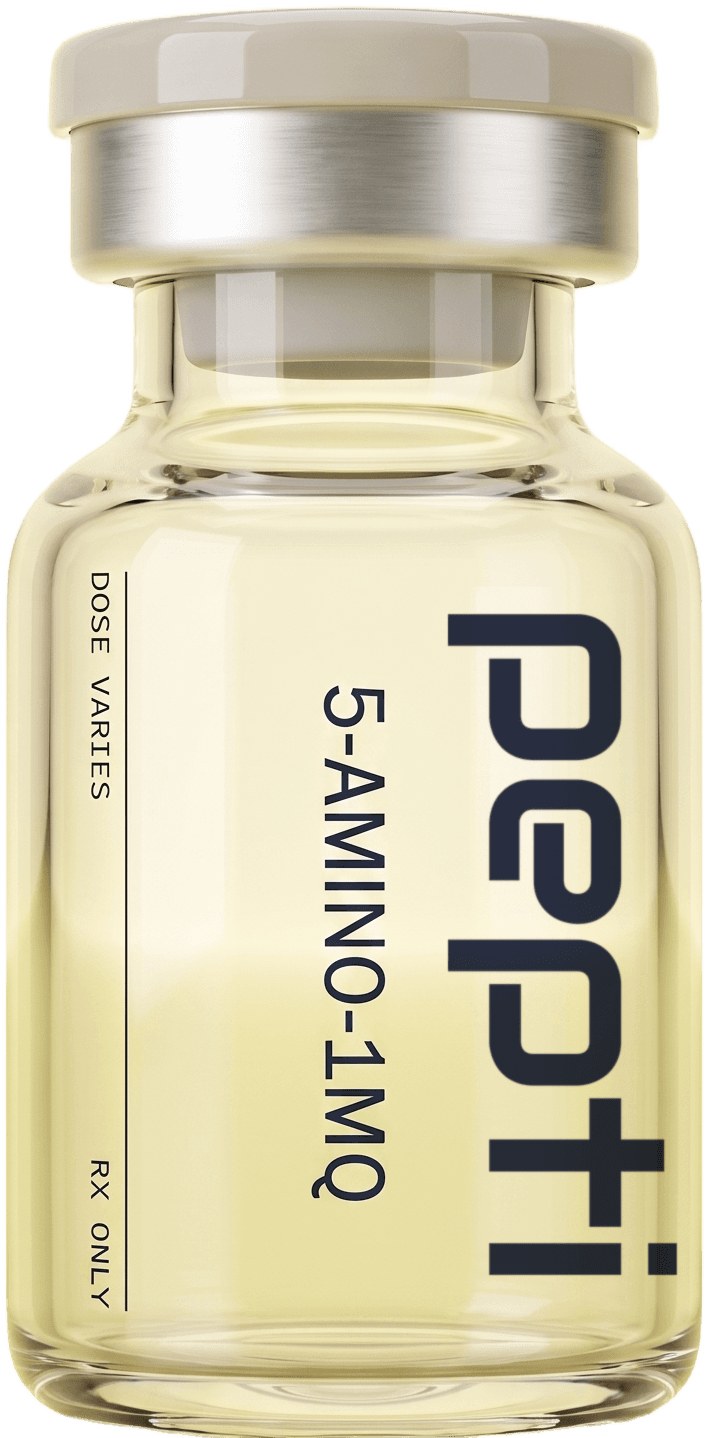
Treatments mentioned
5-Amino-1MQ is a prescription injection supplied as 5 mL multi-dose vial, 5-Amino-1MQ 1 mg/mL (5 mg 5-Amino-1MQ per vial). The reviewed directions are: Inject 0.25 mL (25 units) subcutaneously once daily Monday through Friday. That is 20 doses per vial, about 4 weeks at Monday through Friday. It requires a prescription from a physician licensed in your state, is compounded by a state-licensed US pharmacy, and is not FDA approved.
This page covers what 5-Amino-1MQ is, the enzyme it acts on and the pathways researchers have described, what the published work does and does not establish, where it currently stands with the FDA, how it is dosed, and how to get it prescribed.
5-Amino-1MQ
What 5-Amino-1MQ actually is
A small molecule, not a peptide
5-Amino-1MQ is shorthand for 5-amino-1-methylquinolinium. It is a small synthetic molecule, not a peptide: there is no chain of amino acids in it. The core is a quinolinium ring, a two-ring aromatic structure with a positively charged nitrogen, carrying a methyl group on that nitrogen and an amino group at the fifth position. It is a fraction of the size of the peptides it sits alongside in a catalog, and it belongs there because of how it is used and prescribed, not because of its chemistry.
It is not a hormone, it does not act on a hormone receptor, and it is not a growth hormone secretagogue. What it does, in the laboratory, is block one specific enzyme.
Where it came from
The compound comes out of a medicinal chemistry programme at the University of Texas Medical Branch in Galveston, led by Stanley Watowich with Harshini Neelakantan as first author on the key papers. A 2017 paper in the Journal of Medicinal Chemistry screened N-methylated quinolinium, isoquinolinium, pyridinium and benzimidazolium scaffolds against the enzyme nicotinamide N-methyltransferase (NNMT) and identified quinoliniums as the promising series. A 2018 follow-up in Biochemical Pharmacology reported that methylquinoliniums carrying a primary amine crossed cell membranes well and were selective for NNMT over related methyltransferases and over the enzymes of the NAD+ salvage pathway. The 5-amino compound is the one that was carried forward; in the group's 2024 paper in Diabetes, Obesity and Metabolism it is referred to simply as 5A1MQ.
The reason anyone went looking for an NNMT inhibitor is a 2014 paper in Nature from Barbara Kahn's laboratory at Beth Israel Deaconess and Harvard, which reported NNMT expression rising in the white fat and liver of obese and diabetic mice and reported that knocking the enzyme down protected mice against diet-induced obesity. 5-Amino-1MQ was designed as a drug-like way of doing pharmacologically what that study did genetically.
What it is not
It is not a GLP-1 medication. It does not act on the appetite and incretin pathways that semaglutide and tirzepatide act on, and the 2018 mouse work specifically reported total food intake unchanged in treated animals. It is not a stimulant or a thermogenic. It is not NAD+ and does not contain NAD+; the cell work describes it changing how cells handle a precursor of NAD+, which is a different thing. And it is not a drug with human trial evidence. That last point is the one to hold onto through everything that follows.
5-Amino-1MQ
How 5-Amino-1MQ is described to work
All of the mechanistic detail below comes from cell culture and mouse studies. None of it has been demonstrated in a human being.
What the NNMT enzyme does
Nicotinamide N-methyltransferase takes nicotinamide, the form of vitamin B3 that cells recycle into NAD+, and attaches a methyl group to it, using S-adenosylmethionine (SAM), the cell's main methyl donor. The product, 1-methylnicotinamide (1-MNA), is not used to make NAD+; it is excreted. So every time the enzyme runs it consumes one molecule of an NAD+ precursor and one molecule of SAM. In a tissue where NNMT is highly expressed, the proposed consequence is that nicotinamide is diverted away from NAD+ salvage and SAM is drawn down.
The 2014 Nature work reported the enzyme's expression rising in fat and liver in mouse models of obesity and diabetes, and a 2015 study in Diabetologia reported roughly twofold higher NNMT expression in the fat tissue of people with type 2 diabetes compared with controls. That second finding is observational: it describes the enzyme's level in human tissue, not what happens when it is blocked.
Nicotinamide, NAD+ and SAM in cultured fat cells
The 2018 Biochemical Pharmacology paper measured what NNMT inhibitors did inside cultured adipocytes: reduced intracellular 1-MNA, increased intracellular NAD+ and SAM, and suppressed lipogenesis, the building of new fat within the cell. This is the origin of the "raises NAD+" description attached to 5-Amino-1MQ. It is a cell-culture measurement, and it has not been reproduced in human tissue.
Energy expenditure and polyamine flux in adipose tissue
The Nature paper proposed a mechanism for why blocking NNMT changed body weight in mice without changing how much they ate. Knocking down the enzyme in fat and liver was reported to increase cellular energy expenditure, with adipose SAM and NAD+ rising and two enzymes of polyamine metabolism, ODC and SSAT, being upregulated through changes in histone methylation. Oxygen consumption in adipocytes rose in a way that depended on those enzymes. That study used antisense knockdown of the gene, not 5-Amino-1MQ, so it describes the target rather than this molecule.
Muscle stem cells in aged mice
A 2019 paper in Biochemical Pharmacology from the Galveston group described NNMT as overexpressed in aged skeletal muscle and linked it to impaired NAD+ salvage, dysregulated sirtuin 1 activity and senescence of muscle stem cells. In 24-month-old mice given an acute muscle injury, treatment with the inhibitor was reported to raise muscle stem cell proliferation and fusion and to support larger regenerated fibre cross-sectional area. Different tissue, different indication, same enzyme and the same proposed NAD+ logic.
5-Amino-1MQ
What the research actually shows
Diet-induced obesity in mice
This is the main body of evidence and it is entirely in mice. The 2018 Biochemical Pharmacology study treated diet-induced obese mice systemically with a potent NNMT inhibitor and reported reduced body weight, reduced white adipose mass, smaller adipocytes and lower plasma total cholesterol, with total food intake unchanged and no observable adverse effects at the doses used.
The 2024 paper in Diabetes, Obesity and Metabolism is the most directly relevant to clinical use, because it dosed 5A1MQ once daily for 28 days. In diet-induced obese mice it reported dose-dependent limiting of body weight and fat mass gain, improved oral glucose tolerance and insulin sensitivity, suppressed hyperinsulinaemia, less hepatic steatosis and macrophage infiltration on liver histology, and normalisation of ALT, AST and ketone bodies. The same paper characterised the compound's pharmacokinetics after intravenous, oral and subcutaneous dosing in mice and reported distribution to adipose, muscle and liver after subcutaneous injection, which is the route used here.
Diet change and the gut microbiome
A 2022 study in Scientific Reports combined the inhibitor with a switch from a high-fat Western diet to a low-fat diet in diet-induced obese mice, and reported that the combination normalised adiposity and weight to those of lean animals faster than the diet switch alone, with a distinct caecal microbiome pattern in treated mice. It is a small mechanistic study and it says nothing about a person who has not changed their diet.
Aged muscle and strength
A 2024 paper in Scientific Reports treated mice from 22 to 24 months of age with the inhibitor, intensive exercise, or both, and reported around 40 percent greater grip strength in treated sedentary mice than in sedentary controls, with an additive effect when combined with exercise. The mice were chosen because they recapitulate features of human sarcopenia. That is a rationale for studying it in people; it is not a study in people.
What human data exists
There are no randomised controlled trials of 5-Amino-1MQ in humans. There are no published human trials of any design, and as of September 2026 there are no trials registered under the compound's name. The entire efficacy evidence base is mice and cultured cells, and any source describing human results is describing something that does not exist.
What does exist in humans is evidence about the target rather than the drug. The 2015 Diabetologia study measured NNMT expression in fat tissue from 199 people undergoing abdominal surgery and reported it higher in type 2 diabetes, with plasma 1-MNA tracking tissue NNMT expression and both correlating with insulin resistance. Exercise and bariatric surgery were associated with lower NNMT expression. That is a reason the enzyme is considered an interesting target. It does not tell you what blocking it does in a person.
Beyond that, there is prescribing experience. Physicians have prescribed compounded 5-Amino-1MQ for several years and have formed views about it. That experience is real and is why the compound is on this site, but it is uncontrolled, and the honest framing is "described in mouse and cell research and used clinically," not "shown to work in people."
What the evidence does not establish
- It does not establish that 5-Amino-1MQ does anything in a human being. Mouse body-composition findings frequently do not translate, and this compound has not been tested for translation.
- It does not establish an effect size. No human trial has measured one.
- It does not establish a timeline in humans. The 28-day mouse study is the closest thing to a duration reference.
- It does not establish long-term safety in humans. There is no human safety database of any size.
- It does not establish an interaction profile. NNMT also methylates foreign compounds, which is a theoretical reason for care, and nothing more is known.
- It does not establish efficacy for any condition as an FDA-approved treatment. It is not approved for anything.
5-Amino-1MQ
Where 5-Amino-1MQ stands with the FDA right now
This is verified against the FDA's own documents as of September 2026, because the picture for peptides changed substantially in 2026 and 5-Amino-1MQ's position is different from most of the compounds it is sold alongside.
5-Amino-1MQ is not an FDA-approved drug, is not a component of any FDA-approved drug, and has no USP monograph. It does not appear on the FDA's 503A bulks list in 21 CFR 216.23, which as of this writing contains six substances, none of them peptides or NNMT inhibitors.
It also does not appear in any of the three interim-policy categories in the FDA's list of bulk drug substances nominated for 503A compounding, in the version the FDA updated on 14 May 2026: not Category 1 (under evaluation), not Category 2 (identified safety concerns), and not Category 3 (nominated without adequate support). The FDA has never published a safety-risk finding about it, and it is not on the FDA's Category 2 safety-risks page as updated 22 April 2026.
It was not among the substances the FDA's Pharmacy Compounding Advisory Committee reviewed on 23 and 24 July 2026; that meeting covered BPC-157, KPV, TB-500, MOTS-c, DSIP, Semax and Epitalon. The FDA's 503A page also notes that substances nominated on or after 7 January 2025 are no longer being placed into the categories at all.
So the accurate description today is: no FDA safety finding against it, no FDA determination for it, never placed in Category 2, never before the advisory committee. Unlike BPC-157 or MOTS-c, it has simply not been through the FDA's evaluation process. It remains a compounded, prescription-only medication that is not FDA approved, and compounded medications never are. Are peptides FDA approved explains the distinction.
5-Amino-1MQ
Realistic expectations
These are patterns described by prescribers, not trial endpoints. There are no human trial endpoints for this compound. Individual response varies and a physician decides whether treatment is appropriate at all.
The first two weeks
Do not expect an appetite change; the mechanism described is not an appetite mechanism, and the mouse work reported food intake unchanged. Most people notice nothing in this window, and that is not a sign that anything is wrong.
Weeks two to four
This is the span the first vial covers at Monday through Friday dosing, and it matches the 28-day duration of the most relevant mouse study. If the body-composition changes described in mice occur in a person at all, they would be gradual, and a scale is a poor instrument for detecting them. Prescribers who track this generally describe waist measurement and how clothes fit rather than a single number.
After the first vial
Refills run on a 28-day cycle, and whether to continue is your physician's decision based on what you report. Nothing in the literature describes a withdrawal effect or a rebound on stopping, but the literature is mice.
Alongside diet and exercise, not instead of them
Both the diet-switch study and the exercise study in mice paired the inhibitor with a lifestyle change and reported the combination doing more than either alone. That is the frame prescribers describe as well. Anyone presenting 5-Amino-1MQ as a substitute for diet and activity is not describing the research.
5-Amino-1MQ
When something else makes more sense
A reference that only ever recommends its own product is not much of a reference. Some honest cases where 5-Amino-1MQ is not the first thing to reach for:
- You have meaningful weight to lose and want human evidence behind the decision. Semaglutide and tirzepatide are FDA-approved actives with large randomised human trials in obesity. Compounded versions are not the approved brand products, but the active ingredient's evidence base is human, which is a categorically different position from a compound tested only in mice.
- Visceral fat is the specific concern. Tesamorelin is an FDA-approved active with human trial data on visceral fat in a specific population.
- Your interest is NAD+ itself. NAD+ injection supplies the molecule directly rather than acting on an enzyme upstream of it.
- You want the mitochondrial angle. MOTS-c is described around mitochondrial signalling, and it went before the FDA's advisory committee in July 2026 for obesity, which 5-Amino-1MQ has not.
- You want several mechanisms in one vial. The FUSION blend contains 5-Amino-1MQ alongside BPC-157, MOTS-c and tesamorelin; the SHRED blend takes a different combination. Whether a blend is appropriate is a physician's call.
Your physician will tell you if 5-Amino-1MQ is not the right tool for what you have described. A consultation does not guarantee a prescription, and being declined is refunded.
5-Amino-1MQ
Dosing, and how a vial is actually used
Why the dose is measured in units
The directions are written in millilitres and in insulin-syringe units because that is what you can actually read off the barrel. 0.25 mL is 25 units on a U-100 syringe. You are not calculating anything; the number is printed on your medication, and your physician sets it.
Subcutaneous, and where
Subcutaneous means into the fat layer, not the muscle. Abdomen and thigh are the usual sites, rotated so the same spot is not used repeatedly. The 2024 mouse pharmacokinetic work reported that subcutaneous dosing produced high systemic exposure with distribution to fat, muscle and liver, which is the reasoning behind the injectable route; human pharmacokinetics have not been published.
Why Monday through Friday, and why a vial covers about four weeks
Five doses a week for four weeks is 20 doses, which is exactly what a 5 mL vial holds at 0.25 mL per dose. That is why refills run on a 28-day cycle. The weekday-only schedule is the reviewed direction for this product; it is not derived from a human study, because there is none, and your physician may direct otherwise. One vial per fill, always, not a stockpile.
Storage
Refrigerated, and it ships that way in insulated packaging with ice packs. Beyond-use dating runs from first puncture and is printed on the label. Keep the vial upright, do not freeze it, and do not use it past the date on the label.
5-Amino-1MQ
Safety and side effects
The mouse studies did not report toxicity at the doses used: the 2018 work stated no observable adverse effects, and the 2024 work reported liver enzymes normalising in obese mice rather than rising. Those studies were not designed as toxicology studies, and there is no human safety database of any size. That is the honest baseline.
What gets reported clinically is mostly injection-site: redness, mild soreness, occasional bruising. Because the compound has never been through a controlled human trial, there is no reliable frequency for anything beyond that, and any longer list of side effects you see elsewhere is anecdote.
There is no established interaction list. One theoretical point is worth knowing: NNMT methylates foreign compounds as well as nicotinamide, so blocking it could in principle change how some drugs are handled. Nothing is known about whether that matters in practice. It is precisely why the intake asks for every medication and supplement you take, and why a physician reviews it rather than a form.
Stop and contact your physician for any reaction that is severe, spreading, or involves difficulty breathing.
5-Amino-1MQ
How 5-Amino-1MQ compares
5-Amino-1MQ vs semaglutide and tirzepatide
Different mechanisms and, more importantly, different evidence. Semaglutide and tirzepatide act on incretin receptors, reduce appetite, and have large randomised human trials behind the approved brand products. 5-Amino-1MQ acts on an intracellular enzyme, is not described as affecting appetite, and has mouse data only. They are not competing for the same job, and a physician may reasonably suggest either or, in some cases, both.
5-Amino-1MQ vs NAD+ injection
NAD+ injection is the molecule itself, given directly. 5-Amino-1MQ is described as blocking an enzyme that diverts a precursor of NAD+ away from salvage, which in cultured fat cells was reported to raise NAD+ and SAM. One is a supply approach and the other a conservation approach, in the laboratory. Whether either measurably changes NAD+ in a person, and whether that changes anything you would notice, is a separate question that neither page should overstate.
5-Amino-1MQ vs MOTS-c
MOTS-c is a mitochondrial-derived peptide described around metabolic signalling, and the two are sometimes prescribed together, which is why the FUSION blend contains both. From a regulatory standpoint they are in different places: MOTS-c was reviewed by the FDA's advisory committee in July 2026, while 5-Amino-1MQ has not been through that process.
5-Amino-1MQ
Availability and formats
| Question | Answer |
|---|---|
| Can I get it by telehealth? | Yes, where a physician licensed in your state prescribes it |
| Which states? | All 50 states and DC |
| Does it come as a pen? | No, this one is a vial and syringe only |
| Does it come as a capsule? | No |
| Does it come as a nasal spray? | No |
| Is bloodwork required first? | Not routinely; your physician decides |
5-Amino-1MQ
Where to get 5-Amino-1MQ prescribed
5-Amino-1MQ cannot be bought legitimately without a prescription. Sites shipping it with no prescription are selling a research-use-only product, where no pharmacy is accountable for identity, purity, sterility or concentration.
The prescription route works like this:
- Complete a medical intake covering your history, medications, allergies and what you are treating.
- A physician licensed in your state reviews it.
- If appropriate, a state-licensed, FDA-registered pharmacy compounds it to that prescription.
- It ships refrigerated with your directions printed on the vial.
- Your physician stays reachable afterwards for dose questions and side effects.
Current all-in pricing for 5-Amino-1MQ is published: medication, physician review, refill management and shipping in one figure, with no separate membership fee. What to check on any provider is in how to tell if a peptide seller is legitimate.
5-Amino-1MQ
Who should not take it, or should discuss it first
| Situation | Why |
|---|---|
| Pregnancy or breastfeeding | Not used; safety data is absent |
| Tested athletes | Many peptides are prohibited in competition; check the current list |
Full specification
Everything on the label.
Product
5-Amino-1MQ (Injectable)
How supplied
5 mL multi-dose vial, 5-Amino-1MQ 1 mg/mL (5 mg 5-Amino-1MQ per vial)
Typical directions
Inject 0.25 mL (25 units) subcutaneously once daily Monday through Friday.
Dose volume
0.25 mL (25 units on a U-100 insulin syringe)
Doses per vial
20
Coverage per vial
about 4 weeks at Monday through Friday
Formats
Vial and syringe
Available in
All 50 states and DC
Bloodwork
Not routinely required; your physician decides
Legal status
Prescription-only, compounded, not FDA approved
Category
Weight Loss
References
What this is based on.
References
- Neelakantan H, Vance V, Wetzel MD et al.. Selective and membrane-permeable small molecule inhibitors of nicotinamide N-methyltransferase reverse high fat diet-induced obesity in mice · Biochem Pharmacol (2018) · PMID 29155147
- Neelakantan H, Wang HY, Vance V et al.. Structure-Activity Relationship for Small Molecule Inhibitors of Nicotinamide N-Methyltransferase · J Med Chem (2017) · PMID 28548833
- Neelakantan H, Brightwell CR, Graber TG et al.. Small molecule nicotinamide N-methyltransferase inhibitor activates senescent muscle stem cells and improves regenerative capacity of aged skeletal muscle · Biochem Pharmacol (2019) · PMID 30753815
- Babula JJ, Bui D, Stevenson HL, Watowich SJ, Neelakantan H. Nicotinamide N-methyltransferase inhibition mitigates obesity-related metabolic dysfunction · Diabetes Obes Metab (2024) · PMID 39161060
- Dimet-Wiley AL, Latham CM, Brightwell CR et al.. Nicotinamide N-methyltransferase inhibition mimics and boosts exercise-mediated improvements in muscle function in aged mice · Sci Rep (2024) · PMID 38969654
- Dimet-Wiley A, Wu Q, Wiley JT et al.. Reduced calorie diet combined with NNMT inhibition establishes a distinct microbiome in DIO mice · Sci Rep (2022) · PMID 35013352
- Kraus D, Yang Q, Kong D et al.. Nicotinamide N-methyltransferase knockdown protects against diet-induced obesity · Nature (2014) · PMID 24717514
- Kannt A, Pfenninger A, Teichert L et al.. Association of nicotinamide-N-methyltransferase mRNA expression in human adipose tissue and the plasma concentration of its product, 1-methylnicotinamide, with insulin resistance · Diabetologia (2015) · PMID 25596852
Citations are provided for educational purposes. They do not constitute medical advice. Always discuss any peptide protocol with your prescribing physician.
Common questions
5-Amino-1MQ, answered.
Through a telehealth provider where a physician licensed in your state reviews a medical intake and a licensed US pharmacy compounds the prescription. Pepti prescribes 5-Amino-1MQ in all 50 states and DC; start with the free assessment.
5 mL multi-dose vial, 5-Amino-1MQ 1 mg/mL (5 mg 5-Amino-1MQ per vial)
Inject 0.25 mL (25 units) subcutaneously once daily Monday through Friday. Your physician sets your own dose and it is printed on your medication.
20 at the standard volume, about 4 weeks at Monday through Friday.
5-Amino-1MQ is supplied as a vial, drawn with an insulin syringe. It is not available as a pen or capsule.
Not routinely, though your physician may want labs depending on your history. at-home blood testing covers hormone, metabolic and thyroid markers without a lab visit.
It is legal to prescribe and dispense in the United States with a valid prescription. It is not FDA approved: compounded medications are prepared by licensed pharmacies pursuant to a prescription rather than approved as manufactured products. See are peptides FDA approved.
Pricing is published on the 5-Amino-1MQ page as one all-in figure covering medication, physician review, refill management and shipping. What drives peptide pricing generally is in how much do peptides cost.
No. It is a small synthetic molecule, 5-amino-1-methylquinolinium, built on a quinolinium ring with no amino acids in it. It is grouped with peptides because of how it is prescribed and used, not because of its chemistry. It is not a hormone and not a growth hormone secretagogue; in the laboratory it blocks one enzyme, NNMT.
No. There are no randomised controlled trials of 5-Amino-1MQ in humans and no published human trials of any design. The efficacy research is in diet-induced obese mice, aged mice and cultured fat cells, from the University of Texas Medical Branch group that developed it. The only human data concerns the target enzyme: a 2015 study reported higher NNMT expression in the fat tissue of people with type 2 diabetes. That is a rationale for studying the compound in people, not evidence that it works in them.
In cultured adipocytes, NNMT inhibitors were reported to lower 1-methylnicotinamide and raise intracellular NAD+ and SAM. That is a cell-culture measurement; whether 5-Amino-1MQ changes NAD+ in a person has not been measured. If NAD+ itself is what you are after, NAD+ injection supplies the molecule directly, and your physician can help you decide which is the right conversation.
Neither. As of September 2026 it does not appear on the 503A bulks list in 21 CFR 216.23, and it does not appear in Category 1, 2 or 3 of the FDA's nominated-substances list as updated 14 May 2026. The FDA has never published a safety-risk finding about it, and it was not among the seven peptides the Pharmacy Compounding Advisory Committee reviewed on 23 and 24 July 2026. It has not been evaluated by the FDA for compounding at all. It remains a compounded, prescription-only medication that is not FDA approved.
Not as described in the research. It is not a GLP-1 medication and does not act on appetite pathways; the 2018 mouse study reported total food intake unchanged in treated animals. The mechanism described is intracellular, around the NNMT enzyme, NAD+ and energy expenditure in fat tissue, all of it in mice and cells. If appetite is the problem you want addressed, semaglutide and tirzepatide are the medications with human trial evidence for that.
They act through entirely different mechanisms and some physicians prescribe them together. There is no human study of the combination, so there is no data on whether it adds anything. Whether it is appropriate for you is your physician's decision, made with your full medication list in front of them.
Five doses a week for four weeks is 20 doses, which is what a 5 mL vial holds at 0.25 mL per dose, so the schedule lines up with a 28-day refill cycle. The weekday schedule is the reviewed direction for this product rather than something taken from a human study, because there is no human study. Your physician may direct a different schedule, and whatever is printed on your medication is the one to follow.
Most commonly injection-site reactions: redness, mild soreness, occasional bruising. The mouse studies reported no observable adverse effects at the doses used, but they were not safety studies and there is no human safety database. There is no established interaction list, and because NNMT also methylates foreign compounds there is a theoretical reason to be careful with other medications, which is why your physician reviews every medication and supplement you take.
Next step
See what a physician recommends for you.
A licensed physician in your state reviews your intake and decides what is appropriate. A consultation does not guarantee a prescription.