Supplements · Reference
How Long Does L-Carnitine Take to Work? What the Studies Measured and When
This page sets out what was measured and over what time, why muscle carnitine changes slowly, how a Pepti vial maps onto the calendar, and what to report. The evidence benefit by benefit is in L-carnitine benefits, and the product reference is what is L-carnitine.
Treatments mentioned
No study has measured how long a low-dose L-carnitine injection takes to do anything in healthy adults, so there is no honest timeline to give for the injection itself. What the research does describe: an injection puts carnitine into the blood quickly, and blood levels fall back within a day or two as the kidneys clear the excess; raising the carnitine stored in muscle took 24 weeks of oral dosing taken with carbohydrate in a 2011 study; and the weight trials, almost all oral, ran mostly 8 to 24 weeks and found a modest effect that shrank the longer a trial ran. These describe how long studies ran and what they measured, not when any one person will notice anything.
This page sets out what was measured and over what time, why muscle carnitine changes slowly, how a Pepti vial maps onto the calendar, and what to report. The evidence benefit by benefit is in L-carnitine benefits, and the product reference is what is L-carnitine.
How Long Does L-Carnitine Take to Work? What the Studies Measured and When
The short answer
| What was measured | How long the study ran, or when it was measured | Route | Limit |
|---|---|---|---|
| Carnitine in the blood | Rises quickly after an injection, back toward baseline within a day or two | Injection | A blood level, not an effect |
| Carnitine stored in muscle | Rose 21 percent after 24 weeks; did not change without carbohydrate | Oral, with 80 g carbohydrate twice daily | 14 healthy men; not an injection |
| Muscle fuel use and work output | Measured at the end of the same 24-week study | Oral, with carbohydrate | One small study |
| Body weight | Trials ran mostly 8 to 24 weeks; effect smaller in longer trials | Oral, almost entirely | Modest; alongside diet and activity |
| Body-fat percentage and waist | Measured in the meta-analyses | Oral | No consistent change |
| Fatigue scores in centenarians | Six months | Oral, 2 g daily | A specific population |
| Fatigue and fitness in dialysis patients | 24 weeks | Intravenous after each session | Primary endpoint not met; fatigue improved on secondary analysis |
| Markers of muscle damage after exercise | Smaller trials with biochemical endpoints | Oral | Not return-to-training times |
The product this page covers:
| Product | Vial | Typical printed directions | Doses per vial | Price |
|---|---|---|---|---|
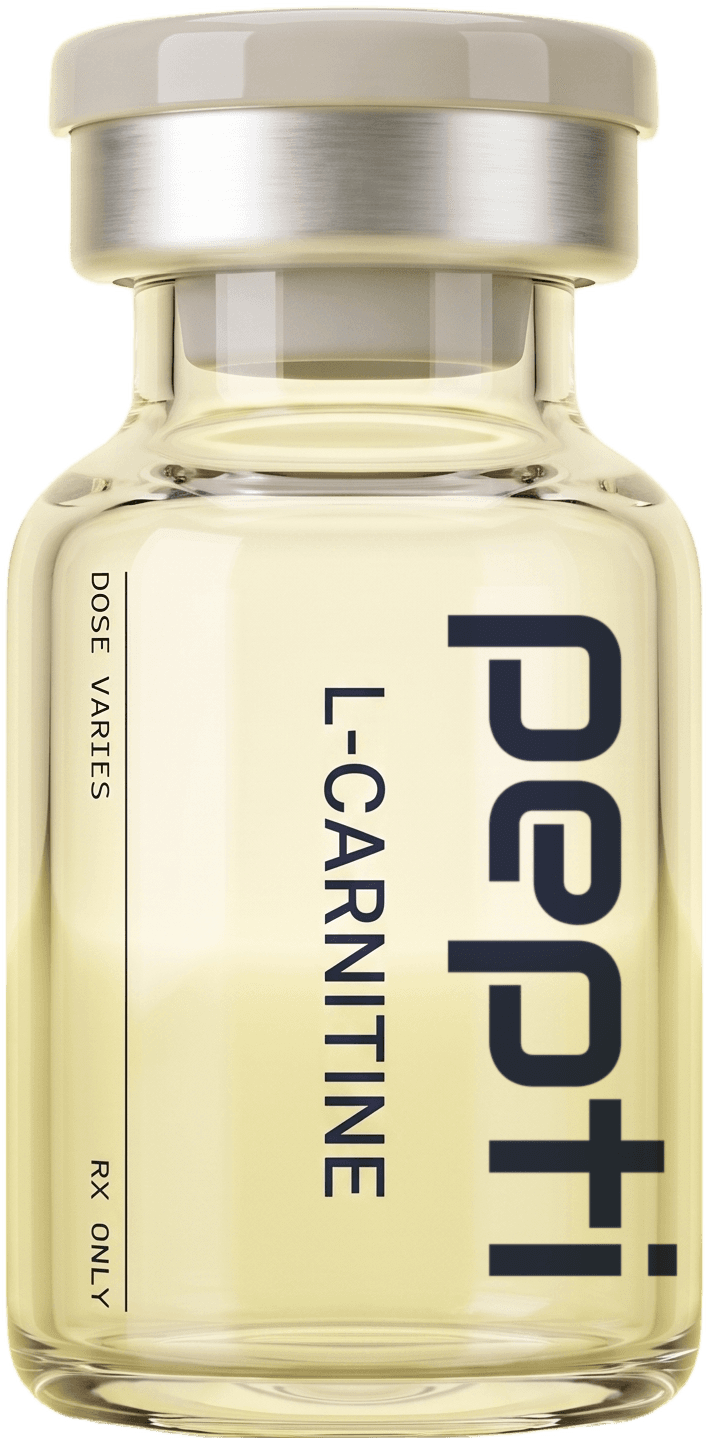
| L-Carnitine Injection | 10 mL multi-dose vial, ready to use; strength printed on the label | 0.50 mL (50 units) intramuscularly once daily Monday through Friday | 20, about four weeks | $219/mo |
The price is all-in, covering medication, physician review, refill management and shipping, with no membership fee. Pepti does not bill insurance. Compounded L-carnitine is not FDA approved.
How Long Does L-Carnitine Take to Work? What the Studies Measured and When
Why "how long" is the wrong first question
L-carnitine is not a stimulant, a hormone or an appetite drug, so there is no moment when it "kicks in." Its job is to carry long-chain fatty acids into mitochondria so they can be used for energy. Having more of it available does not make the body oxidise more fat than the demand for energy calls for; the pathway still has to be driven by activity. So the useful questions are what was measured, in whom, by which route and for how long. The answer to each is below.
The second reason is the route. The trials that produced measurable results were almost entirely oral, mostly 1 to 3 g a day. There are no randomised trials of low-dose intramuscular L-carnitine in healthy adults, so what the injection does in that group, and over what time, is extrapolated rather than measured.
How Long Does L-Carnitine Take to Work? What the Studies Measured and When
What happens in the blood
An intramuscular injection puts carnitine into circulation quickly, bypassing the gut, where large oral doses are absorbed at only about 14 to 18 percent. Plasma levels then fall back within a day or two. The reason is the kidneys: at normal concentrations they reabsorb 90 to 99 percent of the carnitine they filter, as a 2004 review in the Annals of the New York Academy of Sciences describes, but that reabsorption saturates when levels are high, and the excess is cleared in urine.
That is why the injection is given on a regular weekday schedule rather than once in a while. It is also why a blood level is not an effect: carnitine passing through the circulation is not the same as carnitine stored in muscle, which is where most of the body's supply sits.
How Long Does L-Carnitine Take to Work? What the Studies Measured and When
What happens in muscle: the 24-week study
The clearest human timeline comes from a 2011 paper in the Journal of Physiology. Fourteen healthy men took either 2 g of L-carnitine tartrate with 80 g of carbohydrate, or the carbohydrate alone, twice a day for 24 weeks, with muscle biopsies.
| Measured at 24 weeks | What the carnitine plus carbohydrate group showed |
|---|---|
| Muscle total carnitine | Rose 21 percent; did not change in the carbohydrate-only group |
| Muscle glycogen use at low intensity | 55 percent less |
| Muscle lactate at high intensity | 44 percent lower |
| Work output in a 30-minute performance trial | Rose 11 percent from baseline |
Two details are essential. The carbohydrate was there to raise insulin, which is what drives carnitine into muscle; without it, oral carnitine does not change muscle content. And it took 24 weeks. Muscle carnitine loading is slow. The study was oral, in men, with a large carbohydrate load, and nobody has repeated it with an injection at Pepti's dose. The background is in a 2007 review from the same group in the Journal of Physiology, which describes why free carnitine falls in muscle during intense exercise.
How Long Does L-Carnitine Take to Work? What the Studies Measured and When
What the weight trials measured, and for how long
Three meta-analyses of randomised trials have been published: Obesity Reviews in 2016 (nine trials, 911 participants), Pharmacological Research in 2020 (43 trials) and Clinical Nutrition ESPEN in 2020 (37 trials). The individual trials ran mostly 8 to 24 weeks, at 1 to 3 g a day by mouth.
What they found, briefly: a modest average difference in body weight compared with control, confined to overweight and obese adults in trials that also added diet and activity change. Two of the three looked at body-fat percentage and waist circumference and found no consistent change. The Obesity Reviews analysis reported that the effect shrank the longer a trial ran. That matters for anyone asking "how long": longer use was not associated with a growing effect in these trials. None of them used an injection.
How Long Does L-Carnitine Take to Work? What the Studies Measured and When
Energy and fatigue: six-month trials
| Trial | Who | How long | What it found |
|---|---|---|---|
| American Journal of Clinical Nutrition, 2007 | Centenarians | Six months, 2 g oral daily | Lower physical and mental fatigue scores than placebo |
| CHIEF trials, American Journal of Kidney Diseases, 2001 | Dialysis patients | 24 weeks, intravenous after each session | Primary endpoint, peak oxygen uptake, not met; patient-rated fatigue improved on the secondary analysis |
Both are specific populations, and dialysis strips carnitine from the blood, so those patients start low. Neither tells a healthy adult on a weekday intramuscular vial what to expect. More on the fatigue picture is in peptides for energy and fatigue.
How Long Does L-Carnitine Take to Work? What the Studies Measured and When
What the evidence does not establish
- A timeline for the low-dose intramuscular injection in healthy adults. That study has not been run.
- That injecting carnitine loads muscle faster, or at all, compared with the oral route plus carbohydrate.
- That a longer course produces a larger effect. In the weight trials, the effect shrank the longer a trial ran.
- An effect in people whose carnitine status is already normal.
- Any approved use for weight, exercise or fatigue. The approved drug is approved for carnitine deficiency only.
How Long Does L-Carnitine Take to Work? What the Studies Measured and When
How a Pepti vial maps onto the calendar
| Draw | 0.50 mL (50 units on a U-100 insulin syringe) |
| Where | Into the muscle: deltoid, upper outer thigh or upper outer buttock, rotated |
| How often | Once daily, Monday through Friday |
| Doses per vial | 20 |
| One vial lasts | About four weeks |
| Refills | Every 28 days, one vial per fill |
The doses figure is math from the vial: 10 mL at 0.50 mL per dose is 20 doses, five a week for four weeks. The weekend gap is a practical schedule rather than a pharmacological one; carnitine clears quickly and there is no accumulation to manage. Your physician sets your directions after reviewing your intake, and they are printed on the vial. How vials are counted generally is in how long does a peptide vial last.
Set against the studies, one vial covers about four weeks, while the muscle-loading study ran 24 weeks and the weight trials mostly 8 to 24 weeks. That comparison describes study lengths, not a forecast. Some people notice nothing on L-carnitine at any point, which is consistent with what the evidence shows in people who are not deficient.
After stopping
There is no withdrawal and no rebound. Circulating carnitine returns to the body's own set point within days, because synthesis and kidney reabsorption were never switched off.
How Long Does L-Carnitine Take to Work? What the Studies Measured and When
When to message your care team
| What you notice | What to do |
|---|---|
| Soreness or bruising at the injection site | Common with intramuscular injection; rotate sites and mention it if it persists |
| Transient nausea, vomiting or stomach upset | Reported on the label and in trials; message your care team |
| A faint fishy body odour | Dose-related, from trimethylamine; harmless, but worth mentioning |
| A seizure, or more frequent seizures | The label reports seizures; contact your physician the same day, and call 911 for a seizure that does not stop |
| On warfarin, any unusual bruising or bleeding | The label reports INR increases; contact your physician |
| Facial or throat swelling, a spreading rash, or difficulty breathing | Call 911, then tell your physician |
Never change your own dose to try to speed things up. If you have questions about whether L-carnitine is doing what you hoped, raise it with your care team. Bloodwork is not required for any Pepti treatment. If your physician wants labs for your care, they'll ask through your account.
How Long Does L-Carnitine Take to Work? What the Studies Measured and When
Where to get L-carnitine injections prescribed
L-carnitine injection cannot be bought legitimately without a prescription. Sites shipping injectable carnitine with no prescription are not accountable for identity, purity, sterility or concentration.
- Complete a free online intake covering your history, medications and what you want help with.
- A physician licensed in your state reviews it, usually within 24 hours.
- If it is appropriate, a PCAB-accredited, FDA-registered US 503A pharmacy compounds it to that prescription. Lot test results are at /quality/lab-results.
- It ships refrigerated with ice packs, sterile syringes and alcohol prep pads, with directions printed on the vial.
- Your physician stays reachable for questions and side effects.
Pepti is cash-pay, and L-carnitine is available in every state except Oklahoma, plus DC. Step by step: how to get L-carnitine prescribed online.
Common questions
How Long Does L-Carnitine Take to Work? What the Studies Measured and When, answered.
No study has timed the low-dose intramuscular injection in healthy adults. The studies that measured something ran for months: 24 weeks to raise muscle carnitine with oral dosing plus carbohydrate, and mostly 8 to 24 weeks in the oral weight trials.
Quickly. An intramuscular injection bypasses the gut, and blood levels then fall back within a day or two as the kidneys clear the excess.
In the 2011 Journal of Physiology study, muscle carnitine rose 21 percent after 24 weeks of oral L-carnitine taken with carbohydrate, and did not change without the carbohydrate. The injection has not been studied this way.
The oral weight trials ran mostly 8 to 24 weeks and found a modest effect alongside diet and activity, smaller in longer trials, with no consistent change in body-fat percentage or waist. Nothing has tested an injection for weight.
There is no evidence for an immediate effect. L-carnitine is not a stimulant. The fatigue trials ran six months, in centenarians and in dialysis patients.
There is no established course length for the injection. Refills run every 28 days, and your physician reviews your treatment with you; your directions are printed on the vial.
An injection delivers the full dose, where large oral doses absorb at about 14 to 18 percent. Nobody has shown it produces any effect faster, because the injection trial in healthy adults has not been run.
There is no withdrawal and no rebound. Blood carnitine returns to the body's own set point within days.
No. Never change your own dose. Your directions are printed on the vial, and questions go to your care team.
Bloodwork is not required for any Pepti treatment. If your physician wants labs for your care, they'll ask through your account. The free assessment goes to a physician licensed in your state. A consultation does not guarantee a prescription.
Next step
See what a physician recommends for you.
A licensed physician in your state reviews your intake and decides what is appropriate. A consultation does not guarantee a prescription.