Anti-Aging · Reference
GHK-Cu vs KLOW: One Peptide or Four, and Which One Fits
This page explains what each contains, what the extra three peptides add and do not add, how both compare with GLOW, what the research does and does not show, where each component stands with the FDA, how each is dosed, what each costs at Pepti, and who tends to suit which.
Treatments mentioned
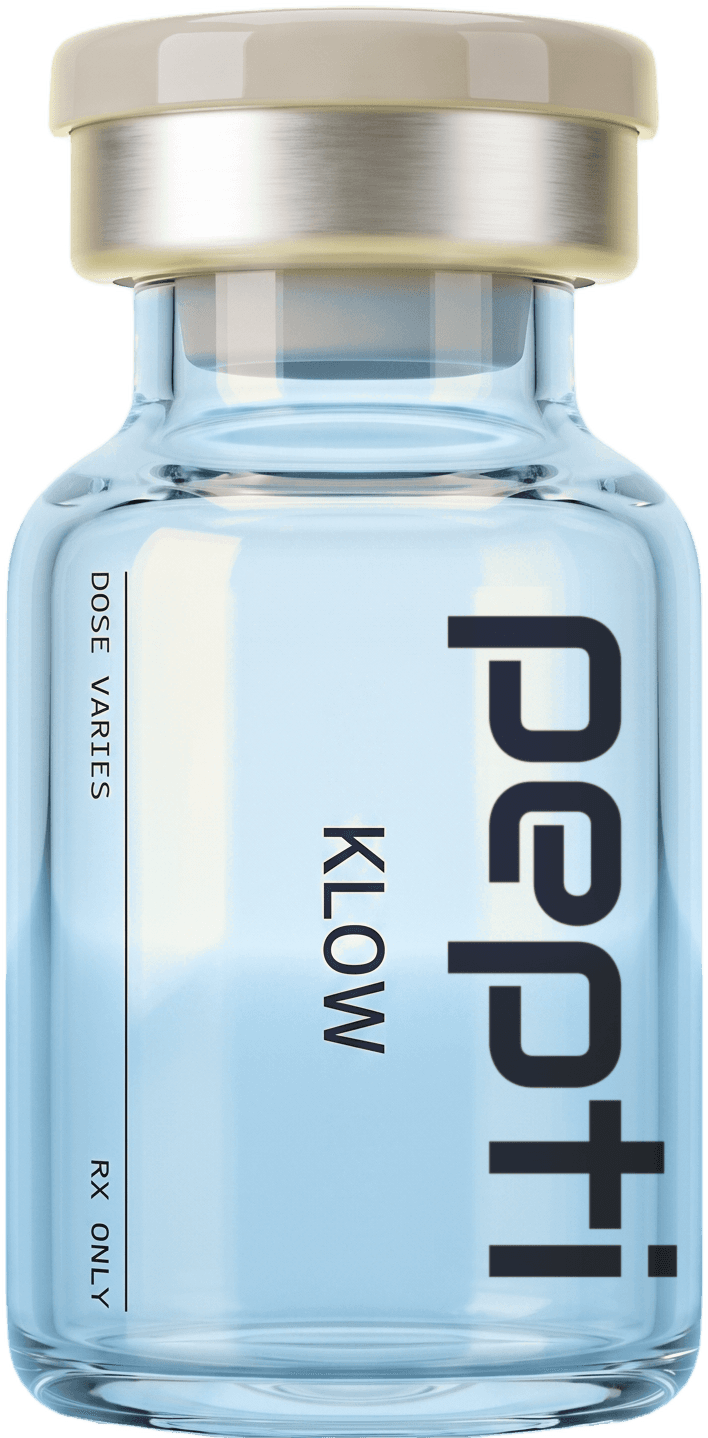
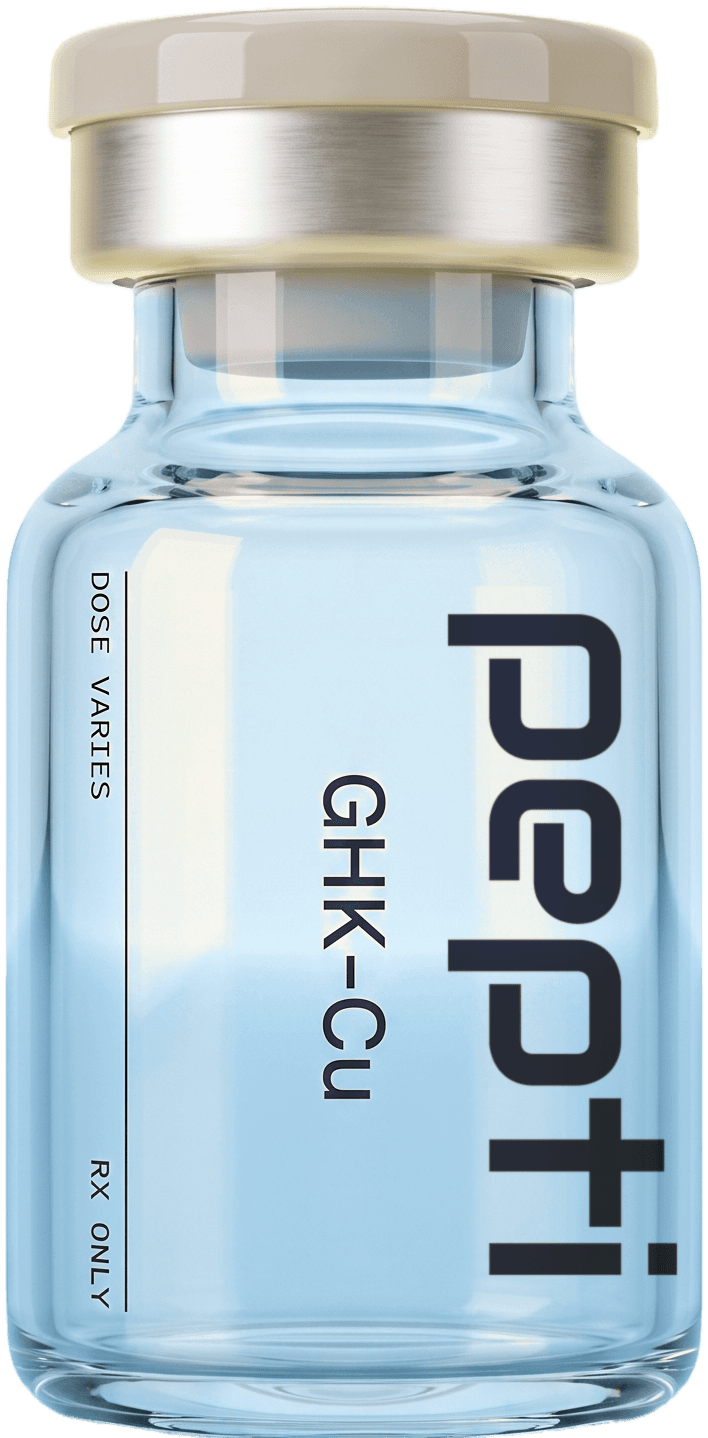
GHK-Cu and KLOW deliver the same amount of GHK-Cu; KLOW adds three more peptides on top. A GHK-Cu vial holds 50 mg of GHK-Cu in 5 mL. A KLOW vial holds the same 50 mg of GHK-Cu plus 10 mg each of KPV, BPC-157 and TB-500, so every 0.25 mL dose of either carries 2.5 mg of GHK-Cu. GHK-Cu alone suits a skin, hair or connective-tissue goal with nothing else in the picture; KLOW suits that goal when a soft-tissue problem and persistent inflammation are part of it too. Both are prescription-only, compounded by a licensed US pharmacy, and neither is FDA approved.
This page explains what each contains, what the extra three peptides add and do not add, how both compare with GLOW, what the research does and does not show, where each component stands with the FDA, how each is dosed, what each costs at Pepti, and who tends to suit which.
GHK-Cu vs KLOW
The short answer
| If your main goal is | The usual prescription | What is in it | Price |
|---|---|---|---|
| Skin, hair or connective-tissue quality only | GHK-Cu | 50 mg GHK-Cu in 5 mL | $239/mo |
| Skin plus a soft-tissue problem plus inflammation | KLOW | 50 mg GHK-Cu, 10 mg KPV, 10 mg BPC-157, 10 mg TB-500 in 5 mL | $259/mo |
| Skin plus a soft-tissue problem, no inflammation focus | GLOW | 50 mg GHK-Cu, 10 mg BPC-157, 10 mg TB-500 in 5 mL | $259/mo |
| Skin alongside a growth-hormone axis peptide | RADIANCE Blend | 50 mg GHK-Cu, 10 mg tesamorelin in 5 mL | $249/mo |
| A tendon or ligament injury, nothing else | BPC-157 + TB-500 | 5 mg BPC-157, 5 mg TB-500 in 5 mL | $259/mo |
Every figure is an all-in monthly price covering the medication, physician review, refill management and shipping. There is no separate membership fee, and Pepti is cash-pay and does not bill insurance. KLOW costs $20 a month more than GHK-Cu alone. Current pricing always lives on each product page.
GHK-Cu vs KLOW
GHK-Cu on its own terms
What it is
GHK is a tripeptide, glycine, histidine and lysine, and GHK-Cu is that tripeptide bound to a copper ion. It was first described in 1973 as a component of human plasma, and the reviews describe its plasma level falling with age. Most of the research is built around the copper complex: copper is a cofactor for the enzymes that cross-link collagen and elastin, and GHK is proposed to carry it in a form that is not free and reactive. That copper is why the solution is blue. The full reference is at what is GHK-Cu.
How it is described to work
- Collagen and matrix. A 1988 FEBS Letters paper reported GHK-Cu stimulating collagen synthesis in cultured human fibroblasts; later cell work extended this to elastin and glycosaminoglycans.
- Remodelling. 1999 and 2000 papers describe it modulating matrix metalloproteinases, the enzymes that clear damaged matrix.
- Angiogenesis. A 1994 paper reported copper-binding GHK fragments stimulating new blood-vessel growth.
- Gene expression. A 2012 Genome Medicine paper reported a broad gene-expression signature in a computational screen and in lung cells.
What human data exists
The human evidence is topical: cosmetic studies of GHK-Cu creams on photoaged facial skin over 8 to 12 weeks, mostly in conference proceedings and industry reports, and a 1994 topical gel study in diabetic ulcers. There are no randomized controlled trials of injectable GHK-Cu in humans. The injectable rests on mouse work and prescriber experience.
GHK-Cu vs KLOW
KLOW on its own terms
What it is
KLOW is four independently studied peptides in one sterile multi-dose vial: GHK-Cu, KPV, BPC-157 and TB-500, 80 mg in total. The name is a brand name for the combination; the combination itself has never been studied, in people or animals. GHK-Cu is 50 of the 80 mg, so by mass KLOW is mostly a GHK-Cu preparation with three smaller components. The full reference is at what is KLOW.
What the other three add
Component Per vial What it is Described in research around KPV 10 mg Last three amino acids of alpha-MSH Anti-inflammatory signalling without the pigmentation effect; NF-kB and cytokines in cell and mouse work BPC-157 10 mg 15-amino-acid fragment of a protein from human gastric juice Angiogenesis, cell migration, gut-lining protection TB-500 10 mg Synthetic fragment of thymosin beta-4 Actin binding and cell movement into damaged tissue The rationale prescribers give is that tissue repair runs in phases, and each component is described as acting on a different one: KPV on inflammation that has not resolved, BPC-157 on blood supply and migration, TB-500 on cell motility, GHK-Cu on collagen and matrix.
What they do not add
None of the three adds anything to the skin and collagen side. KPV has no human trials of any kind. BPC-157 has one small human study for a gut indication, reported as a conference abstract. TB-500 has no human trials of the fragment; the human work is on the full-length thymosin beta-4 protein. Adding them does not change the 2.5 mg of GHK-Cu per dose.
GHK-Cu vs KLOW
Head to head
| GHK-Cu | KLOW | |
|---|---|---|
| Components | GHK-Cu | GHK-Cu, KPV, BPC-157, TB-500 |
| Total per 5 mL vial | 50 mg | 80 mg |
| GHK-Cu per vial | 50 mg | 50 mg |
| Per 0.25 mL dose (math) | 2.5 mg GHK-Cu | 2.5 mg GHK-Cu, 0.5 mg KPV, 0.5 mg BPC-157, 0.5 mg TB-500 |
| Skin and matrix component | Yes | Yes, the same amount |
| Repair components | No | BPC-157 and TB-500 |
| Anti-inflammatory component | No | KPV |
| Typical directions | 0.25 mL (25 units) once daily, Monday to Friday | 0.25 mL (25 units) Monday to Friday mornings |
| Doses per vial | 20, about 4 weeks | 20, about 4 weeks |
| Formats at Pepti | Vial | Vial, or a pre-filled Pen |
| Prohibited in tested sport | Check your sport's list | Yes; BPC-157 and TB-500 are named on the WADA list |
| Price at Pepti | $239 a month | $259 a month |
What the numbers show
The GHK-Cu dose is identical. Moving from GHK-Cu to KLOW does not give more of the skin component; it adds three other peptides at 0.5 mg each per dose. So the question is not "which is stronger for skin" but "do I need the extra three." For a skin, hair or connective-tissue goal alone, the answer on paper is no, and a single agent has a further advantage: if something changes, or a side effect appears, it is clear what caused it. A blend never offers that.
Where GLOW fits
GLOW sits between the two: GHK-Cu, BPC-157 and TB-500 at the same amounts as KLOW, without KPV, at the same $259 a month. The full comparison of the two blends is at KLOW vs GLOW.
GHK-Cu vs KLOW
Who suits which
GHK-Cu alone
GHK-Cu alone suits the person whose goal is skin texture, hair or connective-tissue quality, with no injury and no inflammatory complaint in the picture. It also suits a physician who prefers to add one compound at a time. It has the fewest unknowns of the GHK-Cu options and the clearest attribution.
KLOW
KLOW suits the same skin goal when two other things are also true: there is a soft-tissue problem, such as a slow tendon, a scar or recovery that has lost pace, and inflammation is a distinct part of it, such as an area that stays inflamed or a background ache that will not settle. It means one injection instead of several, at the cost of not knowing which component did what.
Can you take GHK-Cu and KLOW together?
There is no reason to. KLOW already contains the same amount of GHK-Cu. Taking both would double the GHK-Cu and the copper it carries, and no study informs that.
GHK-Cu vs KLOW
When neither is the right first step
| Situation | What makes more sense |
|---|---|
| A single tendon or ligament problem, nothing else | BPC-157 + TB-500 |
| A gut complaint | BPC-157 alone, the component with the gastrointestinal literature |
| Inflammation without a specific injury | KPV alone, $229 a month |
| You are already using a GHK-Cu cream | Whether an injection adds anything on top is untested; see GHK-Cu topical vs injection |
| A complete rupture, displaced fracture or locking joint | A surgical or imaging question; no peptide changes that |
GHK-Cu vs KLOW
What the evidence shows, honestly
There are no randomized controlled trials of injectable GHK-Cu or of KLOW in humans. KLOW has never been studied as a combination, and no study has compared it with GHK-Cu alone. The evidence is per component:
| Component | Human evidence | Main preclinical work |
|---|---|---|
| GHK-Cu | Small topical studies on facial skin; a 1994 topical gel study in diabetic ulcers. None for the injectable | Collagen synthesis in fibroblasts (FEBS Letters 1988); mouse lung injury and fibrosis models |
| KPV | None of any kind | Mouse colitis (Gastroenterology 2008) |
| BPC-157 | One two-week enema study in 53 people with ulcerative colitis, reported only as a 2005 conference abstract | Rat tendon work; tendon cell migration (Journal of Applied Physiology, 2011) |
| TB-500 | None for the fragment; early-phase trials of full-length thymosin beta-4 | Wound closure with thymosin beta-4 (1999) |
The human skin data for GHK-Cu is topical, and no study has shown that injected GHK-Cu does what the creams are reported to do. The accurate framing for both products is "described in preclinical research and used clinically," not "shown to work in people." More on what GHK-Cu research has looked at is in GHK-Cu benefits and, for the blend, KLOW benefits.
GHK-Cu vs KLOW
Where each stands with the FDA
Neither product has a regulatory status of its own; the FDA regulates the bulk substances a pharmacy compounds from. As of the FDA pages checked in September 2026:
| GHK-Cu (injectable) | KPV | BPC-157 | TB-500 | |
|---|---|---|---|---|
| 2023 | Category 2 | Category 2 | Category 2 | Category 2 |
| 15 April 2026 | Removed from Category 2 | Removed | Removed | Removed |
| Advisory committee | Scheduled for a meeting before the end of February 2027 | 23 July 2026: voted 8 to 6, one abstention, to recommend the 503A Bulks List | Same vote | Same vote |
| Final FDA determination | Not yet reviewed | Pending | Pending | Pending |
So a GHK-Cu vial depends on one component's status, and KLOW on four. In each July vote the FDA's own reviewers had recommended against inclusion and the committee voted the other way; a committee vote is a recommendation, not a decision. All four remain legal to prescribe and dispense as compounded medications. Compounded medications are not FDA approved. See are peptides FDA approved.
GHK-Cu vs KLOW
Dosing, side by side
Both are drawn to 0.25 mL, which is 25 units on a U-100 insulin syringe, under the skin into the abdomen or thigh, rotating sites. GHK-Cu is once daily Monday through Friday; KLOW is Monday through Friday mornings.
| What you read | GHK-Cu | KLOW |
|---|---|---|
| Dose volume | 0.25 mL (25 units) | 0.25 mL (25 units) |
| GHK-Cu per dose (math only) | 2.5 mg | 2.5 mg |
| Other peptides per dose (math only) | None | 0.5 mg each of KPV, BPC-157 and TB-500 |
| Doses per vial | 20 | 20 |
| Time per vial | About 4 weeks | About 4 weeks |
KLOW's proportions are fixed by the pharmacy's formulation, so every dose delivers the same split; you cannot take more of one component and less of another. You do not need to calculate anything: your directions are printed on the vial, and your physician sets them after reviewing your intake. Refills run every 28 days, one vial per fill. Both ship refrigerated with ice packs, ready to use, with sterile syringes and alcohol prep pads. KLOW is also available as a pre-filled Pen cartridge with the same four peptides at the same totals. The detail is in GHK-Cu dosage and KLOW dosage.
GHK-Cu vs KLOW
Side effects
Both are mostly reported at the injection site: redness, mild soreness, occasional bruising, and sometimes a faint, transient blue tint from the copper complex. Some people report an early headache, nausea or light-headedness. KPV does not carry alpha-MSH's pigmentation effect, so darkening of skin or moles is not expected with KLOW. There is no established interaction list for either, which is why the intake asks for every medication and supplement you take.
A severe or spreading reaction, swelling of the face or throat, or difficulty breathing needs emergency care first (call 911), then tell your physician.
GHK-Cu vs KLOW
Who should not take either, or should discuss it first
| Situation | Why |
|---|---|
| Wilson's disease or another copper-metabolism disorder | Both contain GHK-Cu, which delivers copper |
| High-dose zinc supplementation | Zinc competes with copper |
| Personal history of cancer | GHK-Cu, and in KLOW also BPC-157 and TB-500, are described as supporting new blood-vessel growth |
| Anticoagulant therapy | Discuss first for KLOW, given the vascular mechanisms |
| Pregnancy or breastfeeding | Not used; safety data is absent |
| Tested athletes | KLOW contains BPC-157 and TB-500, which are named on the WADA Prohibited List |
GHK-Cu vs KLOW
Where to get GHK-Cu or KLOW prescribed
Neither can be bought legitimately without a prescription. Sites selling them "for research use only" are not accountable for what is in the vial: identity, purity, sterility and concentration are untested. The prescription route:
- Complete a free online intake covering your history, medications and what you want help with.
- A physician licensed in your state reviews it, usually within 24 hours.
- If it is appropriate, a PCAB-accredited, FDA-registered US 503A compounding pharmacy prepares it to that prescription. Lot test results are published at /quality/lab-results.
- It ships refrigerated with your directions printed on the vial.
- Your physician stays reachable for questions and dose changes.
Pepti prescribes both in every state except Oklahoma, plus DC Step-by-step pages: how to get GHK-Cu prescribed online and how to get KLOW prescribed online.
References
What this is based on.
References
- Maquart FX, Pickart L, Laurent M, et al.. Stimulation of collagen synthesis in cultured fibroblasts by GHK-Cu · FEBS Letters (1988) · PMID 3169264
- Pickart L, Margolina A. GHK peptide as a natural modulator of multiple cellular pathways in skin regeneration · BioMed Research International (2015) · PMID 26236730
- Pickart L, Margolina A. Regenerative and protective actions of the GHK-Cu peptide in the light of the new gene data · International Journal of Molecular Sciences (2018) · PMID 29986520
- Pickart L. The human tri-peptide GHK and tissue remodeling · Journal of Biomaterials Science, Polymer Edition (2008) · PMID 18644225
- Pickart L, Thaler MM. Tripeptide in human serum which prolongs survival of normal liver cells and stimulates growth in neoplastic liver · Nature: New Biology (1973) · PMID 4349963
- Lane TF, et al.. SPARC is a source of copper-binding peptides that stimulate angiogenesis · Journal of Cell Biology (1994) · PMID 7514608
- Maquart FX, et al.. In vivo stimulation of connective tissue accumulation by the tripeptide-copper complex glycyl-L-histidyl-L-lysine-Cu2+ in rat experimental wounds · Journal of Clinical Investigation (1993) · PMID 8227353
- Mulder GD, et al.. Enhanced healing of ulcers in patients with diabetes by topical treatment with glycyl-l-histidyl-l-lysine copper · Wound Repair and Regeneration (1994) · PMID 17147644
- Siméon A, et al.. Expression and activation of matrix metalloproteinases in wounds: modulation by the tripeptide-copper complex glycyl-L-histidyl-L-lysine-Cu2+ · Journal of Investigative Dermatology (1999) · PMID 10383745
- Siméon A, et al.. The tripeptide-copper complex glycyl-L-histidyl-L-lysine-Cu2+ stimulates matrix metalloproteinase-2 expression by fibroblast cultures · Life Sciences (2000) · PMID 11045606
- Miller TR, et al.. Effects of topical copper tripeptide complex on CO2 laser-resurfaced skin · Archives of Facial Plastic Surgery (2006) · PMID 16847171
- Pyo HK, et al.. The effect of tripeptide-copper complex on human hair growth in vitro · Archives of Pharmacal Research (2007) · PMID 17703734
Citations are provided for educational purposes. They do not constitute medical advice. Always discuss any peptide protocol with your prescribing physician.
Common questions
GHK-Cu vs KLOW, answered.
KLOW is GHK-Cu plus three more peptides. Both vials hold 50 mg of GHK-Cu; KLOW adds 10 mg each of KPV, BPC-157 and TB-500. Every 0.25 mL dose of either delivers 2.5 mg of GHK-Cu.
Not for the GHK-Cu part, which is identical per dose. KLOW is broader, not stronger: it adds anti-inflammatory and repair components aimed at different goals.
On paper they are equivalent for skin, because the skin and collagen component is the same amount in both. GHK-Cu alone is the narrower choice when skin is the whole goal.
No. Both contain 50 mg per 5 mL vial, 10 mg/mL, and deliver 2.5 mg per 0.25 mL dose.
There is no reason to. KLOW already contains the same GHK-Cu, so taking both would double it and the copper it carries.
Yes, a change of prescription is a conversation with your physician through your account. The GHK-Cu amount per dose stays the same; the change adds KPV, BPC-157 and TB-500.
GLOW, by one component. It has GHK-Cu, BPC-157 and TB-500 without KPV. KLOW adds KPV on top of GLOW.
It is not expected to. KPV is the fragment of alpha-MSH that keeps the anti-inflammatory signalling and drops the pigmentation effect.
There is no trial-established timeline for either as an injection. The topical GHK-Cu cosmetic studies ran 8 to 12 weeks, but that was a different route, and it does not tell you when or whether you would notice anything.
At Pepti, GHK-Cu is $239 a month and KLOW is $259 a month, all-in, including the medication, physician review, refill management and shipping.
Bloodwork is not required for any Pepti treatment. If your physician wants labs for your care, they'll ask through your account. The free assessment goes to a physician licensed in your state. A consultation does not guarantee a prescription.
Next step
See what a physician recommends for you.
A licensed physician in your state reviews your intake and decides what is appropriate. A consultation does not guarantee a prescription.