— Anti-Aging · Reference
Tesamorelin: Full Specification, Mechanism, Dosing and Evidence
This page covers what tesamorelin is, the pathway it works through, what the human trials do and do not establish, where it stands with the FDA as of September 2026, how a vial is dosed and monitored, and how to get it prescribed.
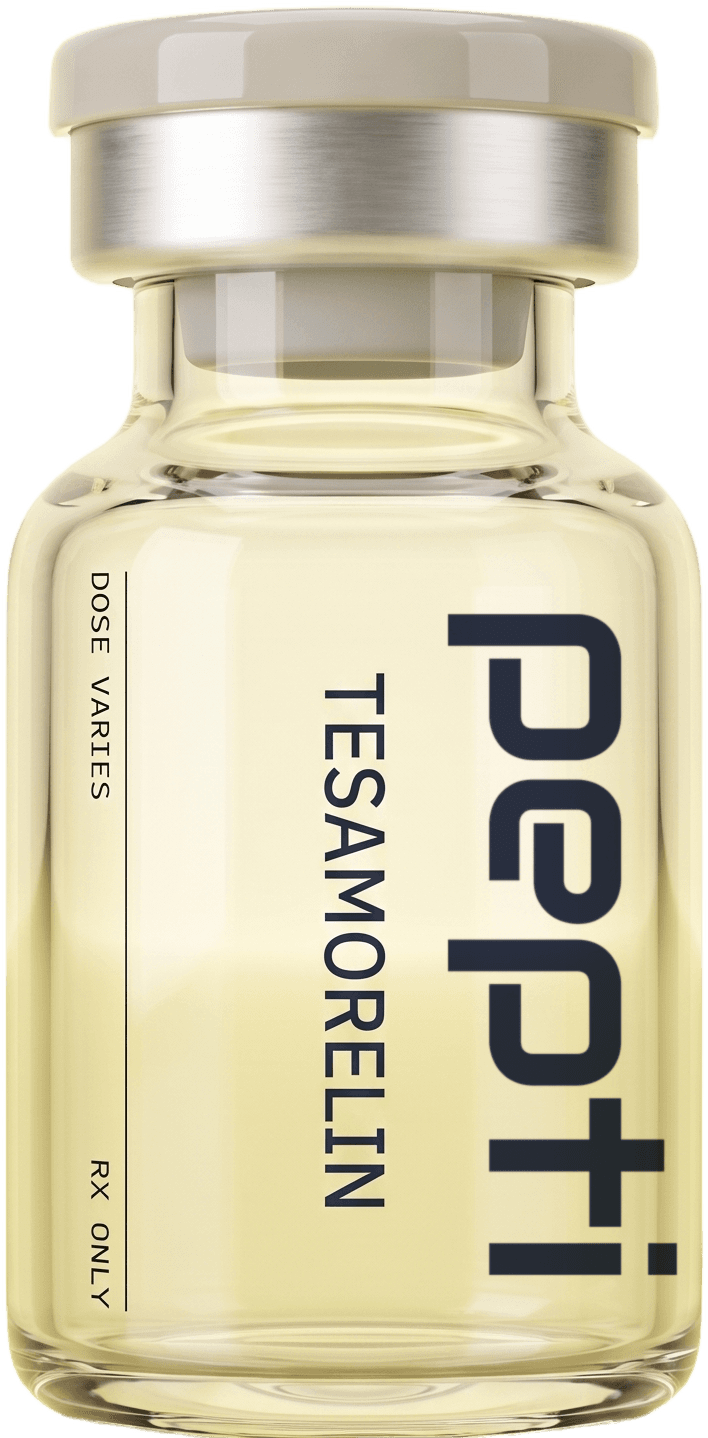
Tesamorelin is a compounded prescription injection containing 10 mg in a 5 mL multi-dose vial, at 2 mg/mL. It is a growth-hormone-releasing hormone analogue that prompts your pituitary to release your own growth hormone, dosed at 0.25 mL — 25 units on a U-100 insulin syringe — subcutaneously on weekday nights at bedtime, giving 20 doses per vial. An FDA-approved tesamorelin product exists for one specific indication; compounded tesamorelin for other uses is not FDA approved.
This page covers what tesamorelin is, the pathway it works through, what the human trials do and do not establish, where it stands with the FDA as of September 2026, how a vial is dosed and monitored, and how to get it prescribed.
— Tesamorelin
What tesamorelin actually is
— The full GHRH sequence with a stabilising cap
Growth-hormone-releasing hormone is the 44-amino-acid signal the hypothalamus sends to the pituitary to trigger a growth hormone pulse. Tesamorelin is that entire sequence with a trans-3-hexenoic acid group attached to one end. Native GHRH is cut apart in the bloodstream within minutes by the enzyme DPP-4; the cap protects the cleavage site so the peptide survives long enough after a subcutaneous injection to reach the pituitary.
That makes it a secretagogue — a compound that causes something else to be secreted. It contains no growth hormone. It delivers the instruction, and the pituitary decides how much to release.
— Where the name and the approved product come from
Tesamorelin was developed by Theratechnologies under the code TH9507 and is the active ingredient in Egrifta, which the FDA approved in November 2010 for one narrow indication: reduction of excess abdominal fat in adults with HIV who have lipodystrophy, a fat-redistribution syndrome associated with antiretroviral therapy. Later formulations, Egrifta SV and Egrifta WR, were approved for the same indication. That history is why tesamorelin has something most compounded peptides do not — randomised, placebo-controlled human trials with published results.
The compounded tesamorelin on this page shares the active peptide with Egrifta. It is not Egrifta; the difference is set out in the FDA section below.
— What it is not
It is not growth hormone, and it cannot substitute for it in someone whose pituitary cannot respond — the approved product is contraindicated where the hypothalamic–pituitary axis is disrupted for exactly that reason. It is not a weight-loss drug: the approved label states it is not indicated for weight-loss management because its effect on scale weight is neutral. And it is not a general fat-loss agent. The trial evidence is about visceral fat, the fat around the organs, and every trial that measured subcutaneous fat reported no significant change.
— Tesamorelin
What it actually does
Tesamorelin is a stabilised analogue of growth-hormone-releasing hormone, the signal your hypothalamus normally sends to the pituitary. It binds the GHRH receptor on pituitary somatotrophs and prompts release of your own growth hormone in a pulse.
Two features matter clinically:
It works through your own regulation. Because the pituitary is doing the releasing, feedback loops including somatostatin and IGF-1 still apply. That is the mechanistic argument for secretagogues over supplied growth hormone, explained further in peptides vs HGH.
Growth hormone acts largely through IGF-1. Released GH stimulates hepatic IGF-1 production, and IGF-1 mediates much of the downstream effect on tissue. That is why IGF-1 is the marker your physician tracks rather than growth hormone itself, which is pulsatile and hard to interpret from a single draw.
Why the dosing is at night
The largest natural GH pulse occurs during slow-wave sleep. Dosing at bedtime amplifies a pulse the body is already producing rather than creating one at a time the system would normally be quiet. Your directions will say bedtime for this reason.
Why the visceral-fat evidence is specific
The trials that supported approval measured visceral adipose tissue, the metabolically active fat around the organs, in people with HIV-associated lipodystrophy. They did not measure general weight loss, and the distinction is frequently lost in marketing.
Growth hormone promotes lipolysis, and visceral fat is particularly GH-responsive, which is the mechanistic reason the effect showed up there. Applying that to general body composition is an extrapolation, and an honest prescriber presents it as one.
— Tesamorelin
How tesamorelin is described to work
Three steps run from the injection to the endpoints the trials measured. Unlike most peptides on this site, each has been measured in humans.
— GHRH receptor binding and a pulsatile release
Tesamorelin binds the same pituitary receptor as native GHRH and triggers a growth hormone pulse. Because the release is pulsatile and still subject to somatostatin, the pattern looks like an amplified version of normal physiology rather than a flat, sustained elevation — the central distinction from injected growth hormone, which bypasses the pituitary altogether.
— IGF-1 as the mediator
Growth hormone released in the pulse acts on the liver to produce IGF-1, which carries most of the signal to tissue. In the 2007 New England Journal of Medicine trial IGF-1 rose by 81% over 26 weeks; in the 2012 Archives of Neurology trial in older adults it rose by 117% and stayed within the physiological range. The size of that rise is why IGF-1 monitoring is written into the approved product's label, and why it is the number your physician actually looks at.
— Lipolysis, and why visceral fat responds first
Growth hormone is lipolytic — it signals fat cells to release stored triglyceride — and visceral fat carries a higher density of the relevant receptors than subcutaneous fat. That explains the pattern every tesamorelin trial has reported: a measurable reduction in visceral fat on CT with no significant change in subcutaneous fat. Because visceral fat and liver fat travel together metabolically, the same signalling is the proposed basis for the liver-fat findings below.
— Tesamorelin
What the research actually shows
— HIV-associated lipodystrophy: the phase 3 programme
This is the evidence the approval rests on. The first phase 3 trial, in the New England Journal of Medicine in 2007, randomised 412 people with HIV and abdominal fat accumulation to daily tesamorelin 2 mg or placebo for 26 weeks. Visceral fat on CT fell 15.2% on treatment and rose 5.0% on placebo; triglycerides fell 50 mg/dL against a 9 mg/dL rise; glycaemic measures did not differ. A second trial of the same design followed in the Journal of Acquired Immune Deficiency Syndromes in 2010.
A pooled analysis of both in the Journal of Clinical Endocrinology and Metabolism in 2010 covered 806 randomised patients with a 26-week safety extension. At week 26 visceral fat fell 24 cm² versus a 2 cm² rise on placebo, a treatment effect of −15.4%, with no significant change in subcutaneous fat. Patients kept on tesamorelin for 52 weeks maintained the reduction, and visceral fat returned toward baseline in those switched to placebo — worth knowing before you start.
— Liver fat
The 2014 JAMA trial randomised 50 people with HIV and abdominal fat accumulation to tesamorelin 2 mg or placebo for six months: a 34 cm² reduction in visceral fat versus an 8 cm² rise on placebo, plus a modest reduction in liver fat by magnetic resonance spectroscopy. The 2019 Lancet HIV trial enrolled 61 people with HIV and non-alcoholic fatty liver disease for 12 months; hepatic fat fraction fell by an absolute 4.1% more than placebo, a 37% relative reduction, and 35% of treated participants reached a fat fraction under 5% against 4% on placebo. Fasting glucose and HbA1c did not differ. It is not an approved indication.
— Abdominal obesity without HIV
One randomised trial has tested tesamorelin outside HIV, in the Journal of Clinical Endocrinology and Metabolism in 2012: 60 abdominally obese adults with reduced growth hormone secretion, tesamorelin 2 mg or placebo for 12 months. Visceral fat fell 16 cm² versus a 19 cm² rise on placebo, with improvements in triglycerides, C-reactive protein and carotid intima-media thickness, no change in subcutaneous fat, and no change in glucose measures. It is one trial of 60 people selected for low GH secretion — but it is the most direct evidence that the visceral-fat finding is a property of the drug rather than of HIV.
— Cognition in older adults
The Archives of Neurology trial in 2012 randomised 152 adults aged 55 to 87, 66 with mild cognitive impairment, to tesamorelin 1 mg or placebo at bedtime for 20 weeks. It reported a favourable effect on a cognitive composite, driven mainly by executive function, in both groups; body fat fell 7.4%. Adverse events were mild but more frequent on the drug (68% versus 36%). A single 20-week trial whose authors call for longer ones — an interesting signal, not an established use.
— What human data exists
Tesamorelin has randomised, double-blind, placebo-controlled human trials, including two phase 3 trials that supported an FDA approval. Roughly 1,100 people have been randomised to tesamorelin or placebo in the published trials above. That is a materially stronger evidence base than any other growth-hormone secretagogue prescribed as a compounded peptide, and it is why tesamorelin is usually the one a physician reaches for when the goal is specifically visceral fat.
What the trials share also limits them: every one used a fixed daily dose of 1 mg or 2 mg, most were in people with HIV, and the longest ran 12 months. None used the weekday-night schedule or the 0.5 mg dose on this page.
— What the evidence does not establish
- It does not establish an effect on scale weight. The approved label calls the drug weight-neutral; the trials measured visceral fat on CT, not kilograms.
- It does not establish an effect on subcutaneous fat. Every trial that measured it reported no significant change.
- It does not establish results at the compounded dose or schedule. The human data is at 1–2 mg daily; 0.5 mg five nights a week is a physician's extrapolation.
- It does not establish long-term cardiovascular outcomes. The approved label says so explicitly.
- It does not establish that benefits persist after stopping. The extension data showed visceral fat returning toward baseline on placebo.
- It does not establish any effect in healthy adults with normal GH secretion who are not overweight, because no trial has enrolled them.
— Tesamorelin
Where tesamorelin stands with the FDA right now
Tesamorelin's position is unusual among compounded peptides, and it did not move in the 2026 changes that affected many of them. As of 24 September 2026:
An FDA-approved tesamorelin product exists. Egrifta (tesamorelin acetate) was approved on 10 November 2010 for the reduction of excess abdominal fat in HIV-infected adult patients with lipodystrophy. On 23 March 2020 that approval was deemed a biologics licence under the Public Health Service Act, in the transition that moved protein products onto the Purple Book. The current formulation, Egrifta WR, was approved on 25 March 2025 as a supplemental biologics licence application, dosed at 1.28 mg once daily. Its label carries three limitations of use: long-term cardiovascular safety has not been established, it is not indicated for weight-loss management because its effect on weight is neutral, and there is no evidence it improves antiretroviral adherence.
It is not on the FDA's 503A bulk drug substances category list, and never was. That list, updated 14 May 2026, is for substances nominated for compounding that are not components of approved drugs. Tesamorelin is the active ingredient of an approved product, so it was never nominated, was not among the peptides removed from Category 2 on 15 April 2026, and was not on the Pharmacy Compounding Advisory Committee's July 2026 agenda.
Compounded tesamorelin is not Egrifta. It is prepared by a state-licensed pharmacy to an individual physician's prescription. It has not been reviewed by the FDA for safety, effectiveness or manufacturing quality as a finished product, and the trial data above belongs to the approved product at its approved doses. Because the approved product is licensed as a biologic, compounded tesamorelin also sits outside the bulks-list process that governs peptides like BPC-157 — its status does not change when those lists change. Prescribing it for anything other than HIV-associated lipodystrophy is off-label, which is a physician's decision and common across medicine, but it should be understood as such.
— Tesamorelin
Realistic expectations
These are patterns described by prescribers, not trial endpoints. The trials measured visceral fat at six and twelve months; nothing in them describes week-by-week experience, and the compounded dose is lower than the trial dose.
— The first two weeks
What people describe first is sleep — often deeper, sometimes with more vivid dreams — which fits a bedtime dose amplifying the slow-wave-sleep pulse. Some early fluid retention, joint stiffness or hand tingling can appear; the trials recorded these as the commonest non-injection-site effects and they generally settle or respond to a lower dose. Nobody should expect a visible change in the abdomen in two weeks.
— Weeks two to twelve
IGF-1 has risen and settled, and this is the window in which prescribers describe recovery between training sessions and the first body-composition changes, where diet and training are in place. The follow-up IGF-1 and fasting glucose draw usually falls here, and it decides whether the dose stays where it is.
— Three to six months
The trials measured their primary endpoint at six months. If visceral fat is the goal, this is the horizon on which to judge it — by waist measurement or imaging rather than the scale, which the evidence says will not move much. The approved label advises weighing the case for continuing in anyone who has not had a reduction in visceral fat by then, and that is a reasonable conversation to have with your physician.
— After stopping
No withdrawal is described. What the extension data does describe is visceral fat drifting back toward baseline over the six months after switching to placebo — the pattern of most metabolic therapies, where the effect is maintained while the signal is present.
— Tesamorelin
What patients typically report, and when
| Timeframe | What is commonly described |
|---|---|
| Week 1 to 2 | Sleep quality is the first thing most patients mention |
| Week 2 to 6 | Recovery between training sessions; sometimes mild fluid retention early on |
| Week 6 to 12 | Body-composition changes, where training and protein are in place |
| Ongoing | Reassessment with IGF-1 and glucose rather than by feel |
Individual response varies. Nobody can promise a number.
— Tesamorelin
Monitoring
| Marker | Why |
|---|---|
| IGF-1 | The mediator of GH effect and the practical dosing guide; the aim is a physiological range, not the highest achievable |
| Fasting glucose | GH reduces insulin sensitivity |
| Lipids | Affected by GH signalling and relevant to the population using it |
| Thyroid | Interacts with the same axis and explains overlapping symptoms |
At-home blood testing covers these without a lab visit. A provider prescribing a GH-axis peptide with no labs at all is not monitoring you.
— Tesamorelin
When something else makes more sense
A reference that only ever recommends its own product is not much of a reference. Some honest cases where tesamorelin is not the first thing to reach for:
- The goal is scale weight. Tesamorelin is weight-neutral on its own label. Semaglutide and tirzepatide have large human trial programmes for exactly that. See peptides for weight loss.
- You want the GH axis for sleep and recovery rather than visceral fat. Sermorelin is often the entry point, and CJC-1295 / Ipamorelin is the most commonly prescribed combination for that purpose.
- You want both pituitary routes at once. Tesamorelin + Ipamorelin pairs the GHRH signal with a ghrelin-receptor agonist in one vial; the PHYSIQ blend adds AOD-9604 and MOTS-c for a broader body-composition brief.
- Your fasting glucose is already borderline. Any GH-axis therapy can push it further. A physician may reasonably want it controlled first.
- Your history includes a pituitary condition or an active cancer. These are contraindications on the approved product, and no compounded version changes that.
Your physician will tell you if tesamorelin is not the right tool for what you have described. A consultation does not guarantee a prescription, and being declined is refunded.
— Tesamorelin
Strengths available
| Strength | Directions |
|---|---|
| Tesamorelin 10mg/5mL | Inject 0.25 mL (25 units) subcutaneously Monday through Friday nights at bedtime |
| Tesamorelin 15mg/5mL | Inject 0.25 mL (25 units) subcutaneously Monday through Friday nights at bedtime |
The same 0.25 mL draw delivers 0.5 mg from the 10 mg vial and 0.75 mg from the 15 mg vial. Which one you are prescribed is your physician's decision, usually informed by your baseline IGF-1.
— Tesamorelin
Dosing, and how a vial is actually used
— Why the dose is measured in units
The directions are written in millilitres and insulin-syringe units because that is what you can read off the barrel. 0.25 mL is 25 units on a U-100 syringe. You are not calculating anything — the number is printed on your medication. The milligram figure is there so you and your physician can relate the dose to the IGF-1 result.
— Subcutaneous, at bedtime, five nights a week
Subcutaneous means into the fat layer, not the muscle. The abdomen is the usual site, rotated so the same spot is not used repeatedly. The dose is taken shortly before sleep so the pulse it triggers lands on top of the one slow-wave sleep already produces. The weekday-only schedule is a prescriber convention that gives the axis two nights without a signal each week; it is not trial-derived, and your physician may direct otherwise.
— Why a vial covers four weeks
20 doses at five nights a week is exactly four weeks, which is why refills run on a 28-day cycle. One vial per fill, always — not a stockpile.
— Storage
Refrigerated, and it ships that way in insulated packaging with ice packs. Beyond-use dating runs from first puncture and is printed on the label. Do not shake the vial.
— Tesamorelin
Safety and side effects
Tesamorelin's safety profile is better characterised than most compounded peptides because the approved product's label reports pooled data from 740 treated patients, 543 of them in the 26-week placebo-controlled phase. The adverse reactions more frequent than placebo were injection-site reactions (17% versus 6%), arthralgia (13% versus 11%), pain in extremity, myalgia and peripheral oedema (each 6%), and paraesthesia (5%). Hypersensitivity reactions — itching, flushing, hives, rash — occurred in 4%. Those figures are at 2 mg daily, four times the compounded dose on this page.
The fluid-related effects — puffiness, joint aches, hand tingling, occasionally carpal tunnel symptoms — are classic growth hormone effects and usually mean the dose is higher than the person needs. They are the reason the dose is titrated to IGF-1 rather than upward by feel.
On glucose: the trials reported no clinically meaningful group differences at 26 or 52 weeks, but the label records new-onset diabetes in 5% of treated patients against 1% on placebo. Fasting glucose at baseline and follow-up is standard, and existing diabetes means closer supervision, not exclusion.
There is no interaction list beyond a label note that growth hormone can alter cytochrome P450 metabolism, which is why the intake asks for every medication you take and a physician reviews it. Stop and contact your physician for any reaction that is severe, spreading, or involves difficulty breathing.
— Tesamorelin
Side effects and cautions
| Effect | Note |
|---|---|
| Injection-site reactions | The commonest complaint: redness, itching, a small lump |
| Fluid retention, puffiness | Classic GH effect; usually means the dose is higher than needed |
| Joint aches, hand tingling | Same category, same interpretation |
| Raised glucose | Monitored; diabetes means closer supervision |
| Cancer history | Standard caution for growth signalling; see can peptides cause cancer |
| Pregnancy or breastfeeding | Not used |
— Tesamorelin
How tesamorelin compares
— Tesamorelin vs sermorelin
Both are GHRH analogues acting on the same pituitary receptor. Sermorelin is the first 29 amino acids of GHRH and is cleared quickly; tesamorelin is the full 44-residue sequence with a stabilising cap and a longer action. The practical difference is the evidence: sermorelin's human data is older and smaller, tesamorelin's includes a phase 3 programme with CT-measured visceral fat. Sermorelin is often the entry point for sleep and recovery; tesamorelin is chosen when visceral fat is the specific goal.
— Tesamorelin vs CJC-1295 / Ipamorelin
CJC-1295 / Ipamorelin pairs a GHRH analogue with a ghrelin-receptor agonist, reaching the pituitary through two routes at once; it is the most commonly prescribed GH-axis combination for a general recovery and body-composition brief. Tesamorelin is a single-route product with the stronger trial record for one endpoint. Tesamorelin + Ipamorelin exists for people who want tesamorelin's GHRH signal with the second route added.
— Compounded tesamorelin vs the approved product
The same active peptide, not the same product. Egrifta is manufactured under a biologics licence, was tested at 2 mg daily in people with HIV-associated lipodystrophy, and is approved for that indication alone. Compounded tesamorelin is prepared by a licensed pharmacy to your prescription, at a dose and schedule your physician sets, and is not FDA approved. The trial results belong to the approved product; the compounded version borrows the mechanism, not the data.
— Tesamorelin
Compared with the alternatives
| Option | Class | Notes |
|---|---|---|
| Tesamorelin | GHRH analogue | The one with an approved product and visceral-fat trial data |
| Sermorelin | GHRH analogue | Shorter acting, often the entry point |
| CJC-1295 / Ipamorelin | GHRH analogue plus ghrelin-receptor agonist | The most commonly prescribed combination |
| Tesamorelin + Ipamorelin | Both routes in one vial | Pairs tesamorelin with a ghrelin-receptor agonist |
| Growth hormone | Supplied hormone | Tightly restricted; overrides your own regulation |
— Tesamorelin
How it is obtained legitimately
A medical intake, a physician licensed in your state, usually baseline labs, and a compounded prescription from a licensed US pharmacy shipped refrigerated with your directions on the vial. The free assessment starts that, and a consultation does not guarantee a prescription.
— Tesamorelin
Who should not take it, or should discuss it first
| Situation | Why |
|---|---|
| Pituitary disorder, pituitary surgery, head irradiation or head trauma | The approved product is contraindicated where the hypothalamic–pituitary axis is disrupted; a secretagogue needs a pituitary that can respond |
| Active cancer | Contraindicated on the approved label; a prior cancer should be inactive with treatment complete |
| Pregnancy or breastfeeding | Contraindicated; modifying visceral fat offers no benefit in pregnancy and animal data describe fetal harm |
| Diabetes or borderline fasting glucose | Not a bar, but GH reduces insulin sensitivity; closer monitoring is required |
| Known hypersensitivity to tesamorelin | Contraindicated |
| Tested athletes | GHRH analogues are prohibited in competition; check the current list for your sport |
— Full specification
Everything on the label.
— Formulation
Compounded multi-dose vial, 5 mL
— Concentration
2 mg/mL
— Total per vial
10 mg
— Typical directions
Inject 0.25 mL (25 units) subcutaneously Monday through Friday nights at bedtime
— Per injection
0.5 mg
— Doses per vial
20
— Route
Subcutaneous
— Class
GHRH analogue, growth-hormone secretagogue
— Legal status
Prescription-only; approved product exists for one indication; compounded use is not FDA approved
— Prohibited in sport
Yes
— References
What this is based on.
References
- Falutz J, Allas S, Blot K et al.. Metabolic effects of a growth hormone-releasing factor in patients with HIV · N Engl J Med (2007) · PMID 18057338
- Stanley TL, Feldpausch MN, Oh J et al.. Effect of tesamorelin on visceral fat and liver fat in HIV-infected patients with abdominal fat accumulation: a randomized clinical trial · JAMA (2014) · PMID 25038357
- Falutz J, Mamputu JC, Potvin D et al.. Effects of tesamorelin (TH9507), a growth hormone-releasing factor analog, in human immunodeficiency virus-infected patients with excess abdominal fat: a pooled analysis of two multicenter, double-blind placebo-controlled phase 3 trials with safety extension data · J Clin Endocrinol Metab (2010) · PMID 20554713
- Falutz J, Potvin D, Mamputu JC et al.. Effects of tesamorelin, a growth hormone-releasing factor, in HIV-infected patients with abdominal fat accumulation: a randomized placebo-controlled trial with a safety extension · J Acquir Immune Defic Syndr (2010) · PMID 20101189
- Stanley TL, Fourman LT, Feldpausch MN et al.. Effects of tesamorelin on non-alcoholic fatty liver disease in HIV: a randomised, double-blind, multicentre trial · Lancet HIV (2019) · PMID 31611038
- Makimura H, Feldpausch MN, Rope AM et al.. Metabolic effects of a growth hormone-releasing factor in obese subjects with reduced growth hormone secretion: a randomized controlled trial · J Clin Endocrinol Metab (2012) · PMID 23015655
- Dal J, Leisner MZ, Hermansen K et al.. Cancer Incidence in Patients With Acromegaly: A Cohort Study and Meta-Analysis of the Literature · J Clin Endocrinol Metab (2018) · PMID 29590449
- Johannsson G, Touraine P, Feldt-Rasmussen U et al.. Long-term Safety of Growth Hormone in Adults With Growth Hormone Deficiency: Overview of 15 809 GH-Treated Patients · J Clin Endocrinol Metab (2022) · PMID 35368070
- Zhou H, Sun L, Zhang S, Wang Y, Wang G. Effect of long-term growth hormone replacement on glucose metabolism in adults with growth hormone deficiency: a systematic review and meta-analysis · Pituitary (2021) · PMID 32888174
- Clemmons DR. Roles of insulin-like growth factor-I and growth hormone in mediating insulin resistance in acromegaly · Pituitary (2002) · PMID 12812310
- Clemmons DR. Consensus statement on the standardization and evaluation of growth hormone and insulin-like growth factor assays · Clinical Chemistry (2011) · PMID 21285256
- Liu H, Bravata DM, Olkin I, Nayak S, Roberts B. Systematic review: the safety and efficacy of growth hormone in the healthy elderly · Annals of Internal Medicine (2007) · PMID 17227934
Citations are provided for educational purposes. They do not constitute medical advice. Always discuss any peptide protocol with your prescribing physician.
— Common questions
Tesamorelin, answered.
Clinically it is prescribed for body composition, particularly visceral fat, and for the sleep and recovery effects associated with the GH axis. The approved product covers one specific indication in HIV-associated lipodystrophy.
0.5 mg at the standard 0.25 mL dose from a 10 mg / 5 mL vial, or 0.75 mg from the 15 mg strength.
Because the body's largest natural growth-hormone pulse happens during deep sleep, and dosing at bedtime works with that rhythm.
The trial evidence is about visceral fat specifically rather than scale weight. For weight loss, GLP-1 medications have far more evidence; see peptides for weight loss.
Usually yes. IGF-1 and fasting glucose at baseline and follow-up are standard for this class.
An approved product exists for one indication. Compounded tesamorelin prescribed for other uses is not FDA approved.
No, it is prohibited in competition.
Through a provider where a physician licensed in your state prescribes it and a licensed US pharmacy compounds it. Pricing is on the tesamorelin page.
Same active peptide, different product. Egrifta is manufactured under an FDA biologics licence and approved for reducing excess abdominal fat in adults with HIV-associated lipodystrophy. Compounded tesamorelin is prepared by a state-licensed pharmacy to an individual prescription, is not FDA approved, and is prescribed off-label at a dose and schedule your physician sets.
Yes, more than for any other compounded growth-hormone secretagogue. Two phase 3 randomised placebo-controlled trials in over 800 people with HIV-associated abdominal fat accumulation reported a roughly 15% reduction in visceral fat over 26 weeks. Smaller randomised trials report reductions in liver fat, a visceral-fat reduction in abdominally obese adults without HIV, and a cognitive signal in older adults. All used 1–2 mg daily rather than the compounded dose.
Both act on the pituitary GHRH receptor. Sermorelin is a 29-amino-acid fragment cleared quickly; tesamorelin is the full 44-amino-acid sequence with a stabilising modification, a longer action, and phase 3 trial data that sermorelin does not have. Sermorelin is often the entry point for sleep and recovery; tesamorelin is chosen when visceral fat is the specific goal.
It does — that is how it works. The trials reported rises of roughly 80–120% that stayed within the physiological range at the doses studied. The aim is a physiological IGF-1, not the highest achievable, which is why your physician checks it at baseline and follow-up and adjusts the dose rather than pushing it up by feel.
Growth hormone reduces insulin sensitivity, so it can. The trials reported no clinically meaningful group differences in glucose at 26 or 52 weeks, but the approved label records new-onset diabetes in 5% of treated patients versus 1% on placebo. Fasting glucose is monitored, and existing diabetes means closer supervision rather than exclusion.
They work through unrelated pathways and are sometimes prescribed together, with the GLP-1 addressing total weight and tesamorelin addressing visceral fat. No trial has tested the combination, so whether it is appropriate for you — and how glucose is monitored across both — is your physician's decision.
No. The April 2026 removals from Category 2 and the July 2026 Pharmacy Compounding Advisory Committee meeting concerned peptides on the 503A bulk substances list. Tesamorelin has never been on that list because it is the active ingredient of an approved product, Egrifta. Its status — approved product for one indication, compounded versions not FDA approved — is unchanged.
— Next step
See what a physician
recommends for you.
A licensed physician in your state reviews your intake and decides what is appropriate. A consultation does not guarantee a prescription.
Important legal & safety information
The assessment process available on the Pepti website asks a series of medical questions, and the answers provided are reviewed by an independent licensed physician affiliated with our partner physician network. The licensed providers have established exclusionary criteria, and the answers provided determine if the individual is screened out of eligibility for treatment. The licensed clinicians retain the sole decision to prescribe peptide therapy and other compounded medications to patients. Treatment may be denied at the physician's sole discretion. If a prescription is not approved, you will not be charged for the medication.
Pharmacy Providers. Pepti is a technology platform and is not a healthcare provider, pharmacy, or prescriber. All medications offered through the platform are compounded by independent FDA-registered 503A or 503B compounding pharmacies based on a valid prescription written by a licensed physician for an individual patient. Compounded medications are not FDA-approved as products. The active pharmaceutical ingredients used by our partner pharmacies are sourced from FDA-registered facilities. Compounded medications may not undergo the same testing or quality control as commercially manufactured FDA-approved drugs.
Results vary. Results from peptide therapy and other compounded treatments vary based on individual factors, including age, weight, medical history, adherence to the prescribed protocol, lifestyle factors, and physiological response. Pepti makes no guarantee of any specific outcome. Statements about peptide therapy and compounded medications offered through the platform have not been evaluated by the Food and Drug Administration. These products are not intended to diagnose, treat, cure, or prevent any disease.
Product images. Product photographs and renderings shown on this website are for illustrative purposes only. The appearance of vials, packaging, labeling, and other materials you receive may vary and is determined by the dispensing compounding pharmacy.
Off-label use.Many peptides offered through the platform are prescribed for off-label use. “Off-label” means the medication is being prescribed for a use, dose, or patient population that is not specifically approved by the FDA. Off-label prescribing is legal and common in U.S. medical practice when supported by clinical experience and judgment.
Mailing & shipping. Pepti currently dispenses prescription medication to patients in all 50 states and Washington, D.C.. All orders ship in unbranded, tamper-evident packaging via expedited delivery from our partner compounding pharmacies. Temperature-sensitive medications ship with insulated packaging and ice packs. Shipping is included at no additional cost. We do not currently ship medication outside all 50 states and Washington, D.C., internationally, or to APO/FPO addresses.
Not for emergencies. Pepti is not designed for medical emergencies. If you are experiencing a medical emergency, call 911 or go to your nearest emergency room immediately. For urgent but non-emergency medical questions, contact your primary care provider or use an urgent care service.
No doctor-patient relationship with Pepti. Your use of the platform does not create a doctor-patient relationship between you and pepti LLC. A doctor-patient relationship is established only between you and the independent licensed physician who reviews your intake and prescribes your treatment. The physicians who use the platform are independent contractors and are solely responsible for the medical care they provide.
Prescription medications. All prescription products require a valid prescription from a licensed healthcare provider. By using the platform, you acknowledge that you are at least 18 years old and that the information you provide is true, accurate, current, and complete. Providing false information may result in inappropriate treatment recommendations or denial of service.
Cosmetic & wellness products.Certain products offered through Pepti — including skincare, hair care, body care, supplements, men's grooming, sports recovery, and sexual wellness products — are cosmetic or dietary supplement products, not prescription medications. These products do not require a prescription and are not reviewed or prescribed by a physician. Statements regarding dietary supplements have not been evaluated by the Food and Drug Administration. These products are not intended to diagnose, treat, cure, or prevent any disease. Results vary by individual. Consult your healthcare provider before starting any new supplement or topical product, especially if you are pregnant, nursing, or taking other medications.
pepti LLC · Delaware Limited Liability Company · 131 Continental Dr, Suite 305, Newark, DE 19713 · For media or partnership inquiries, email hello@hellopepti.com. For patient support, email support@hellopepti.com. For privacy and HIPAA inquiries, email privacy@hellopepti.com.