Skin & Hair · Reference
Melanotan II: What It Is, Where to Get It Prescribed, and What It Costs
This page covers what Melanotan II is, the receptors it acts on, what the published human studies do and do not establish, where it currently stands with the FDA, how it is dosed, what to watch for on your skin, and how to get it prescribed.

Reviewed by Dr. Gene, MD · Board-certified Family Medicine
Every Pepti prescription is reviewed by a licensed U.S. physician before it's dispensed — and only provided if clinically appropriate.
Treatments mentioned
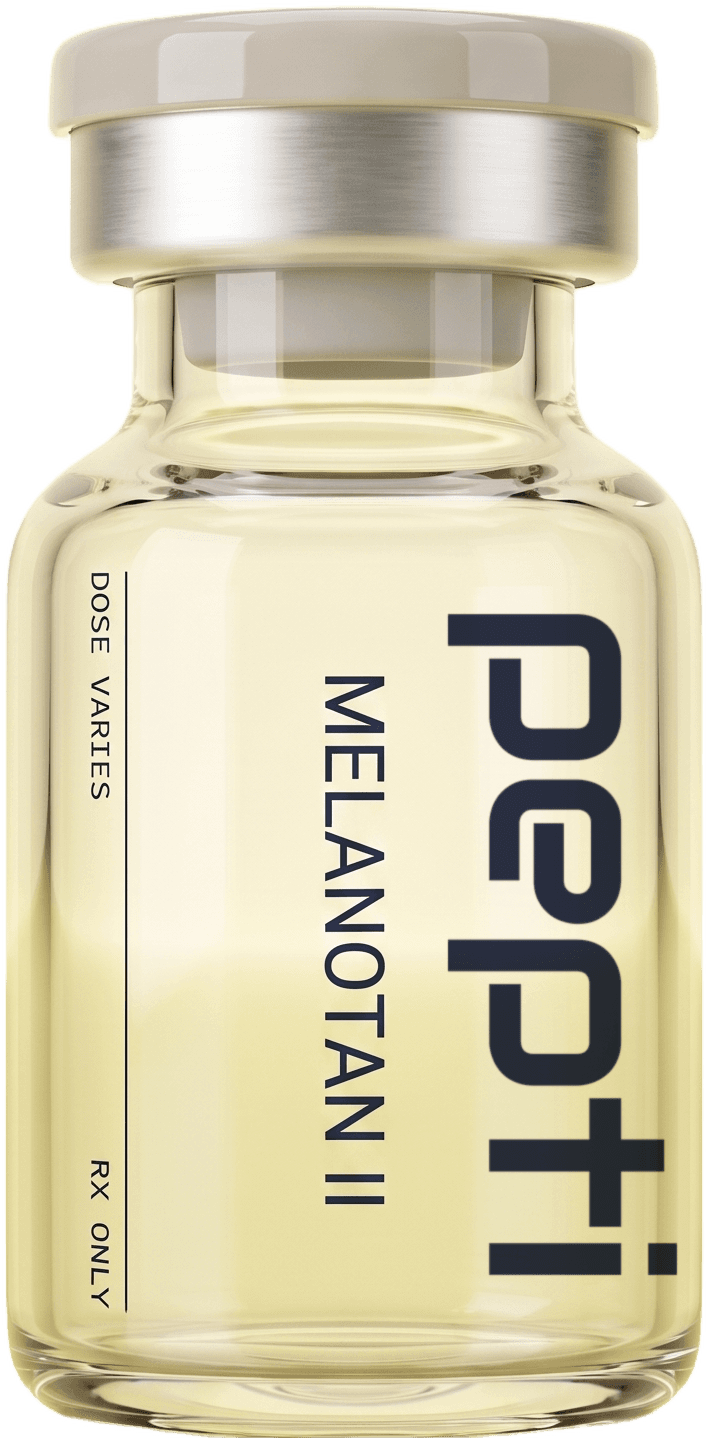
Melanotan II is a prescription injection supplied as 5 mL multi-dose vial, Melanotan II 2 mg/mL (10 mg Melanotan II per vial). The reviewed directions are: Inject 0.25 mL (25 units) subcutaneously once daily Monday through Friday. That is 20 doses per vial, about 4 weeks at Monday through Friday. It requires a prescription from a physician licensed in your state, is compounded by a state-licensed US pharmacy, and is not FDA approved.
This page covers what Melanotan II is, the receptors it acts on, what the published human studies do and do not establish, where it currently stands with the FDA, how it is dosed, what to watch for on your skin, and how to get it prescribed.
Melanotan II
What Melanotan II actually is
A synthetic version of a hormone your skin already responds to
Melanotan II is a synthetic analogue of alpha-melanocyte-stimulating hormone, or alpha-MSH — the small peptide your skin releases after sun exposure to tell pigment cells called melanocytes to make more melanin. It keeps the seven amino acids of alpha-MSH that do the receptor binding, swaps in a few modified residues, and closes the chain into a ring with a lactam bridge. The published sequence is Ac-Nle-Asp-His-D-Phe-Arg-Trp-Lys-NH2.
That ring is the point. Natural alpha-MSH is broken down within minutes; the cyclic structure makes Melanotan II far more resistant to enzymes and considerably more potent, which is why the 1996 pilot study called it "superpotent" and why it produced visible pigmentation after a handful of low doses.
Where the name comes from
Melanotan II was designed in the 1980s at the University of Arizona by the Hruby and Hadley laboratories, which had already produced Melanotan I, a linear analogue that became afamelanotide, the active ingredient in an approved implant for a rare light-sensitivity disorder. Melanotan II was the second-generation, cyclic compound. A metabolite of it was later developed as bremelanotide, better known as PT-141, approved under a brand name for low sexual desire in premenopausal women. Three names that get confused; three different molecules with a shared ancestry.
What it is not
It is not a sunscreen and does not block ultraviolet light; the research does not describe it preventing sunburn or skin cancer. It is not selective: unlike afamelanotide, which is relatively focused on the skin's MC1 receptor, it activates several melanocortin receptors at once, which is why it also affects erections, sexual desire and appetite. And it is not a hormone in the endocrine sense: it does not bind androgen or oestrogen receptors and does not suppress your own hormone production.
Melanotan II
How Melanotan II is described to work
Melanotan II is a non-selective agonist at the melanocortin receptor family. The pigmentation and erection effects have been observed directly in humans; the appetite and receptor-level detail comes largely from animal and cell work.
MC1 receptor on melanocytes: more eumelanin
The skin effect runs through the MC1 receptor on melanocytes. When alpha-MSH or Melanotan II binds MC1R, the cell raises cyclic AMP, switches on tyrosinase and shifts production toward eumelanin, the brown-black pigment that gives a tan its colour, rather than the red-yellow pheomelanin. This is the pathway ultraviolet light uses; Melanotan II turns it on without the ultraviolet step. In the 1996 pilot study, pigmentation was measured in the face, upper body and buttocks — areas the volunteers had not been exposing — which fits a systemic signal rather than a local one.
MC4 receptor in the brain and spinal cord: erection
The MC4 receptor in the hypothalamus and spinal cord is the pathway behind the erectile effect. Animal work established that central melanocortin signalling initiates erections independently of the local nitric-oxide mechanism that sildenafil-type drugs act on, and the human crossover studies confirmed it in men: erections began without sexual stimulation and were rigid enough to register on a RigiScan monitor. This is a centrally initiated erection, not a blood-flow drug.
MC4 receptor and sexual desire
The same receptor family is implicated in sexual motivation, which is separate from the mechanics of an erection. In the human studies men reported higher sexual desire after Melanotan II than after placebo, and that observation is what led to bremelanotide being developed as a desire drug rather than an erection drug.
MC3 and MC4 receptors: appetite
Melanocortin signalling in the hypothalamus is one of the body's main satiety systems. Animal studies describe Melanotan II reducing food intake, and "decreased appetite" appeared on the side-effect questionnaires in the human studies. It is a documented effect, not a marketed one, and not what the compound is prescribed for.
Why the stretching and yawning happen
Every human study noted a "stretching and yawning complex" that tends to precede the erections. It is a recognised melanocortin effect seen in animals decades earlier: transient, dose-related, and worth knowing about in advance because it is otherwise alarming.
Melanotan II
What the research actually shows
Pigmentation
The direct human evidence is the pilot phase I study published in Life Sciences in 1996. Three healthy male volunteers received subcutaneous Melanotan II or saline on alternating weekdays for two weeks, with dose escalation. Two of the three showed increased pigmentation in the face, upper body and buttocks, measured by reflectance and by eye, a week after dosing ended; the authors concluded that Melanotan II has tanning activity in humans after only five low doses. That is the whole formal pigmentation dataset: a three-person, single-blind pilot that showed the effect clearly but was not designed to measure how much, how evenly, or how long.
Erectile function
This is where the human data is stronger. The Journal of Urology published a double-blind, placebo-controlled crossover study in 1998 in ten men with psychogenic erectile dysfunction: erections developed in eight of ten on Melanotan II, with 38 minutes of tip rigidity above 80 percent versus 3 minutes on placebo. A companion study in Urology in 2000 repeated the design in ten men with organic erectile dysfunction and reported erections after 12 of 19 active injections versus 1 of 21 placebo. A pooled review in the International Journal of Impotence Research in 2000 reported erections in 17 of 20 men and increased sexual desire after 68 percent of active doses versus 19 percent of placebo.
These are small, single-dose studies. But they are randomised, placebo-controlled and objectively measured, and they establish that Melanotan II initiates erections in men. The desire finding was a secondary, questionnaire-based measure; that signal was pursued with bremelanotide rather than Melanotan II itself.
Appetite
Reduced appetite was recorded as a side effect in the human studies and is described in animal work as a melanocortin effect. No human trial has studied Melanotan II for appetite or weight, and this page does not describe it as a weight tool.
What human data exists
Precisely: one three-person pilot pigmentation study, two ten-person randomised placebo-controlled crossover studies in erectile dysfunction, and a pooled review, all from one research group in the 1990s. There are no large randomised controlled trials of Melanotan II in humans, and there are no controlled trials of repeated dosing over weeks or months, which is the way it is actually prescribed. Beyond that the human literature is case reports and clinical experience. That is a more solid human footing than most compounded peptides have, and a much thinner one than an approved drug.
What the evidence does not establish
- It does not establish how dark a tan a given person will get, or how evenly. The pilot study measured a change; it did not characterise it.
- It does not establish how long pigmentation persists after stopping.
- It does not establish long-term safety over repeated courses. Nobody has followed a cohort for years.
- It does not establish whether it changes melanoma risk in either direction. There are case reports of moles changing and of melanoma diagnosed during or after use; a 2017 review in the International Journal of Dermatology concluded that conclusive evidence of a causal link is lacking but that the reports warrant caution.
- It does not establish efficacy for any condition as an approved treatment. Melanotan II is not approved for anything.
Melanotan II
Where Melanotan II stands with the FDA right now
Most of what is online about Melanotan II's status is out of date.
Melanotan II was placed in Category 2 of the FDA's 503A bulk drug substances list in 2023, the category for substances flagged for significant safety concerns. It is no longer in Category 2. The FDA's current three-category list, updated 14 May 2026, does not include it there. The FDA's safety-risk page, current as of 22 April 2026, lists Melanotan II among substances previously in Category 2 and keeps its original note on file: a possible immunogenicity risk from aggregation or peptide impurities, and published case reports of melanoma, posterior reversible encephalopathy syndrome, sympathomimetic toxidrome and priapism.
The FDA has announced that its Pharmacy Compounding Advisory Committee will meet before the end of February 2027 to discuss Melanotan II for possible inclusion on the 503A bulks list, alongside LL-37, GHK-Cu, Dihexa and PEG-MGF. The agenda is published; the date, docket and meeting materials are not yet. Melanotan II was not among the peptides discussed at the July 2026 meeting, which covered BPC-157, KPV, TB-500, MOTS-c, DSIP, Semax and Epithalon.
So the accurate description today is: no longer flagged in Category 2, scheduled for formal advisory committee review by February 2027, and awaiting that review. It remains legal to prescribe and dispense with a valid prescription, it is still not an FDA-approved drug, and compounded medications never are. The committee's vote will be advisory; the FDA issues its own determination afterwards.
Melanotan II
Realistic expectations
These are patterns described by prescribers, not trial endpoints. Response varies with skin type, baseline pigmentation and sun exposure, and a physician decides whether treatment is appropriate at all.
The first few doses
The first week is mostly about side effects rather than colour. Nausea, facial flushing, warmth and the stretching-and-yawning sensation are what people notice, usually within an hour or two of an injection and settling the same day. In men, spontaneous erections in the hours after a dose are expected. Prescribers describe these effects as most pronounced at the start and fading with repeated dosing; if nausea is a problem, evening injection is a common adjustment, but that is your physician's call.
Weeks one to four
Pigmentation, where it occurs, tends to show first in areas that already carry pigment: moles, freckles, the face, the upper body. Moles darkening is expected and is why your skin is examined before you start — a darker mole is not itself a warning sign, but one that changes shape, border or texture is, and you need a baseline to tell the difference. Modest sun exposure is usually described as part of the picture; nothing here should be read as encouraging sunbeds.
After the vial
There is no withdrawal described. Pigment fades as skin cells turn over, so for most people the tan recedes over several weeks once dosing stops. Whether a further vial is prescribed is decided at refill review, not automatically.
The ongoing job: skin checks
Anyone on Melanotan II should check their skin regularly and have any new or changing pigmented lesion looked at promptly. It is the single most important practical point on this page.
Melanotan II
When something else makes more sense
Some honest cases where Melanotan II is not the first thing to reach for:
- Sexual function is the actual goal. Melanotan II's erectile and desire effects are real but come bundled with pigmentation and nausea. PT-141, the bremelanotide descendant of this molecule, was developed for exactly that purpose, and the PT-141 + Oxytocin preparation exists for the same reason.
- You want better skin, not darker skin. Texture, firmness and repair are a different pathway. GHK-Cu, the KLOW blend, GLOW and the RADIANCE blend are aimed at that.
- You have a personal history of melanoma or atypical moles. This is a stop, not a caveat. Your physician will almost certainly decline, and should.
- You are hoping the appetite effect will handle weight. It is a side effect, not a treatment, and is not studied for that. Semaglutide and tirzepatide are the conversation with human trial evidence behind them.
- Your skin is very fair and burns rather than tans. Prescribers describe a wide range of response, and your physician may judge the risk-to-benefit ratio is not there.
Your physician will tell you if Melanotan II is not the right tool for what you have described. A consultation does not guarantee a prescription, and being declined is refunded.
Melanotan II
Dosing, and how a vial is actually used
Why the dose is measured in units
The directions are written in millilitres and insulin-syringe units because that is what you can read off the barrel. 0.25 mL is 25 units on a U-100 syringe. You are not calculating anything — the number is printed on your medication, and your physician sets it.
Subcutaneous, and where
Subcutaneous means into the fat layer, not the muscle. Abdomen and thigh are the usual sites, rotated. Because the melanocortin signal is systemic, where you inject does not decide where you tan.
Why Monday through Friday, and why a vial covers about four weeks
The reviewed directions are five days a week with the weekend off, as the human research used. It gives a predictable break from the side effects while keeping the pigment signal going. 20 doses at five per week is four weeks, which is why refills run on a 28-day cycle. One vial per fill, always — not a stockpile.
Storage
Refrigerated, and it ships that way in insulated packaging with ice packs. A fresh sterile syringe every time; beyond-use dating runs from first puncture and is on the label.
Melanotan II
Safety and side effects
Melanotan II has a better-characterised side-effect profile than most compounded peptides, because the human studies recorded it. The consistent findings are nausea (reported at most dose levels, severe after a minority of doses at the higher study dose), facial flushing, stretching and yawning, reduced appetite, somnolence at the top of the dose escalation, and in men spontaneous erections lasting intermittently for one to five hours after a dose. These are dose-related, and the study authors described them as manageable.
The dermatological concern is the one to take most seriously. Melanotan II darkens existing moles and freckles, and case reports describe new moles appearing and existing ones changing during use; a small number, in Dermatology in 2014 and the Australasian Journal of Dermatology in 2012 among others, describe melanoma diagnosed during or shortly after a course. The 2017 review of the alpha-MSH analogue literature concluded that a causal link has not been established but that the reports justify caution and skin surveillance. This is why the intake asks about melanoma and atypical moles, why pigmented lesions are examined before starting, and why anything new or changing should be looked at promptly.
The FDA's on-file safety note also cites case reports of priapism, posterior reversible encephalopathy syndrome and a sympathomimetic toxidrome. For context, the toxicity case in Clinical Toxicology in 2012 involved a single self-administered dose of product bought online, many times larger than any reviewed direction, and the priapism case in BMJ Case Reports in 2019 likewise involved self-sourced product. They are real events, and they are the reason the dose is set by a physician and printed on the vial.
There is no established drug-interaction list, because the trials that would produce one have not been run. That is why the intake asks for every medication you take, including anything for erectile dysfunction or blood pressure, and why a physician reviews it rather than a form.
Stop and contact your physician for any reaction that is severe, spreading, or involves difficulty breathing. Seek emergency care for an erection lasting more than four hours, a severe headache with visual change or confusion, or a racing heart with agitation and muscle pain.
Melanotan II
How Melanotan II compares
Melanotan II vs PT-141
PT-141 is bremelanotide, a metabolite of Melanotan II. The two act on the same receptors, but PT-141 was developed specifically for sexual function and its pigmentation effect is comparatively minor. If tanning is not the goal, PT-141 is the more targeted choice; if it is, PT-141 will not deliver it.
Melanotan II vs Melanotan I
Melanotan I is afamelanotide, a linear analogue relatively selective for the skin's MC1 receptor, approved as an implant for erythropoietic protoporphyria, a rare disorder of severe light sensitivity. It is not a compounded product. Melanotan II is the cyclic, non-selective sibling: more potent, and carrying the erection, desire and appetite effects that Melanotan I largely does not.
Melanotan II vs simply tanning
Ultraviolet tanning damages DNA in the process of producing pigment, which is where its skin-cancer risk comes from. Melanotan II produces eumelanin without the ultraviolet step, but it stimulates melanocytes directly, and whether that carries its own long-term risk is the unresolved question in the case-report literature. They are different risks, not the absence of one. A darker tone from Melanotan II is not enough protection to skip sunscreen.
Melanotan II
Availability and formats
| Question | Answer |
|---|---|
| Can I get it by telehealth? | Yes, where a physician licensed in your state prescribes it |
| Which states? | All 50 states and DC |
| Does it come as a pen? | No, this one is a vial and syringe only |
| Does it come as a capsule? | No |
| Does it come as a nasal spray? | No |
| Is bloodwork required first? | Not routinely; your physician decides |
Melanotan II
Where to get Melanotan II prescribed
Melanotan II cannot be bought legitimately without a prescription. Sites shipping it with no prescription are selling a research-use-only product, where no pharmacy is accountable for identity, purity, sterility or concentration.
The prescription route works like this:
- Complete a medical intake covering your history, medications, allergies and what you are treating.
- A physician licensed in your state reviews it.
- If appropriate, a state-licensed, FDA-registered pharmacy compounds it to that prescription.
- It ships refrigerated with your directions printed on the vial.
- Your physician stays reachable afterwards for dose questions and side effects.
Current all-in pricing for Melanotan II is published: medication, physician review, refill management and shipping in one figure, with no separate membership fee. What to check on any provider is in how to tell if a peptide seller is legitimate.
Melanotan II
Who should not take it, or should discuss it first
| Situation | Why |
|---|---|
| A history of melanoma or atypical moles | Raised at intake |
| Existing pigmented lesions should be examined first | Raised at intake |
| Pregnancy or breastfeeding | Not used; safety data is absent |
| Tested athletes | Many peptides are prohibited in competition; check the current list |
Full specification
Everything on the label.
Product
Melanotan II (Injectable)
How supplied
5 mL multi-dose vial, Melanotan II 2 mg/mL (10 mg Melanotan II per vial)
Typical directions
Inject 0.25 mL (25 units) subcutaneously once daily Monday through Friday.
Dose volume
0.25 mL (25 units on a U-100 insulin syringe)
Doses per vial
20
Coverage per vial
about 4 weeks at Monday through Friday
Formats
Vial and syringe
Available in
All 50 states and DC
Bloodwork
Not routinely required; your physician decides
Legal status
Prescription-only, compounded, not FDA approved
Category
Skin & Hair
References
What this is based on.
References
- Dorr RT, Lines R, Levine N et al.. Evaluation of melanotan-II, a superpotent cyclic melanotropic peptide in a pilot phase-I clinical study · Life Sci (1996) · PMID 8637402
- Wessells H, Fuciarelli K, Hansen J et al.. Synthetic melanotropic peptide initiates erections in men with psychogenic erectile dysfunction: double-blind, placebo controlled crossover study · J Urol (1998) · PMID 9679884
- Wessells H, Gralnek D, Dorr R et al.. Effect of an alpha-melanocyte stimulating hormone analog on penile erection and sexual desire in men with organic erectile dysfunction · Urology (2000) · PMID 11018622
- Wessells H, Levine N, Hadley ME et al.. Melanocortin receptor agonists, penile erection, and sexual motivation: human studies with Melanotan II · Int J Impot Res (2000) · PMID 11035391
- Habbema L, Halk AB, Neumann M, Bergman W. Risks of unregulated use of alpha-melanocyte-stimulating hormone analogues: a review · Int J Dermatol (2017) · PMID 28266027
- Hjuler KF, Lorentzen HF. Melanoma associated with the use of melanotan-II · Dermatology (2014) · PMID 24355990
- Ong S, Bowling J. Melanotan-associated melanoma in situ · Australas J Dermatol (2012) · PMID 22724573
- Nelson ME, Bryant SM, Aks SE. Melanotan II injection resulting in systemic toxicity and rhabdomyolysis · Clin Toxicol (Phila) (2012) · PMID 23121206
- Dreyer BA, Amer T, Fraser M. Melanotan-induced priapism: a hard-earned tan · BMJ Case Rep (2019) · PMID 30796078
- Zhang Y, Collazo R, Gao Y, Li G, Scarpace PJ. Intermittent MTII application evokes repeated anorexia and robust fat and weight loss · Peptides (2010) · PMID 20034526
Citations are provided for educational purposes. They do not constitute medical advice. Always discuss any peptide protocol with your prescribing physician.
Common questions
Melanotan II, answered.
Through a telehealth provider where a physician licensed in your state reviews a medical intake and a licensed US pharmacy compounds the prescription. Pepti prescribes Melanotan II in all 50 states and DC; start with the free assessment.
5 mL multi-dose vial, Melanotan II 2 mg/mL (10 mg Melanotan II per vial)
Inject 0.25 mL (25 units) subcutaneously once daily Monday through Friday. Your physician sets your own dose and it is printed on your medication.
20 at the standard volume, about 4 weeks at Monday through Friday.
Melanotan II is supplied as a vial, drawn with an insulin syringe. It is not available as a pen or capsule.
Not routinely, though your physician may want labs depending on your history. at-home blood testing covers hormone, metabolic and thyroid markers without a lab visit.
It is legal to prescribe and dispense in the United States with a valid prescription. It is not FDA approved: compounded medications are prepared by licensed pharmacies pursuant to a prescription rather than approved as manufactured products. See are peptides FDA approved.
Pricing is published on the Melanotan II page as one all-in figure covering medication, physician review, refill management and shipping. What drives peptide pricing generally is in how much do peptides cost.
No. It was placed in Category 2 of the FDA's 503A bulk substances list in 2023 and is no longer in that category as of the FDA's 2026 updates. The FDA has announced its Pharmacy Compounding Advisory Committee will discuss Melanotan II for possible inclusion on the 503A bulks list before the end of February 2027. It remains legal to prescribe and dispense with a valid prescription.
Yes, more than most compounded peptides have. A 1996 pilot study in Life Sciences reported measurable pigmentation in two of three volunteers after five low doses, and two double-blind, placebo-controlled crossover studies, in the Journal of Urology in 1998 and Urology in 2000, reported that it initiated erections in most men with psychogenic and organic erectile dysfunction. All of it is small and from one research group; there are no large randomised trials and no controlled studies of repeated courses.
Expect existing moles and freckles to darken; that is the pigment pathway working and it is why your skin is examined before you start. Case reports describe new moles appearing and existing ones changing during use, and a small number describe melanoma found during or after a course, without a causal link having been established. Any mole that changes shape, border or texture, or any new pigmented spot, should be looked at promptly.
It is the most commonly reported side effect in the human studies, with facial flushing and a stretching-and-yawning sensation. It is dose-related, usually short-lived, and described by prescribers as fading with repeated dosing. If it is a problem, tell your physician.
Because it activates the MC4 melanocortin receptor in the brain and spinal cord, which initiates erections centrally, independent of the blood-flow mechanism sildenafil-type drugs act on. In the human studies erections began without sexual stimulation and lasted intermittently for one to five hours. An erection lasting more than four hours is an emergency, whatever the cause.
No. PT-141 is bremelanotide, a metabolite of Melanotan II developed specifically for sexual function; its pigmentation effect is minor. Melanotan II is the parent molecule and does both.
The pilot study measured pigmentation without deliberate ultraviolet exposure, so the pathway does not require it. Prescribers commonly describe modest sun exposure as part of how a tan develops in practice, but nothing about this medication is a reason to use sunbeds or skip sunscreen.
The reviewed directions use weekday dosing with the weekend off, as the original human research did: it keeps the pigment signal going while giving a predictable break from the side effects, and 20 weekday doses is four weeks, matching the 28-day refill cycle.
Next step
See what a physician recommends for you.
A licensed physician in your state reviews your intake and decides what is appropriate. A consultation does not guarantee a prescription.