Cognitive · Reference
How Long Does PE-22-28 Take to Work? What the Studies Measured, and When
This page goes through each study's length and what it measured, explains why the four-day figure is so often misquoted, and covers your directions and what to track.
Treatments mentioned
No study has measured how long PE-22-28 takes to work in people, because PE-22-28 has no human trials of any kind. The studies that exist are in rodents: the 2010 spadin paper and the 2017 PE-22-28 paper both measured antidepressant-like behaviour and hippocampal neurogenesis in mice after a four-day course. A four-day result in a mouse is not a human timeline, and nothing in the research predicts when, or whether, a person will notice anything. Compounded PE-22-28 is a prescription injection, has never been evaluated by the FDA, and is not FDA approved.
If you are in crisis or thinking about harming yourself, call or text 988 in the US, or call 911, now.
This page goes through each study's length and what it measured, explains why the four-day figure is so often misquoted, and covers your directions and what to track.
How Long Does PE-22-28 Take to Work? What the Studies Measured, and When
The short answer
| Study | What was studied | How long | What was measured |
|---|---|---|---|
| Nature Neuroscience, 2006 | Mice bred without the TREK-1 gene | Not a treatment study | Behaviour across standard tests, compared with normal mice |
| PLoS Biology, 2010 | Spadin, the longer parent fragment, in mice | A four-day course | Forced-swim, tail-suspension, novelty-suppressed feeding and learned-helplessness tests; hippocampal neurogenesis |
| Neuropharmacology, 2012 | Spadin in mice | At behaviourally active doses | Pain, seizure and ischaemia endpoints; no worsening signal |
| British Journal of Pharmacology, 2015 | Spadin in cultured neurons and mice | Not stated in the live pages | Synapse formation |
| Frontiers in Pharmacology, 2017 | PE-22-28 in cells and mice | A four-day course | Reproduced spadin's behavioural effects; neurogenesis retained; half-life in the mouse roughly a day |
| ACS Chemical Neuroscience, 2018 | TREK-1 blockers against fluoxetine in rats | A chronic unpredictable mild stress model | Behaviour in a chronic stress model |
| Neuropharmacology, 2019 | Sortilin-derived peptides in a mouse stroke model | Recovery after stroke | Functional recovery and depression-like behaviour |
| Human studies | None | None | None |
Every row is cell or animal work. The timing in each was set by the experiment, not by anything a person would experience.
How Long Does PE-22-28 Take to Work? What the Studies Measured, and When
Why the four-day figure is misquoted
It is a mouse result
The 2010 paper reported spadin's effects appearing after four days, and the authors contrasted that window with the several weeks conventional antidepressants take for comparable changes in animals. The 2017 paper reported PE-22-28 reproducing the effects after a four-day course. Online sources turn that into "works in four days." That is not what the studies say. They describe behaviour in standard rodent tests, which are an entry point in antidepressant research, not proof of an effect in people.
Mouse behaviour is not a feeling
The forced-swim and tail-suspension tests measure how long a mouse keeps moving in a stressful situation. Neurogenesis is a count of new neurons in a mouse brain. Neither is something a person notices, and neither has been measured in a person taking PE-22-28.
There is no human dose or timeline
Because no human trial exists, there is no human dose-finding study, no human pharmacokinetics, and no measured time course of anything. The directions in use are a prescriber's translation from animal work. Anyone giving a week-by-week schedule of what you will feel is going beyond the evidence.
The human papers are not about PE-22-28
The only human data in the area is a 2017 Journal of Affective Disorders paper reporting the body's own sortilin propeptide lower in the blood of people with major depressive disorder, and a 2018 paper reporting it rising after electroconvulsive therapy. Those measure a natural molecule as a possible marker. They say nothing about how long PE-22-28 takes to do anything.
How Long Does PE-22-28 Take to Work? What the Studies Measured, and When
What your directions look like
| What the label shows | Value |
|---|---|
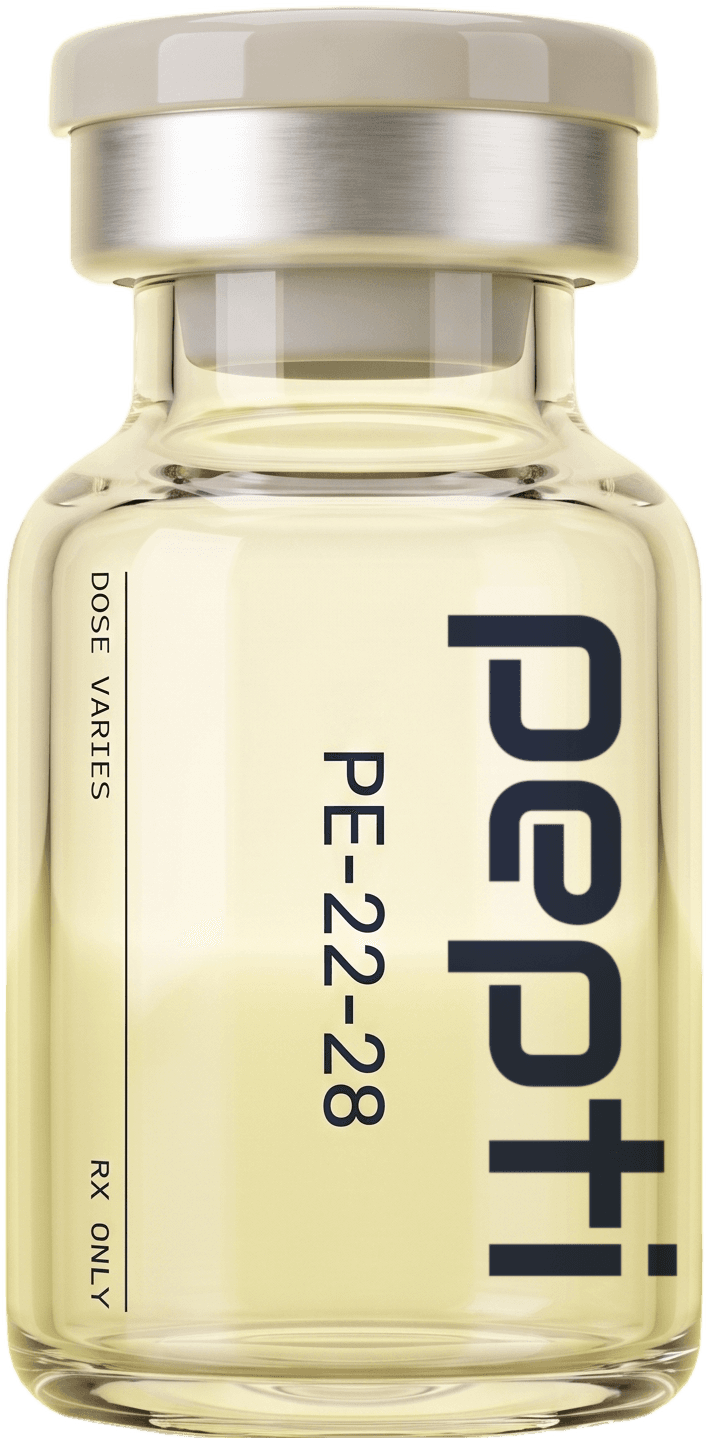
| Product | PE-22-28, 5 mL multi-dose vial at 2 mg/mL (10 mg per vial) |
| Typical directions | Inject 0.25 mL (25 units) subcutaneously once daily Monday through Friday |
| PE-22-28 per dose | 0.5 mg (2 mg/mL x 0.25 mL, math only) |
| Doses per vial | 20, about four weeks |
| Price | $219/mo, all-in |
The weekday schedule is a prescriber's schedule, not a trial-derived one, and the vial is sized at about four weeks so refills run every 28 days, one vial per fill. Vials ship ready to use, refrigerated with ice packs, with sterile syringes and alcohol prep pads. Your physician sets your directions after reviewing your intake, and they are printed on the vial. The conversion chart is in PE-22-28 dosage.
How Long Does PE-22-28 Take to Work? What the Studies Measured, and When
What to track, and when to message your care team
Because there is no human timeline, a simple record of what actually happens is more useful than waiting for a particular week.
| What to note | Why |
|---|---|
| Your mood, sleep and energy, briefly, once a week | Gives your care team something concrete at the refill, including if nothing has changed |
| Every dose you take, and any you miss | Missed doses are followed by your directions, never doubled |
| Injection-site reactions | The commonest clinical report; rotate sites |
| Headaches in the first days | Report one that persists |
| New medications, including antidepressants or triptans | The proposed mechanism overlaps with serotonin; your physician reviews anything new |
| What happens | What to do |
|---|---|
| Nothing noticeable | Normal; tell your care team honestly at the refill rather than changing the dose |
| A change in mood that worries you or those around you | Contact your physician promptly |
| Thoughts of harming yourself | Call or text 988, or call 911, now |
| Facial or throat swelling, difficulty breathing | Call 911 first, then tell your physician |
| You think you may have taken too much | Call Poison Control at 1-800-222-1222 and message your care team |
Never raise, lower, skip or double a dose to try to make PE-22-28 work faster. If you have questions about your directions, message your care team.
If you have a diagnosed mood disorder
PE-22-28 is not a treatment for depression, and no existing antidepressant should be stopped on the strength of a rodent literature. If you are under treatment, the clinician managing it needs to be part of the decision. Waiting to see whether PE-22-28 "kicks in" is never a reason to delay care for worsening mood.
How Long Does PE-22-28 Take to Work? What the Studies Measured, and When
What the evidence shows, honestly
There are no randomised controlled trials of PE-22-28 in humans, and no published human trials of any kind. The research is a coherent set of rodent and cell studies, mostly from one group in Nice, France, with pieces replicated by others. It describes a fast effect in mice and a longer half-life than the parent fragment. It does not establish any effect in people, any timeline, any dose, or long-term safety.
PE-22-28 has not been evaluated by the FDA: it is not in Category 1, 2 or 3 of the 503A nominated-substances list updated 14 May 2026, has no FDA safety notice and was not on the July 2026 advisory committee agenda. Compounded medications are not FDA approved. The full picture is in what is PE-22-28, PE-22-28 benefits and PE-22-28 side effects.
How Long Does PE-22-28 Take to Work? What the Studies Measured, and When
Where to get PE-22-28 prescribed
- Complete a free online intake covering your history, every medication you take, any mood diagnosis, and what you want help with.
- A physician licensed in your state reviews it, usually within 24 hours.
- If it is appropriate, a PCAB-accredited, FDA-registered US 503A compounding pharmacy prepares it to that prescription. Lot test results are published at /quality/lab-results.
- It ships refrigerated with your directions printed on the vial.
- Your care team stays reachable for questions, side effects and mood changes.
Every price is all-in, covering medication, physician review, refill management and shipping, with no membership fee. Pepti is cash-pay and does not bill insurance. Step by step: how to get PE-22-28 prescribed online. Bloodwork is not required for any Pepti treatment. If your physician wants labs for your care, they'll ask through your account.
References
What this is based on.
References
- Djillani A, Pietri M, Moreno S et al.. Shortened Spadin Analogs Display Better TREK-1 Inhibition, In Vivo Stability and Antidepressant Activity · Front Pharmacol (2017) · PMID 28955242
- Mazella J, Pétrault O, Lucas G et al.. Spadin, a sortilin-derived peptide, targeting rodent TREK-1 channels: a new concept in the antidepressant drug design · PLoS Biol (2010) · PMID 20405001
- Heurteaux C, Lucas G, Guy N et al.. Deletion of the background potassium channel TREK-1 results in a depression-resistant phenotype · Nat Neurosci (2006) · PMID 16906152
- Moha Ou Maati H, Veyssiere J, Labbal F et al.. Spadin as a new antidepressant: absence of TREK-1-related side effects · Neuropharmacology (2012) · PMID 21807005
- Devader C, Khayachi A, Veyssière J et al.. In vitro and in vivo regulation of synaptogenesis by the novel antidepressant spadin · Br J Pharmacol (2015) · PMID 25598009
- Moha ou Maati H, Bourcier-Lucas C, Veyssiere J et al.. The peptidic antidepressant spadin interacts with prefrontal 5-HT(4) and mGluR(2) receptors in the control of serotonergic function · Brain Struct Funct (2016) · PMID 25233810
- Ye D, Li Y, Zhang X et al.. TREK1 channel blockade induces an antidepressant-like response synergizing with 5-HT1A receptor signaling · Eur Neuropsychopharmacol (2015) · PMID 26441141
- Hivelin C, Béraud-Dufour S, Devader C et al.. Potentiation of Calcium Influx and Insulin Secretion in Pancreatic Beta Cell by the Specific TREK-1 Blocker Spadin · J Diabetes Res (2016) · PMID 28105440
- Devader C, Roulot M, Moréno S et al.. Serum sortilin-derived propeptides concentrations are decreased in major depressive disorder patients · J Affect Disord (2017) · PMID 27838145
- Roulot M, Minelli A, Bortolomasi M et al.. Increased serum levels of sortilin-derived propeptide after electroconvulsive therapy in treatment-resistant depressed patients · Neuropsychiatr Dis Treat (2018) · PMID 30233189
- Qi X, Xu H, Wang L et al.. Comparison of Therapeutic Effects of TREK1 Blockers and Fluoxetine on Chronic Unpredicted Mild Stress Sensitive Rats · ACS Chem Neurosci (2018) · PMID 29952548
- Djillani A, Pietri M, Mazella J et al.. Fighting against depression with TREK-1 blockers: Past and future. A focus on spadin · Pharmacol Ther (2019) · PMID 30291907
Citations are provided for educational purposes. They do not constitute medical advice. Always discuss any peptide protocol with your prescribing physician.
Common questions
How Long Does PE-22-28 Take to Work? What the Studies Measured, and When, answered.
No study has measured that in people, because PE-22-28 has no human trials. The rodent studies measured behaviour and neurogenesis in mice after a four-day course, which is not a human timeline.
That figure comes from mice. The 2010 and 2017 papers reported antidepressant-like behaviour in standard rodent tests after four-day courses. It does not describe what a person will notice, or when.
Nobody can say. There is no human data on what PE-22-28 feels like or when. Noticing nothing is a normal report; tell your care team honestly at the refill.
The key mouse studies used four-day courses. A 2018 rat study used a chronic stress model, and a 2019 mouse study followed recovery after stroke. None was in people.
In mice, the authors contrasted the four-day window with the several weeks conventional antidepressants take in animals. No human comparison exists, and PE-22-28 is not a substitute for an antidepressant.
No. Take the dose printed on your vial, on the schedule printed on your vial. No study shows a higher dose does anything different in people. Message your care team with questions.
About four weeks: 20 weekday doses of 0.25 mL from a 5 mL vial.
The 2017 paper reported a half-life in the mouse of roughly a day. No human pharmacokinetic study exists.
No. The FDA has not evaluated it, and compounded medications are not FDA approved.
No. Bloodwork is not required for any Pepti treatment. If your physician wants labs for your care, they'll ask through your account. The free assessment goes to a physician licensed in your state. A consultation does not guarantee a prescription.
Next step
See what a physician recommends for you.
A licensed physician in your state reviews your intake and decides what is appropriate. A consultation does not guarantee a prescription.