Anti-Aging · Reference
Ipamorelin + Sermorelin: What It Is, Where to Get It Prescribed, and What It Costs
This page covers what the two components are, why a ghrelin-receptor peptide is paired with a GHRH analogue, what the published work on each does and does not establish, where each stands with the FDA, how a vial is dosed, and how to get it prescribed.

Reviewed by Dr. Gene, MD · Board-certified Family Medicine
Every Pepti prescription is reviewed by a licensed U.S. physician before it's dispensed — and only provided if clinically appropriate.
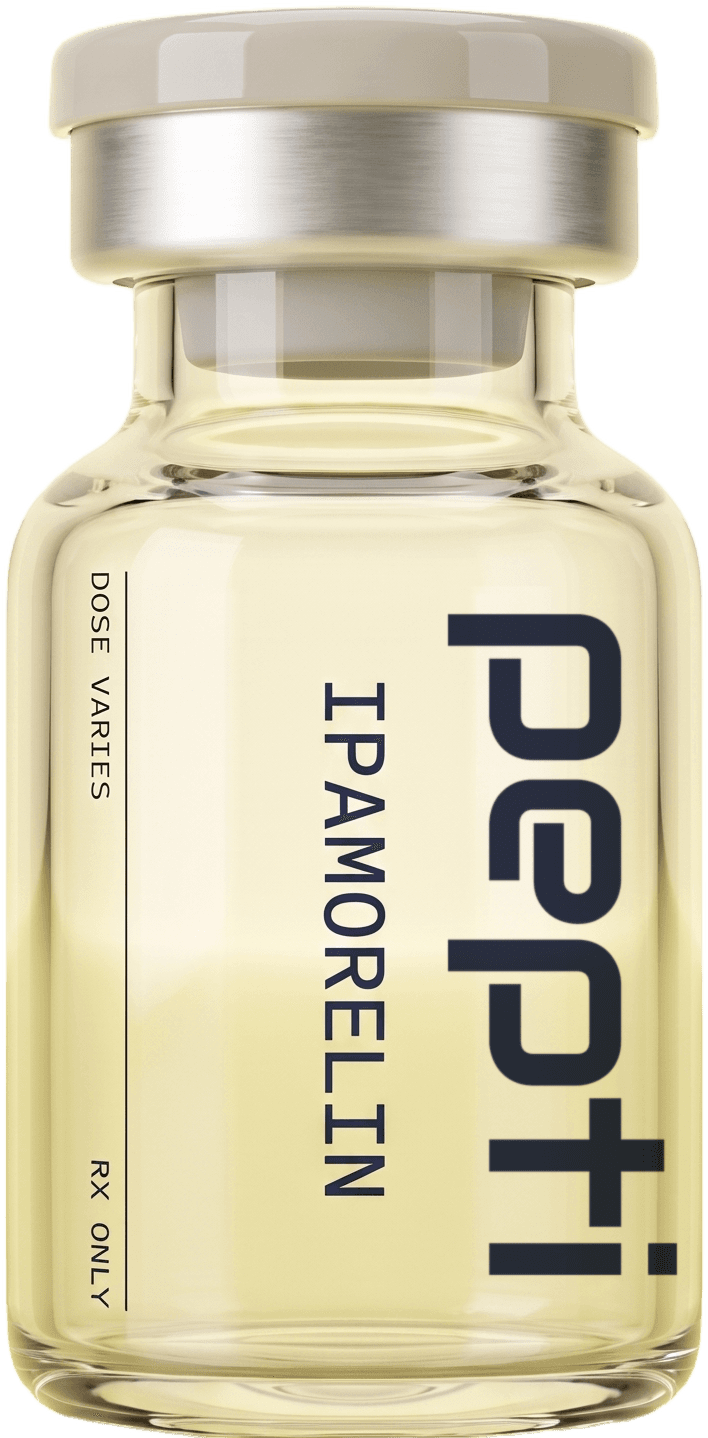
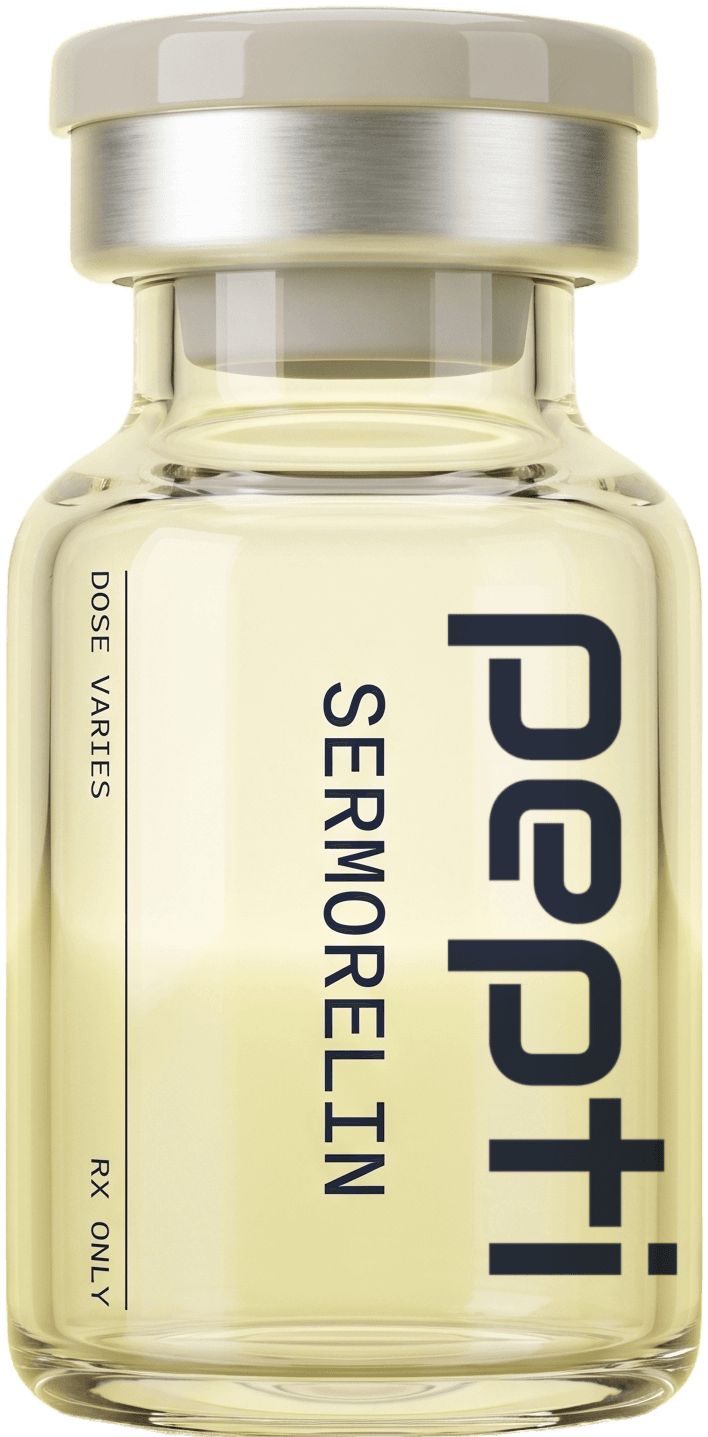
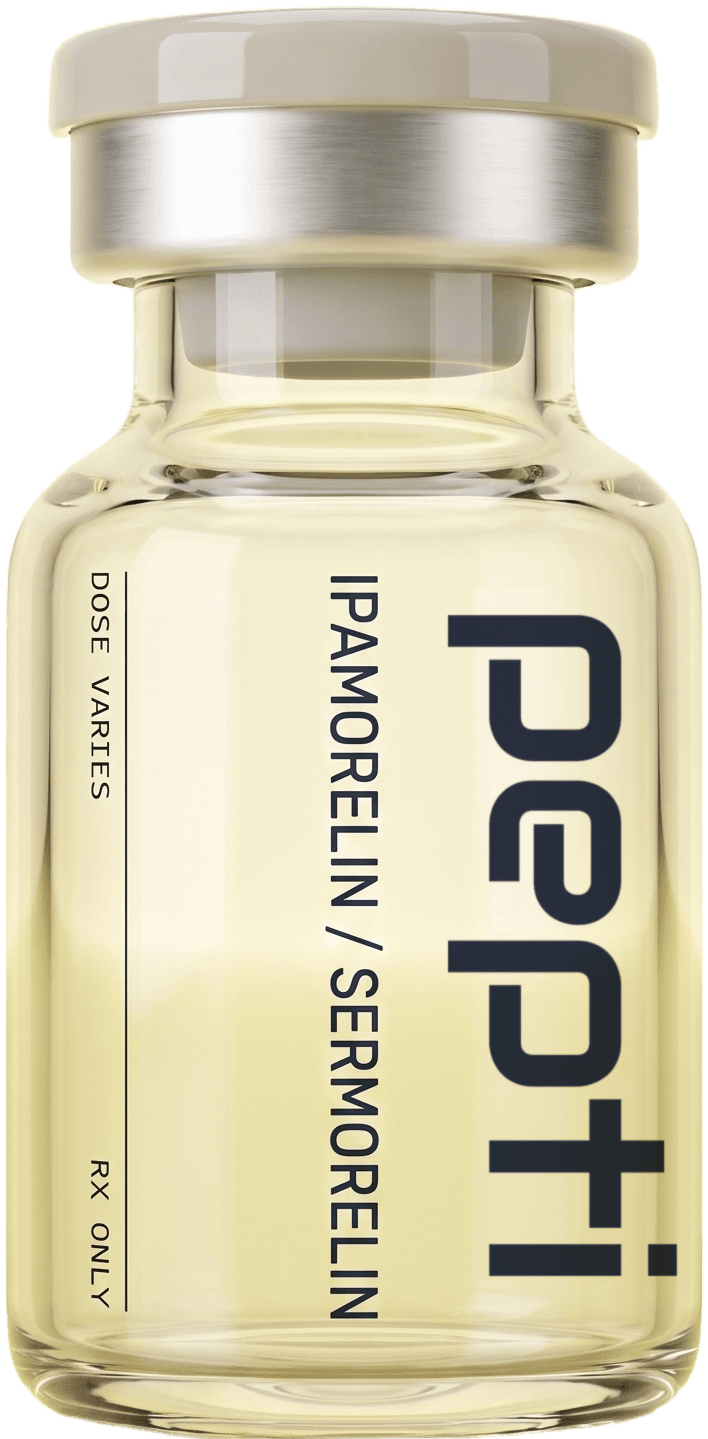
Ipamorelin + Sermorelin is a prescription injection supplied as 5 mL multi-dose vial, Ipamorelin 2 mg/mL + Sermorelin 2 mg/mL (10 mg Ipamorelin / 10 mg Sermorelin per vial). The reviewed directions are: Inject 0.25 mL (25 units) subcutaneously Monday through Friday nights at bedtime. That is 20 doses per vial, about 4 weeks at Monday through Friday. It requires a prescription from a physician licensed in your state, is compounded by a state-licensed US pharmacy, and is not FDA approved.
This page covers what the two components are, why a ghrelin-receptor peptide is paired with a GHRH analogue, what the published work on each does and does not establish, where each stands with the FDA, how a vial is dosed, and how to get it prescribed.
Ipamorelin + Sermorelin
What Ipamorelin + Sermorelin actually is
Two separate peptides, one vial
This is not a single molecule. It is two independently studied peptides, in equal amounts, dissolved together in one sterile vial by a compounding pharmacy. Each has its own literature, mechanism and regulatory history, and the two histories could hardly be more different. The combination has never been studied as a combination, so "does it work" is two questions and "is it approved" is two answers.
Component Per vial What it is Where it acts Sermorelin 10 mg A synthetic copy of the first 29 amino acids of growth-hormone-releasing hormone (GHRH), the signal the hypothalamus sends to the pituitary The GHRH receptor on pituitary somatotroph cells Ipamorelin 10 mg A five-amino-acid synthetic peptide from the growth-hormone-releasing-peptide (GHRP) family The ghrelin receptor on the pituitary and hypothalamus Sermorelin was the active ingredient of Geref, which the FDA approved in 1990 as a diagnostic test of pituitary function and in 1997 as a treatment for children with growth hormone deficiency. Ipamorelin was developed by Novo Nordisk and reported in the European Journal of Endocrinology in 1998 as "the first selective growth hormone secretagogue." It has never been an approved product anywhere.
Why a GHRP is paired with a GHRH analogue
The pituitary releases growth hormone in pulses, and two inputs shape each one. GHRH is the "go" signal, acting through the GHRH receptor. Ghrelin, a hormone first identified in the stomach, acts through a separate receptor, amplifies the pulse and is described in animal work as restraining somatostatin, the "stop" signal. Sermorelin reproduces the first input; ipamorelin the second, so the rationale is two signals at two receptors on one pulse. The human evidence for the principle comes from the wider classes: a 1995 paper in Clinical Endocrinology gave eight healthy men GHRH(1-29) and GHRP-2 separately and together, and reported the combination produced the largest response — roughly the sum of the two, with no synergy. Whether this pairing behaves the same way at nightly subcutaneous doses has not been tested.
What it is not
It is not growth hormone: both peptides are signals to the pituitary, which decides how much to release. It is not a steroid, and not a treatment for diagnosed growth hormone deficiency, a specialist diagnosis with approved products. And it is not a shortcut around sleep, training or diet: everything described in the research is a change in a hormone pulse, not a change in the body that follows automatically from it.
Ipamorelin + Sermorelin
How each component is described to work
The detail below is from animal, cell or human pharmacology studies, with the population named where humans were studied. No study has looked at what the two do together.
Sermorelin: the hypothalamic signal, reproduced
Natural GHRH is 44 amino acids long; the first 29 carry all of its receptor activity, and sermorelin is that fragment made synthetically. A 1999 review in BioDrugs describes it as specifically stimulating growth hormone secretion from the anterior pituitary. Released growth hormone acts largely through IGF-1 made in the liver, which is why IGF-1 is the marker physicians track rather than growth hormone itself, whose level swings with every pulse.
Ipamorelin: the ghrelin-receptor signal, without the cortisol
Ipamorelin is a pentapeptide built partly from unnatural amino acids, acting at the ghrelin receptor like the older GHRPs. What made it notable was selectivity. The 1998 European Journal of Endocrinology paper reported that in rats and pigs it released growth hormone with potency similar to GHRP-6 but, unlike GHRP-6 and GHRP-2, did not raise ACTH or cortisol above the levels seen after GHRH itself, even at doses more than 200 times its growth-hormone-releasing dose; none of the peptides tested affected prolactin, LH, FSH or TSH. In humans, a 1999 dose-escalation study in Pharmaceutical Research of intravenous ipamorelin in 40 healthy men reported a half-life of about two hours and, at every dose, a single episode of growth hormone release peaking at about 40 minutes and then declining to negligible levels — a pulse, not a sustained elevation, which is why it is dosed on a schedule.
Why the pituitary stays in charge
Both peptides work upstream of the gland, so somatostatin still brakes the pulse and IGF-1 still feeds back. A 2018 review in Sexual Medicine Reviews makes this the central argument for secretagogues over growth hormone itself, while being equally clear that few long-term controlled studies exist and naming reduced insulin sensitivity as the recurring concern in those that do.
How the two are meant to fit together
Step in a growth hormone pulse What has to happen Component described here The "go" signal GHRH binds its receptor on the pituitary Sermorelin The amplifier The ghrelin receptor is activated, enlarging the pulse Ipamorelin The "stop" signal Somatostatin restrains the pulse; ghrelin-receptor activity is described as reducing it Ipamorelin (animal work) The brake IGF-1 rises and feeds back on hypothalamus and pituitary Left intact by both This is the clinical rationale, not a finding.
Ipamorelin + Sermorelin
What the research actually shows
Sermorelin in children with growth hormone deficiency
This is the evidence that got the molecule approved. A 1996 paper in the Journal of Clinical Endocrinology and Metabolism reported the Geref International Study Group's multicentre open-label trial: 110 previously untreated prepubertal children with growth hormone deficiency received 30 µg/kg sermorelin subcutaneously at bedtime for up to a year. Among the 86 evaluable, mean height velocity rose from 4.1 cm/yr to 8.0 at six months and 7.2 at twelve, with no change in fasting glucose — smaller increases than growth hormone itself produces, per the BioDrugs review. None of this transfers to adults taking it for sleep or body composition.
Sermorelin and GHRH analogues in older adults
Three small controlled studies from the 1990s, all in healthy older people, form the adult evidence.
A 1992 paper in the Journal of Clinical Endocrinology and Metabolism gave ten healthy men aged about 68 GHRH(1-29) — the sermorelin sequence — twice daily for 14 days; at 1 mg twice daily, 24-hour growth hormone and IGF-1 rose to levels not significantly different from nine men in their twenties. Body composition was not measured.
A 1997 paper in Metabolism tested the regimen closest to this page: single nightly injections of 2 mg GHRH(1-29) in eleven healthy men aged 64 to 76, for six weeks. Nocturnal growth hormone rose, but IGF-1, weight, body composition, glucose, insulin and lipids did not change; two of six strength measures improved. The authors concluded that single nightly doses are less effective than multiple daily doses.
A 1997 paper in the Journal of Clinical Endocrinology and Metabolism used a closely related analogue, [Nle27]GHRH(1-29), nightly for 16 weeks in nineteen men and women aged 55 to 71. IGF-1 rose within two weeks but drifted back toward baseline by week 16; skin thickness increased in both sexes, lean mass and insulin sensitivity improved in men only, and sleep quality was unchanged. The one adverse effect was a transient rise in lipids.
Read together: a GHRH analogue restores a more youthful pulse in healthy older adults, and what happens beyond the hormone level is dose-dependent, sex-dependent and modest.
Ipamorelin in humans
Beyond the pharmacokinetic study, ipamorelin has one clinical trial, for a different purpose. A 2014 paper in the International Journal of Colorectal Disease reported a phase 2, double-blind, placebo-controlled trial of intravenous ipamorelin, 0.03 mg/kg twice daily for up to seven days, in 114 adults recovering from bowel resection, testing whether it would speed the return of gut motility. Median time to a first tolerated meal was 25.3 hours against 32.6 with placebo, not a significant difference. The committee cited a lack of safety data for the uses it examined, both intravenous and in hospital patients. There is no randomised trial of subcutaneous ipamorelin for any indication.
What human data exists
There are no randomised controlled trials of Ipamorelin + Sermorelin, or of any ipamorelin–sermorelin combination, in humans. The evidence is per component and uneven: sermorelin has the paediatric trial, decades of diagnostic use and three small controlled studies in about 40 healthy older adults; ipamorelin has a pharmacokinetic study and one intravenous trial that did not meet its endpoint; the blend has never been studied as a blend. Much of medicine rests on mechanism plus clinical experience, and that is the basis physicians prescribe this on. The accurate framing is "described in pharmacology research and, for sermorelin, in small trials, and used clinically" — not "proven in people" for what most adults take it for.
What the evidence does not establish
- That the two together do more than either alone at these doses.
- Any outcome for sleep, recovery or body composition in adults, or an effect size or timeline in humans. Prescribers' timelines are clinical experience, not trial endpoints.
- Long-term safety; the longest controlled adult study of a GHRH analogue ran 16 weeks.
- Efficacy for any condition as an FDA-approved treatment. Neither the blend nor either component is currently approved for anything.
Ipamorelin + Sermorelin
Where Ipamorelin + Sermorelin stands with the FDA right now
The blend has no status of its own; the FDA regulates the bulk substances a pharmacy compounds from. The two answers differ in kind, and much of what is online about both is out of date.
Sermorelin: a formerly approved drug, withdrawn for commercial reasons
Sermorelin acetate was the active ingredient of two FDA-approved EMD Serono products: Geref Diagnostic (NDA 19-863), approved 28 December 1990, and Geref (NDA 20-443), approved 26 September 1997 for idiopathic growth hormone deficiency in children. The company discontinued both in 2008 and asked to withdraw the applications; the FDA withdrew approval effective 18 June 2009.
On 4 March 2013 the FDA published a formal determination that both Geref products "were not withdrawn from sale for reasons of safety or effectiveness." Consistent with that, sermorelin is not on the FDA's list of drugs withdrawn for safety or effectiveness reasons (21 CFR 216.24) and appears in none of the 503A nomination categories. The compounded sermorelin in this vial is still not an approved product — compounded medications never are — but the active ingredient has an FDA safety and effectiveness record behind it.
Ipamorelin: Category 2, a committee vote against, then a withdrawn nomination
Ipamorelin has never been approved. On 29 September 2023 the FDA placed ipamorelin acetate in Category 2 of its interim compounding policy — nominated substances the agency considers to raise significant safety risks — citing possible immunogenicity from aggregation and impurities, the characterisation difficulty of unnatural amino acids, and the serious adverse events reported with intravenous ipamorelin, while noting it lacks safety information for other injectable routes.
On 29 October 2024 the FDA's Pharmacy Compounding Advisory Committee reviewed ipamorelin (free base and acetate) for growth hormone deficiency and postoperative ileus and voted 0 in favour, 12 against, one abstaining, on adding each form to the 503A bulks list. The FDA's own review had recommended against inclusion; members who voted no cited a lack of information supporting safety and efficacy for the uses evaluated.
What happened next is easy to misread. Ipamorelin was not among the twelve peptides the FDA removed from Category 2 in April 2026. Instead, the FDA's safety-risks page, current as of 22 April 2026, lists ipamorelin acetate under "bulk drug substances nominated but withdrawn" — previously in Category 2, 503A nomination withdrawn by the nominators — with CJC-1295 alongside it, and the 503A category document updated 14 May 2026 shows ipamorelin in no 503A category. It remains in Category 2 under the separate 503B policy governing outsourcing facilities. No final FDA rule has been published; the only Federal Register notice on ipamorelin remains the 2024 meeting announcement.
What that adds up to
As of September 2026: sermorelin is a formerly approved active with a formal FDA finding that it was not withdrawn for safety, on no restricted list. Ipamorelin has never been approved, was flagged in 2023, voted against in 2024, and now sits in no 503A category while remaining in 503B Category 2. Neither is an FDA-approved drug product as compounded here.
Ipamorelin + Sermorelin
Realistic expectations
These are patterns described by prescribers, not trial endpoints. Individual response varies widely, and a physician decides whether treatment is appropriate at all — and, for this product, usually wants baseline bloodwork first.
The first one to two weeks
Most people notice little beyond a flushed, warm feeling for a few minutes after the injection — sermorelin's best-documented side effect — and injection-site tenderness. Some describe falling asleep faster. Noticing nothing in this window is normal.
Weeks two to four
Where prescribers most often describe deeper sleep and easier waking; it is the window one vial covers, and in the adult studies it is when IGF-1 had moved, where it moved at all, which is why a physician may recheck labs after the first vial or two.
Weeks four to twelve
Where change in recovery or body composition happens, prescribers describe it appearing here, typically two or three vials in. The 16-week adult study found IGF-1 drifting back toward baseline by its end, one reason physicians reassess rather than assume a steady state.
After the course
No withdrawal and no rebound are described for either component; the pituitary returns to its own pulse. Whether anything persists depends on whether sleep, training or body composition actually changed while it was larger.
Ipamorelin + Sermorelin
When something else makes more sense
Some honest cases where this blend is not the first thing to reach for:
- You want the longer-acting GHRH signal. CJC-1295 / Ipamorelin pairs the same ghrelin-receptor peptide with a GHRH analogue modified to last longer between doses.
- One signal is enough. Sermorelin alone is the component with the approval history and the trials; ipamorelin alone is the choice when a physician wants the ghrelin-receptor pulse without a GHRH analogue.
- The goal is abdominal fat specifically. Tesamorelin is the GHRH analogue with a currently approved product behind it; the Tesamorelin + Ipamorelin pairing and the PHYSIQ blend exist for that reason.
- Sleep is the whole problem. DSIP and the SERENITY blend are aimed at it more directly than a secretagogue is.
- Recovery from a specific injury. BPC-157 and the BPC-157 + TB-500 stack are the tissue-repair conversation.
- Your bloodwork says something else. Impaired glucose tolerance, an already-high IGF-1, or a thyroid or testosterone picture that explains the symptoms gets addressed first.
Your physician will tell you if Ipamorelin + Sermorelin is not the right tool. A consultation does not guarantee a prescription, and being declined is refunded.
Ipamorelin + Sermorelin
Dosing, and how a vial is actually used
| Question | Answer |
|---|---|
| Standard dose | 0.25 mL, 25 units on a U-100 insulin syringe |
| Schedule | Monday through Friday nights at bedtime, weekends off |
| Per injection | 0.5 mg ipamorelin and 0.5 mg sermorelin, fixed 1:1 |
| Doses per 5 mL vial | 20 |
| Coverage per vial | Four working weeks |
| Who sets the dose | The prescribing physician; it is printed on your vial |
| Storage | Refrigerated, with a beyond-use date on the label |
Why the dose is measured in units
The directions are written in millilitres and insulin-syringe units because that is what you can read off the barrel. 0.25 mL is 25 units on a U-100 syringe; the number is printed on your medication. Because both peptides are at the same concentration, every dose delivers 0.5 mg of each — you cannot take more of one and less of the other.
Subcutaneous, at bedtime
Subcutaneous means into the fat layer, not the muscle; abdomen and thigh are the usual sites, rotated. Bedtime is not a convenience: the largest natural growth hormone pulse occurs in the first hours of sleep, and the sermorelin studies dosed at night to coincide with it.
Why a vial covers four working weeks
20 doses at five per week is four weeks of weekday dosing, which is why refills run monthly. Weekends off is part of the schedule, not a missed dose; prescribers describe the gap as a way of keeping the pituitary responsive. One vial per fill, always.
Storage
Refrigerated, and it ships that way in insulated packaging with ice packs. Beyond-use dating is on the label; a two-peptide vial is not something to keep past it.
Ipamorelin + Sermorelin
Safety and side effects
Sermorelin's side-effect profile is the best documented of any peptide on this site because it went through FDA approval: transient facial flushing and injection-site pain were the most commonly reported adverse events, and the 16-week adult study recorded a transient rise in lipids. What gets reported on the blend is mostly flushing, warmth or a brief headache after the injection, injection-site soreness, and occasionally water retention or tingling in the hands early on, described as settling.
Two things deserve attention. Growth hormone reduces insulin sensitivity, and the secretagogue literature names rising blood glucose as its recurring concern — which is why diabetes or impaired glucose tolerance is raised at intake and baseline bloodwork is commonly required. And growth hormone and IGF-1 support the growth of any tissue, which is why a history of cancer is a reason to discuss rather than proceed.
The FDA's stated concern about ipamorelin — immunogenicity from impurities and aggregation — is about how the substance is made and characterised, which is what a licensed pharmacy's sourcing and testing exist to address; how each vial is verified is on the quality page. There is no established interaction list, because the trials that would produce one have not been run, which is why a physician reviews every medication you take. Stop and contact your physician for any reaction that is severe, spreading, or involves difficulty breathing.
Ipamorelin + Sermorelin
How Ipamorelin + Sermorelin compares
Ipamorelin + Sermorelin vs CJC-1295 / Ipamorelin
Same ghrelin-receptor peptide, different GHRH analogue. CJC-1295 is a modified GHRH fragment engineered to act for longer; sermorelin is the unmodified sequence, cleared within hours, so its pulse more closely resembles the natural one. Sermorelin has an FDA approval history and human trials; CJC-1295 has neither. The three-peptide version includes both.
Ipamorelin + Sermorelin vs either component alone
Sermorelin alone is the evidence-first choice, and a physician who wants to see how a pituitary responds to one well-characterised signal may reasonably start there. Ipamorelin alone is chosen when the ghrelin-receptor pulse specifically is wanted. Whether both in one injection is worth a second peptide is a clinical judgement, not something a trial has answered.
Ipamorelin + Sermorelin vs a tesamorelin pairing
Tesamorelin is a stabilised GHRH analogue with a currently approved product, Egrifta, for excess abdominal fat in HIV-associated lipodystrophy; the compounded version is not that product. Tesamorelin + Ipamorelin is where physicians go when abdominal fat, rather than sleep or recovery, is the stated goal.
Ipamorelin + Sermorelin
Availability and formats
| Question | Answer |
|---|---|
| Can I get it by telehealth? | Yes, where a physician licensed in your state prescribes it |
| Which states? | All 50 states and DC |
| Does it come as a pen? | No, this one is a vial and syringe only |
| Does it come as a capsule? | No |
| Does it come as a nasal spray? | No |
| Is bloodwork required first? | Usually, for this medication |
Ipamorelin + Sermorelin
Where to get Ipamorelin + Sermorelin prescribed
Ipamorelin + Sermorelin cannot be bought legitimately without a prescription. Sites shipping it with no prescription are selling a research-use-only product, where no pharmacy is accountable for identity, purity, sterility or concentration.
The prescription route works like this:
- Complete a medical intake covering your history, medications, allergies and what you are treating.
- A physician licensed in your state reviews it and will usually want baseline bloodwork before prescribing this one.
- If appropriate, a state-licensed, FDA-registered pharmacy compounds it to that prescription.
- It ships refrigerated with your directions printed on the vial.
- Your physician stays reachable afterwards for dose questions and side effects.
Current all-in pricing for Ipamorelin + Sermorelin is published: medication, physician review, refill management and shipping in one figure, with no separate membership fee. What to check on any provider is in how to tell if a peptide seller is legitimate.
Ipamorelin + Sermorelin
Who should not take it, or should discuss it first
| Situation | Why |
|---|---|
| Personal history of cancer | Raised at intake |
| Diabetes or impaired glucose tolerance | Raised at intake |
| Personal history of cancer | standard for growth signalling |
| Diabetes or impaired glucose tolerance | since GH reduces insulin sensitivity |
| Pregnancy or breastfeeding | Not used; safety data is absent |
| Tested athletes | Many peptides are prohibited in competition; check the current list |
Full specification
Everything on the label.
Product
Ipamorelin + Sermorelin (Injectable)
How supplied
5 mL multi-dose vial, Ipamorelin 2 mg/mL + Sermorelin 2 mg/mL (10 mg Ipamorelin / 10 mg Sermorelin per vial)
Typical directions
Inject 0.25 mL (25 units) subcutaneously Monday through Friday nights at bedtime.
Dose volume
0.25 mL (25 units on a U-100 insulin syringe)
Doses per vial
20
Coverage per vial
about 4 weeks at Monday through Friday
Formats
Vial and syringe
Available in
All 50 states and DC
Bloodwork
Commonly required before prescribing
Legal status
Prescription-only, compounded, not FDA approved
Category
Anti-Aging
References
What this is based on.
References
- Raun K, Hansen BS, Johansen NL et al.. Ipamorelin, the first selective growth hormone secretagogue · Eur J Endocrinol (1998) · PMID 9849822
- Walker RF. Sermorelin: a better approach to management of adult-onset growth hormone insufficiency? · Clin Interv Aging (2006) · PMID 18046908
- Tiulpakov AN, Brook CG, Pringle PJ et al.. GH responses to intravenous bolus infusions of GH releasing hormone and GH releasing peptide 2 separately and in combination in adult volunteers · Clin Endocrinol (Oxf) (1995) · PMID 7586605
- Sigalos JT, Pastuszak AW. The Safety and Efficacy of Growth Hormone Secretagogues · Sex Med Rev (2018) · PMID 28400207
- Greenwood-Van Meerveld B, Tyler K, Mohammadi E, Pietra C. Efficacy of ipamorelin, a ghrelin mimetic, on gastric dysmotility in a rodent model of postoperative ileus · Journal of Experimental Pharmacology (2012) · PMID 27186127
- Andersen NB, Malmlöf K, Johansen PB, et al.. The growth hormone secretagogue ipamorelin counteracts glucocorticoid-induced decrease in bone formation of adult rats · Growth Hormone & IGF Research (2001) · PMID 11735244
- Lall S, Tung LY, Ohlsson C, Jansson JO, Dickson SL. Growth hormone (GH)-independent stimulation of adiposity by GH secretagogues · Biochemical and Biophysical Research Communications (2001) · PMID 11162489
- Adeghate E, Ponery AS. Mechanism of ipamorelin-evoked insulin release from the pancreas of normal and diabetic rats · Neuro Endocrinology Letters (2004) · PMID 15665799
- Semenistaya E, Zvereva I, Thomas A et al.. Determination of growth hormone releasing peptides metabolites in human urine after nasal administration of GHRP-1, GHRP-2, GHRP-6, Hexarelin, and Ipamorelin · Drug Test Anal (2015) · PMID 25869809
- Nass R, Pezzoli SS, Oliveri MC et al.. Effects of an oral ghrelin mimetic on body composition and clinical outcomes in healthy older adults: a randomized trial · Ann Intern Med (2008) · PMID 18981485
- Moreno-Reyes R, Kerkhofs M, L'Hermite-Balériaux M, Thorner MO et al.. Evidence against a role for the growth hormone-releasing peptide axis in human slow-wave sleep regulation · Am J Physiol (1998) · PMID 9612233
- Copinschi G, Leproult R, Van Onderbergen A, Caufriez A et al.. Prolonged oral treatment with MK-677, a novel growth hormone secretagogue, improves sleep quality in man · Neuroendocrinology (1997) · PMID 9349662
Citations are provided for educational purposes. They do not constitute medical advice. Always discuss any peptide protocol with your prescribing physician.
Common questions
Ipamorelin + Sermorelin, answered.
Through a telehealth provider where a physician licensed in your state reviews a medical intake and a licensed US pharmacy compounds the prescription. Pepti prescribes Ipamorelin + Sermorelin in all 50 states and DC; start with the free assessment.
5 mL multi-dose vial, Ipamorelin 2 mg/mL + Sermorelin 2 mg/mL (10 mg Ipamorelin / 10 mg Sermorelin per vial)
Inject 0.25 mL (25 units) subcutaneously Monday through Friday nights at bedtime. Your physician sets your own dose and it is printed on your medication.
20 at the standard volume, about 4 weeks at Monday through Friday.
Ipamorelin + Sermorelin is supplied as a vial, drawn with an insulin syringe. It is not available as a pen or capsule.
Usually yes for this medication. A physician will generally want baseline labs before prescribing, and at-home blood testing covers hormone, metabolic and thyroid markers without a lab visit.
It is legal to prescribe and dispense in the United States with a valid prescription. It is not FDA approved: compounded medications are prepared by licensed pharmacies pursuant to a prescription rather than approved as manufactured products. See are peptides FDA approved.
Pricing is published on the Ipamorelin + Sermorelin page as one all-in figure covering medication, physician review, refill management and shipping. What drives peptide pricing generally is in how much do peptides cost.
Yes. Sermorelin acetate was the active ingredient of Geref, approved in 1990 as a diagnostic test and in 1997 to treat growth hormone deficiency in children. The manufacturer discontinued it in 2008, and in 2013 the FDA formally determined it was not withdrawn for reasons of safety or effectiveness. The compounded sermorelin in this vial is not that approved product.
No. The FDA placed ipamorelin acetate in Category 2 of its compounding policy in September 2023; in October 2024 the Pharmacy Compounding Advisory Committee voted 0–12, one abstaining, against adding it to the 503A bulks list; and its 503A nomination has since been withdrawn, so as of May 2026 it is listed in no 503A category, while remaining in Category 2 under the separate 503B policy. No final FDA rule has been issued, and it has never been an approved drug.
Because they act at different receptors on the same pulse: sermorelin reproduces the hypothalamic "go" signal, and ipamorelin acts at the ghrelin receptor, which amplifies the pulse and is described in animal work as reducing the somatostatin "stop" signal. A human study of the wider classes reported a larger, roughly additive response from the two together. That has not been tested with this pairing at these doses.
No. Both are signals to the pituitary, which releases its own growth hormone in a pulse that remains subject to normal feedback. That is the main argument prescribers make for secretagogues over growth hormone itself, and also why response varies: it depends on what the pituitary can still do.
No. The combination has never been studied. Sermorelin has an open-label trial in 110 growth-hormone-deficient children and three small controlled studies in healthy older adults; ipamorelin has a pharmacokinetic study and one randomised intravenous trial that did not meet its endpoint. There are no randomised controlled trials of this blend.
Ipamorelin is called selective because, in the animal work that introduced it, it released growth hormone without raising ACTH or cortisol above what GHRH itself produces, and none of the peptides tested affected prolactin. Sermorelin acts only at the GHRH receptor. Neither is described as a cortisol or prolactin secretagogue.
No. Growth hormone secretagogues are prohibited in competition by anti-doping bodies, and a prescription does not change that. Check the current list for your sport before starting, and tell your physician.
Next step
See what a physician recommends for you.
A licensed physician in your state reviews your intake and decides what is appropriate. A consultation does not guarantee a prescription.